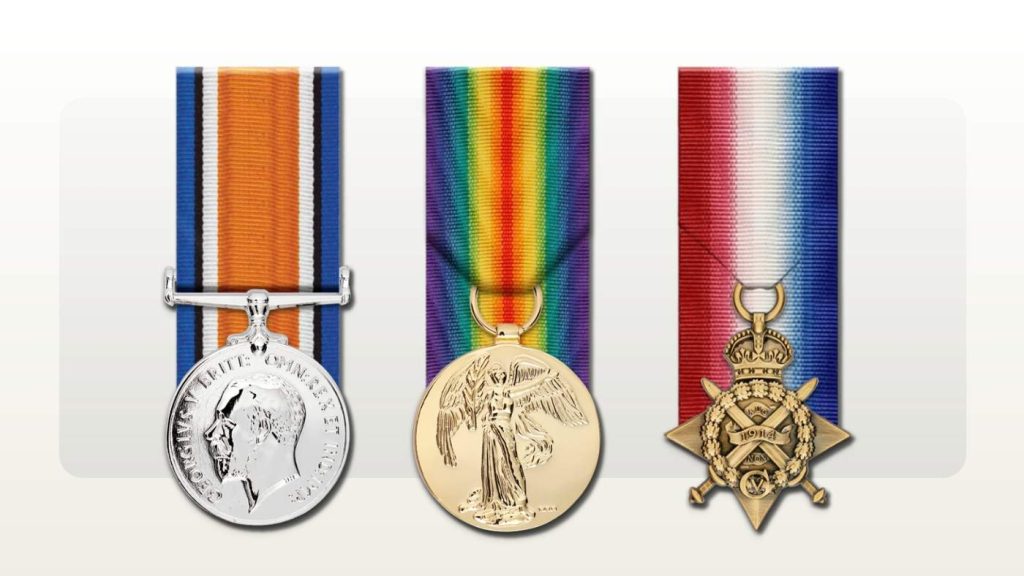
Two soldiers from the same town can leave very different WW1 medals behind. One family holds a star and two medals, another holds two medals, and a third finds an oak leaf on one of the ribbons. These differences are usually not mistakes. Defence notes that eligible members were commonly entitled to one or more of three First World War medals, the 1914-15 Star, the British War Medal and the Victory Medal, and each had its own qualifying rules.[1]
This guide busts six common myths about why First World War medal groups differ, then shows how to check a group and build a rack from what the recipient actually received. Rack Builder arranges the awards you select in the order of wear, but it does not determine entitlement.[12][13]
Myth 1: Every First World War soldier received the same three medals
Not every member qualified for all three, because each medal had different dates and conditions.
| Medal | Qualifying rule in brief |
|---|---|
| 1914-15 Star | Service in specified theatres of war between 5 August 1914 and 31 December 1915[1][2] |
| British War Medal | For the Army, entering a theatre of war, or leaving home and rendering approved service overseas; for the Navy, 28 days mobilised service in Australia, at sea or overseas[3] |
| Victory Medal | Prescribed classes who entered a theatre of war on duty between 5 August 1914 and 11 November 1918[4] |
Read together, these rules explain the most common variations:
- No star. The 1914-15 Star covers service in specified theatres up to 31 December 1915, so a member whose service in a theatre of war began later would not have it.[1][2]
- No Victory Medal. The British War Medal could be earned through approved overseas service, or naval mobilised service, without entering a theatre of war, while the Victory Medal required entry to a theatre of war. The British War Medal criteria refer separately to members "eligible for the British War Medal only".[3][4]
- Service after the Armistice. The British War Medal's qualifying period was later extended to cover post-war mine clearance and service in Russia in 1919 and 1920.[1][3]
Myth 2: A group with a 1914 Star is missing its 1914-15 Star
It is not. The 1914 Star and the 1914-15 Star share the same ribbon, and a recipient of the 1914 Star could not also be awarded the 1914-15 Star.[2] The Australian Order of Wearing Honours and Awards 2025 repeats the rule: recipients of the 1914 Star are not eligible for the 1914-15 Star.[6] A group should contain one star or the other, never both.
Myth 3: Merchant seamen's groups are incomplete
Merchant service could earn a different medal. Defence notes that the Mercantile Marine War Medal went to those eligible for the British War Medal who could show at least one voyage through a danger zone as merchant seamen.[1] In the 2025 order of wearing, the First World War section lists the 1914 Star, 1914-15 Star, British War Medal, Mercantile Marine War Medal and Victory Medal in that sequence.[6]
Myth 4: Gallantry awards and emblems sit wherever they fit
They have set positions. In the 2025 order of wearing, Imperial awards such as the Military Cross, Military Medal and Distinguished Conduct Medal appear in the main schedule before the row for war, campaign and service medals.[6] So a decoration changes the look of the group as well as its length.
A Mention in Despatches is shown by an emblem, not a separate medal. Defence says a member mentioned in despatches for First World War service wears a bronze spray of oak leaves on the Victory Medal ribbon, and only one emblem is worn however many times the member was mentioned.[4] The Australian War Memorial adds that the emblem was issued for mentions between 4 August 1914 and 10 August 1920.[5] The 2025 order notes that the Mention in Despatches is a UK award not positioned in the order, and that Defence provides advice on wearing the emblem.[6]
On a ribbon bar, Rack Builder lets you add emblems and devices to the relevant ribbon for an extra cost and asks you to review them before checkout.[14]
Myth 5: The Anzac Commemorative Medallion belongs in the medal rack
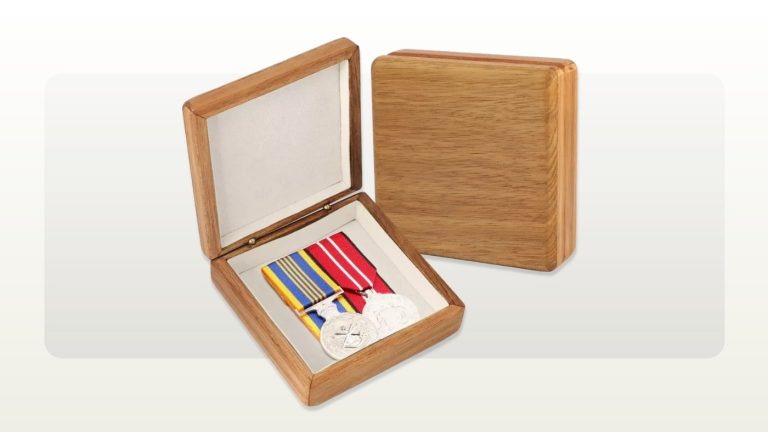
Check before adding it. Defence says the Anzac Commemorative Medallion was instituted in 1967 for surviving members of the Australian forces who served on the Gallipoli Peninsula, and is issued in a presentation box.[7] Its criteria cover service on the peninsula, or in direct support from close offshore, from April 1915 to January 1916, and state that surviving members could also receive a lapel badge for wearing.[1][8]
The medallion is not listed in the Australian Order of Wearing Honours and Awards 2025, so it does not take a position in the worn group.[6] You can plan for it in a display instead; if you intend to wear it, ask Defence for advice first.
The same applies to the Memorial Plaque and Scroll, which were issued to the next of kin of members who died as a result of the war. The bronze plaque is about 11 cm across. Defence cannot replace or gift them.[1] They suit a medal frame or display planned around them, not a worn rack.
Myth 6: A group that looks short has lost medals
Sometimes, but check the records first. Defence notes that a set of medal stamps can be found in First World War service records, and that an "N E" annotation means the member was not eligible for that award.[1] The National Archives says all First World War service records can be viewed digitally on RecordSearch, and that they include correspondence about awards and medals, although service records may not include information about which service medals a person was entitled to.[9]
If a medal was never issued, Defence handles the enquiry. Defence's replacement fact sheet says it replaces service and campaign medals from the First World War onwards in set circumstances, but honours bestowed under the Imperial honours system cannot be replaced.[11] Defence's First World War fact sheet adds that Defence cannot assess First World War honours eligibility.[1]
How to check a First World War group before you build a rack
- 1. List what the family holds. Note each medal, any oak leaf emblem, and items such as a medallion or plaque.
- 2. Check the service record. Look for medal stamps and any "N E" annotation.[1][9]
- 3. Compare against the rules above. Dates in a theatre of war, overseas service and merchant service usually explain the shape of the group.[1][3][4]
- 4. Check honours separately. Use the Australian War Memorial's Honours and Awards database for citations, where available.[5]
- 5. Choose the award type and country, then add the medals. In the Rack Builder builder you start with Custom Rack, choose an award type (National and Military Awards or Civil and Service Awards) and a country, then add the medals from the Imperial awards section of the medal library. Unusual or conflicting groups are flagged for manual review before production.[12][13]
For wider background on these medals, Medals of Australia's guide to identifying WWI and WWII campaign medals covers the history.
A worked example: two brothers, two different groups
This is a hypothetical example, not a real customer, and it does not determine anyone's entitlement.
A family holds medals from two brothers. The elder's group has the 1914-15 Star, British War Medal and Victory Medal, with an oak leaf on the Victory Medal ribbon. The younger's group has only the British War Medal and Victory Medal. The family assumes the younger brother's star was lost.
They check both service records. The younger brother first entered a theatre of war in 1916, outside the 1914-15 Star dates, which explains why there is no star.[1][2] The elder's oak leaf is a Mention in Despatches, so it stays on the Victory Medal ribbon.[4] An Anzac Commemorative Medallion in the same box is not listed in the order of wearing, so they plan it for a presentation display rather than the worn rack.[6] They build two replica racks and review each before checkout.
What to check, and what to send if you have a question
- Each medal the family holds, and any emblem on the ribbons
- Medal stamps and "N E" annotations on the service record[1]
- One star at most: the 1914 Star or the 1914-15 Star, never both[2][6]
- Honours checked separately from campaign medals[5]
- Items that are not in the order of wearing, such as the medallion[6]
You do not need to send a full service record or personal identifiers to ask about a layout. A short enquiry like this is usually enough:
"I am building a First World War group for [recipient] under [jurisdiction]. My saved rack reference is [reference]. The group has [medals and emblems]. I am unsure about [medal, emblem or layout]. My source is [document name]. I need it by [date]."
Where to get help
Start with How it works for the four building steps and the Rack Builder FAQ for order of wear and product formats.[12][13] If you are wearing a relative's medals at an event such as Anzac Day, the Rack Builder FAQ says to wear them on the right chest, and the Department of the Prime Minister and Cabinet notes that the RSL encourages wearing forebears' medals on the right breast to show they are not your own.[10][13] For a question about a group, use the Support page with your saved rack reference or order number, or call (02) 6123 2996.[15] Check Shipping and returns before setting a required date.[16]
If an award in the group exists in more than one version, our guide to identifying the correct medal version explains what to check before you add it.
When the group is checked, build the full-size replica set in Rack Builder and review the finished arrangement before checkout.
Frequently asked questions
Did every Australian First World War soldier receive three medals?
No. Defence notes members were commonly entitled to one or more of the 1914-15 Star, British War Medal and Victory Medal. Each had different rules: the Star covered service in specified theatres to 31 December 1915, and the Victory Medal required entering a theatre of war, so some groups have two medals or one.[1][4]
Can a soldier have both the 1914 Star and the 1914-15 Star?
No. Defence states that a recipient of the 1914 Star could not also be awarded the 1914-15 Star, and the Australian Order of Wearing Honours and Awards 2025 repeats that rule. The two stars share the same ribbon, so check the medal itself rather than the ribbon.[2][6]
Why does a First World War group have a British War Medal but no Victory Medal?
The British War Medal could be earned through approved overseas service, or naval mobilised service in Australia, at sea or overseas, while the Victory Medal required entering a theatre of war. Defence's criteria refer to members eligible for the British War Medal only.[3][4]
What does an oak leaf on a First World War ribbon mean?
It marks a Mention in Despatches. Defence says the bronze spray of oak leaves is worn on the Victory Medal ribbon, and only one emblem is worn however many times the member was mentioned. The Australian War Memorial says it covered mentions from 4 August 1914 to 10 August 1920.[4][5]
Is the Anzac Commemorative Medallion worn with First World War medals?
It is not listed in the Australian Order of Wearing Honours and Awards 2025, so it has no position in the worn group. Defence says it was instituted in 1967 for surviving Gallipoli veterans and issued in a presentation box. Ask Defence before wearing it, or plan it for a display.[6][7]
Sources
Source pages reviewed 13 October 2026. Numbered citations in the article open the sources below.
- Department of Defence: DHA Fact Sheet, World War I Medals: Recognising Australian Service (PDF) November 2021: the three medals, Mercantile Marine War Medal, Anzac Commemorative Medallion, Memorial Plaque and Scroll, medal stamps and "N E" annotations.
- Department of Defence: 1914-15 Star (Imperial awards) Service in specified theatres, 5 August 1914 to 31 December 1915; shared ribbon with the 1914 Star.
- Department of Defence: British War Medal 1914-20 (Imperial awards) Army and Navy criteria and the post-war extension; the linked criteria PDF refers to members eligible for the British War Medal only.
- Department of Defence: Victory Medal (Imperial awards) Prescribed classes who entered a theatre of war on duty; Mention in Despatches oak leaf emblem.
- Australian War Memorial: Mention in despatches Last updated 24 October 2023: emblem for mentions 4 August 1914 to 10 August 1920; Honours and Awards database.
- Federal Register of Legislation: The Australian Order of Wearing Honours and Awards 2025 (C2025G00607) 7 November 2025: Annex 1 World War I sequence, 1914 Star note, Mention in Despatches note.
- Department of Defence: Anzac Commemorative Medallion (Imperial awards) Instituted 1967 for surviving Gallipoli veterans; issued in a presentation box.
- Department of Defence: Anzac Commemorative Medallion criteria (PDF) Service on the peninsula or in direct support from close offshore; lapel badge for surviving members.
- National Archives of Australia: Army, First World War 1914-18 All WW1 service records viewable on RecordSearch; records may not show medal entitlement.
- Department of the Prime Minister and Cabinet: Wearing awards 24 June 2016: RSL encourages wearing forebears' medals on the right breast.
- Department of Defence: Fact Sheet for Replacement Medals (PDF) Version 6, August 2022: service and campaign medals replaceable; Imperial honours cannot be replaced.
- Rack Builder: How to Build and Order a Medal Rack (How it works) Building steps and review before production.
- Rack Builder: FAQ Order of wear, manual review of unusual groups and relatives' medals on the right chest.
- Rack Builder: Custom Ribbon Bars and Order of Wear Emblems and devices added to the relevant ribbon for an extra cost and reviewed before checkout.
- Rack Builder: Support Saved rack reference or order number, and phone support.
- Rack Builder: Shipping and Returns Review, production and delivery timing before a required date.