Two Australians who both served in the Second World War can wear very different medal groups, and both can be correct. That is why WW2 medal groups differ so often: Australian WW2 medals were awarded under conditions that depended on where a person served, which service they were in, how long they served and in what order they qualified. Campaign stars had their own time rules, some stars could not be held together, and no person could receive more than five stars, or six with the later Arctic Star.[1][2]
This guide works through the common myths that lead families to think a WW2 medal group is wrong or incomplete, then shows how to check the group and place it in the correct order of wear before you build a rack. Rack Builder arranges the awards you select; it does not decide entitlement, which rests with Defence or the relevant awarding authority.[9]
Myth 1: Everyone who served received the same WW2 medals
The Second World War awards were not a single standard set. The December 1948 summary of conditions lists eight campaign stars plus the Defence Medal and the War Medal 1939-45, each with its own qualifying rules.[2] The current Australian Order of Wearing Honours and Awards adds the Arctic Star, introduced retrospectively in 2013, and the Australia Service Medal 1939-45.[1]
The conditions differ in ways that change a group:
- The War Medal 1939-45 was granted to full-time members of the Armed Forces on a 28-day qualification, for service between 3 September 1939 and 2 September 1945 wherever it was rendered.[2]
- The Australia Service Medal 1939-45 now requires 30 days full-time or 90 days part-time service in that period, reduced in 1996 from the original 18 months full-time or three years part-time, and the member must have been honourably discharged.[5]
- The campaign stars depend on operational service in a particular theatre, as the sections below show.[2]
So two members with different service can hold different groups, and neither is a mistake.
Myth 2: More theatres always means more stars on the rack
The order of wear notes state that no more than five stars may be awarded to one person. The retrospective Arctic Star means a sixth star can be awarded and worn, and in all cases only the Arctic Star can be that sixth star. Those who qualify for more receive a clasp with the title of a further star, attached to the ribbon of one of the stars they hold.[1]
Two pairings matter most:
- Pacific Star and Burma Star. A person who qualified for both is awarded only the star first earned, plus a clasp for the service that would have qualified for the other star.[1][2]
- Atlantic Star, Air Crew Europe Star and France and Germany Star. A person who qualified for two or three of these is awarded only the star first earned, with a clasp for the second. No one may receive more than one clasp to that star, even if they qualified for all three.[1]
If a relative served in both New Guinea and Burma, for example, expect one of the Pacific Star or the Burma Star with a clasp, not both stars. The 1948 summary also states that service qualifying for one star cannot run concurrently with service qualifying for another.[2]
Myth 3: Navy, Army and Air Force earned the stars the same way
They did not. Under the 1948 summary, the 1939-45 Star required six months service afloat in areas of active operations for the Navy, six months in an operational command for the Army, and, for air crew, operations against the enemy with two months in an operational unit.[2] Defence's current page confirms six months (180 days) for non-air crew, two months for air crew, and six months at sea for the Merchant Navy, provided at least one voyage was made through one of the specified areas of active operations.[3]
The order in which stars could be earned also differed by service:
- In the Navy and Merchant Navy, the 1939-45 Star had to be earned before a person could qualify for the Pacific, Burma or Italy Stars. In the Army and Air Force there was no prior time qualification for those stars.[2]
- The 1939-45 Star had to be earned before a person could begin to qualify for the Atlantic Star or the Air Crew Europe Star.[2]
- The Africa Star had no condition that the 1939-45 Star be earned first.[2]
Defence's Pacific Star page also notes that Navy and Merchant Navy personnel could qualify by entering the Pacific theatre between 2 March 1945 and 2 September 1945.[4]
Aircrew groups can carry further differences: the 1939-45 Star has clasps for the Battle of Britain and, since 2012, Bomber Command.[3]
Myth 4: A missing star means a medal has been lost
A gap is not always a loss. The star may never have been awarded because a clasp was issued instead, because the qualifying time was not met, or because the service fell in a different theatre. Compare the group with the service record and award documents first. Our guide to what to do when a service record does not list every medal explains how to approach that check.
Defence's Honours and Awards page directs family members of deceased veterans to the Defence Medals Application Form, which can also be used to request a list of a deceased relative's previously issued awards.[6] DVA's nominal rolls list members of Australia's defence forces who served in the Second World War, and can be searched by name or service number.[7]
How to put a Second World War group in the correct order of wear
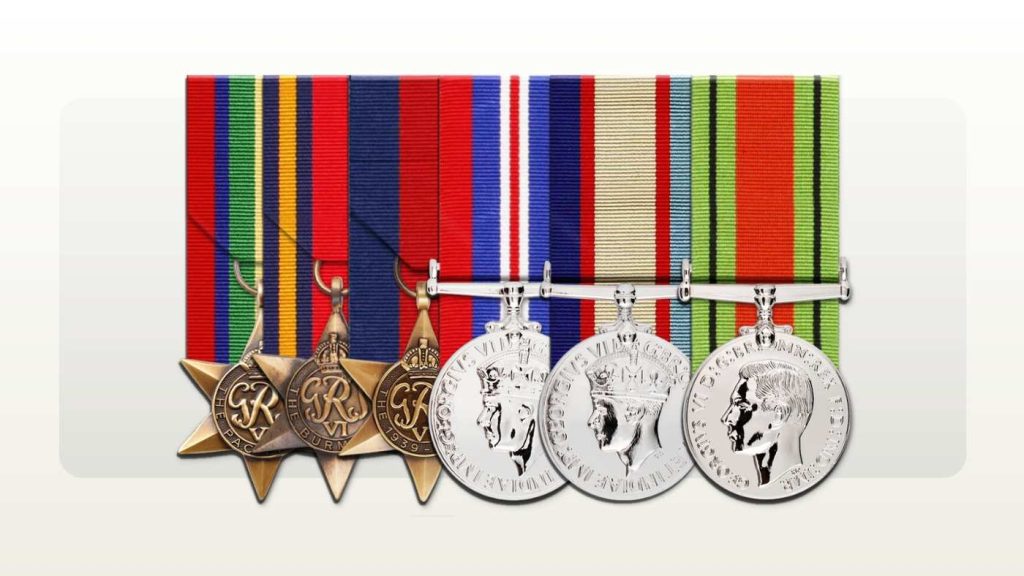
The 2025 order of wear lists the Second World War medals in this sequence, from first to last, with the first worn closest to the centre of the chest.[1]
| Position | Award |
|---|---|
| 1 | 1939-45 Star |
| 2 | Atlantic Star |
| 3 | Arctic Star |
| 4 | Air Crew Europe Star |
| 5 | Africa Star |
| 6 | Pacific Star |
| 7 | Burma Star |
| 8 | Italy Star |
| 9 | France and Germany Star |
| 10 | Defence Medal |
| 11 | War Medal 1939-45 |
| 12 | Australia Service Medal 1939-45 |
In the 2025 schedule these sit in the block of war, campaign, active service and service medals, which comes after the orders, decorations, gallantry and distinguished service awards, and before the commemorative and long service medals.[1] Our Imperial awards library has a page for each star, including the Italy Star, France and Germany Star and Defence Medal.
How clasps show on a ribbon bar
When the ribbon alone is worn, a clasp to a campaign star is shown by an emblem on the ribbon. The 1948 summary describes a silver rose emblem for the Pacific, Burma, Atlantic, Air Crew Europe and France and Germany clasps, and a gilt rose for the Battle of Britain clasp. It also says no one can wear more than one emblem on any one star ribbon.[2] Defence notes that it does not supply the rosette for the Pacific Star's Burma clasp.[4]
On a Rack Builder ribbon bar, rosettes, emblems and devices are added to the specific ribbon they belong to, for an extra cost, and you review them before checkout.[10] For more on how devices change a ribbon, see checking rosettes and devices in your rack.
A worked example of a WW2 group
This is a hypothetical example, not a real customer, and it does not determine anyone's entitlement.
A family is building a replica rack for a grandfather who served in the Army. His documents show a 1939-45 Star, the Pacific Star with a Burma clasp, the Defence Medal, the War Medal 1939-45 and the Australia Service Medal 1939-45. A cousin expected a separate Burma Star. The order of wear notes confirm that only the first star earned is awarded, with a clasp for the other.[1] They choose Custom Rack in the builder, select the National and Military Awards award type and the country, add the five medals in the order shown in the table, and add a rosette to the Pacific Star ribbon for the ribbon bar.[1][10] Because the grandfather's medals are being worn by a relative, they note that relatives' medals are worn on the right chest.[9]
What to check, and what to send if you have a question
- Each award appears in the recipient's service record or award documents, not only in family memory[9]
- No more than five stars, or six only where the sixth is the Arctic Star[1]
- Only one of the Pacific or Burma Stars, and only one of the Atlantic, Air Crew Europe or France and Germany Stars, with any clasp on the star actually held[1]
- No more than one clasp on any star[1][2]
- The War Medal 1939-45 and Australia Service Medal 1939-45 checked against their own criteria[2][5]
- The correct ribbon emblem for each star clasp, such as a silver rose for a Pacific or Burma clasp[2][10]
You do not need to send a full service record or personal identifiers to ask about a layout. A short enquiry like this is usually enough:
"I am building a Second World War group for [recipient: self or relative]. My saved rack reference is [reference]. I am unsure about [star, clasp or rosette]. My source for this award is [document name]. I need it by [date]."
Where to get help with a WW2 medal rack
The How it works page sets out the four building steps, and the Rack Builder FAQ covers order of wear, wearing a relative's medals and product formats.[8][9] For a question about a saved rack, a clasp or a rosette, use the Support page and include your saved rack reference or order number, or call (02) 6123 2996.[11] Custom racks take 3 to 5 weeks production, and a required date does not confirm delivery until the team accepts the production schedule, so check Shipping and returns before you order.[11][12] For the wider history of these campaign awards, Medals of Australia has a guide to identifying WWI and WWII campaign medals.
If your family also has a First World War group to display, see why WW1 medal groups differ for the rules that shaped those medals.
When the group is checked, build it as full-size medals, miniatures or a ribbon bar and review the finished arrangement before checkout.[8]
Frequently asked questions
Why do Australian WW2 medal groups differ so much?
Each WW2 award had its own conditions. Campaign stars depended on operational service in a particular theatre, with different time rules for the Navy, Army, Air Force and Merchant Navy. The War Medal 1939-45 and Australia Service Medal 1939-45 have separate criteria again. No person could receive more than five stars, or six where the sixth is the Arctic Star.[1][2][5]
Can someone have both the Pacific Star and the Burma Star?
No. A person who qualified for both is awarded only the star first earned, and a clasp is awarded for the service that would have qualified for the other star. When the ribbon alone is worn, the 1948 conditions describe a silver rose emblem on the ribbon to show the clasp.[1][2]
What is the maximum number of WW2 stars one person can wear?
Five, or six where the sixth is the Arctic Star. The order of wear notes say no more than five stars may be awarded to one person, and the retrospective introduction of the Arctic Star in 2013 means a sixth star can be awarded and worn, but only the Arctic Star can be that sixth star. Anyone who qualified for more receives a clasp naming a further star, attached to the ribbon of a star they hold.[1]
How do I check a relative's WW2 medal entitlement?
Start with the service record and award documents. Defence's Honours and Awards page directs family members of deceased veterans to the Defence Medals Application Form, which can also be used to request a list of a deceased relative's previously issued awards. DVA's nominal rolls can be searched by name or service number. Rack Builder arranges the awards you select but does not decide entitlement.[6][7][9]
Sources
Source pages reviewed 12 November 2026. Numbered citations in the article open the sources below.
- Governor-General, Federal Register of Legislation: The Australian Order of Wearing Honours and Awards 2025 (C2025G00607) Schedule dated 15 October 2025; registered 7 November 2025
- Department of Defence: Summary of the Conditions of Award of the Campaign Stars, the Defence Medal and the War Medal for Service in the War 1939-1945 December 1948
- Department of Defence: 1939-45 Star No date shown
- Department of Defence: Pacific Star No date shown
- Department of the Prime Minister and Cabinet: Australian Service Medal 1939-1945 No date shown
- Department of Defence: Honours and Awards No date shown
- Department of Veterans' Affairs: DVA's Nominal Rolls No date shown
- Rack Builder: How to Build and Order a Medal Rack (How it works) Builder steps
- Rack Builder: Rack Builder FAQ Entitlement checks and relatives' medals
- Rack Builder: Custom Ribbon Bars and Order of Wear Rosettes, emblems and devices
- Rack Builder: Rack Builder Support Contact details and production time
- Rack Builder: Shipping and Returns Production time and required dates