
History
The British War Medal was instituted on 26 July 1919 for service rendered between 5 August 1914, the day after Britain's declaration of war, and the armistice of 11 November 1918, with eligibility later extended to cover mine-clearance and operations in Russia and elsewhere in 1919 and 1920. It was the most widely awarded of all the First World War medals: about 6.5 million were struck, the great majority in silver, with roughly 110,000 in bronze for members of labour corps.
For the Army, officers and men had to have entered a theatre of war or left the United Kingdom for overseas service; for the Navy, 28 days of mobilised service sufficed, without a requirement to serve overseas. Clasps for battles and theatres were proposed but never awarded, the idea abandoned in 1923 on grounds of cost. It is the only medal of the Great War trio that could be awarded alone, and its heavy silver made it the one most often pawned in hard times. As an Imperial award it retains its place in the Australian Order of Wearing.
Design & ribbon
The medal
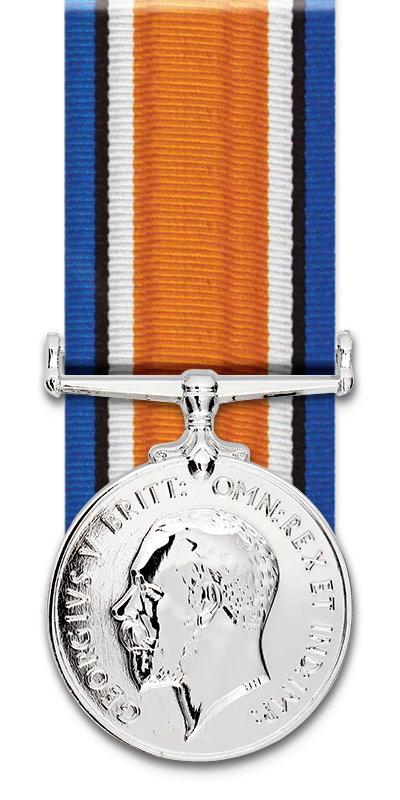
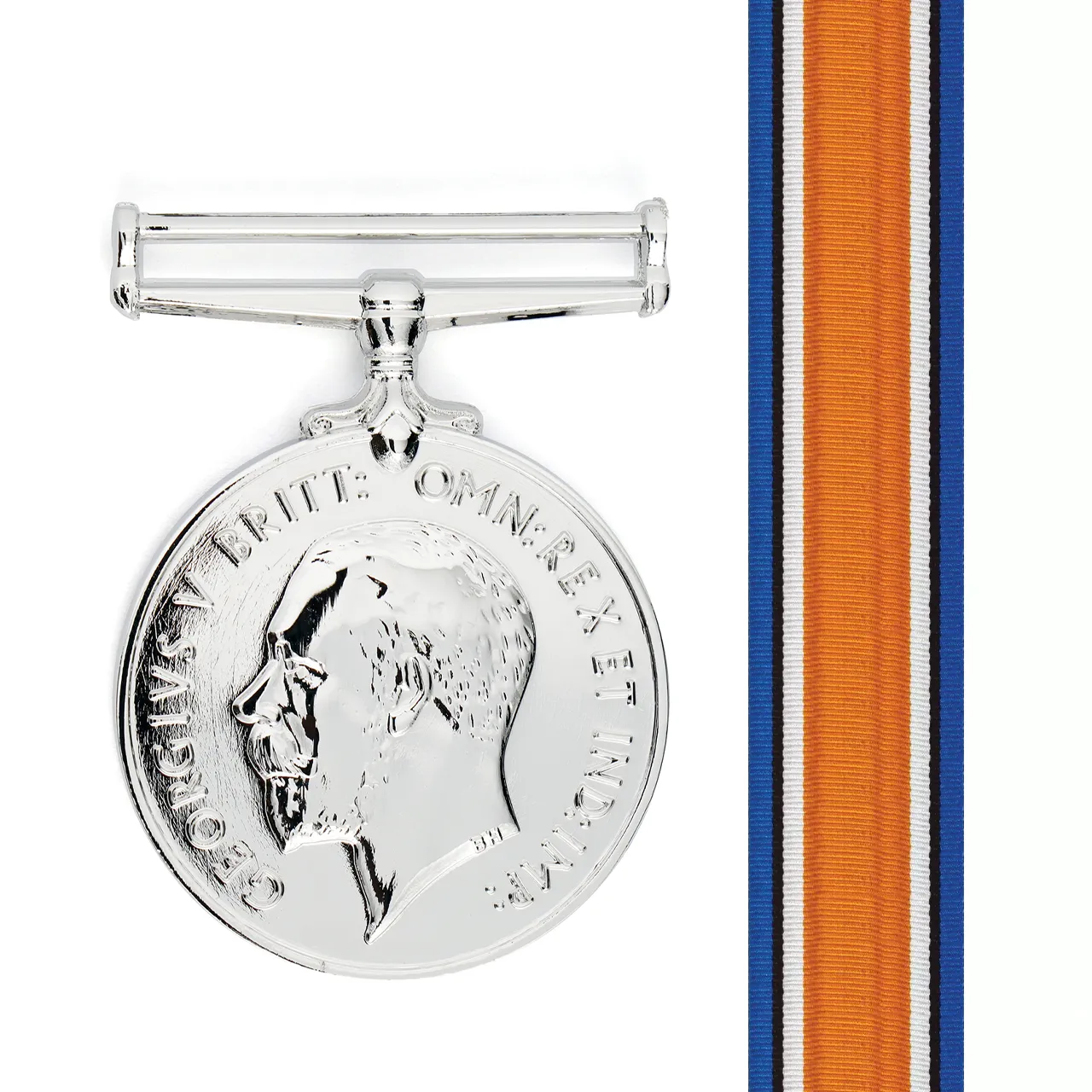
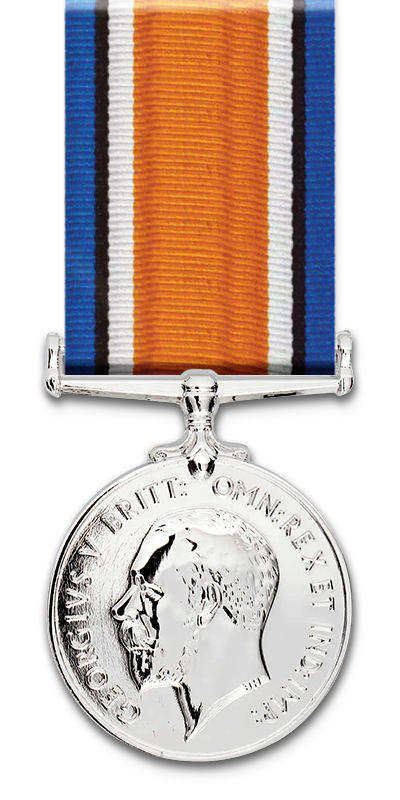
The medal is a silver disk, 36 millimetres in diameter, with a straight non-swivelling clasp suspender. The obverse bears Bertram Mackennal's bareheaded effigy of King George V facing left with a Latin legend. The reverse, by William McMillan, shows St George on horseback trampling the Prussian eagle shield and the emblems of death, with the risen sun of victory and the dates 1914 and 1918. The recipient's details are impressed on the rim.
The ribbon
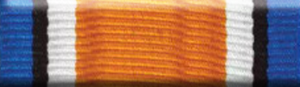
A broad orange centre edged with white, black and blue.
The ribbon has a broad central orange band edged on each side by narrow stripes of white, black and royal blue; the colours are generally held to have no special symbolism.
Eligibility
The medal was awarded for service during the First World War between 5 August 1914 and 11 November 1918.
- Army personnel, including Dominion and Colonial forces, had to have entered a theatre of war or left the United Kingdom for overseas service and completed the qualifying period; naval personnel qualified on 28 days of mobilised service without a requirement to serve overseas;
- Eligibility was extended to certain service in 1919 and 1920, including mine-clearance at sea and operations in Russia; battle and theatre clasps were proposed but never awarded;
- It could be awarded alone, unlike the stars and the Victory Medal. As an Imperial award it retains its place in the Australian Order of Wearing.
Order of wear
Imperial awards were the honours of Australia before the Australian honours system was established in 1975, and they retain their place in the Order of Wearing. They are worn after the Australian honours of their kind and among the Imperial awards in the order set by the Australian Order of Wearing, which follows the British order of precedence.
Frequently asked questions
What is the British War Medal awarded for?
Service in the First World War between 5 August 1914 and 11 November 1918, extended to certain service in Russia and mine-clearance in 1919 and 1920.
Who qualified?
Army personnel who entered a theatre of war or left the United Kingdom for overseas service; naval personnel on 28 days of mobilised service, without a requirement to serve overseas.
Were there clasps?
Clasps for battles and theatres were proposed, and naval clasps were even printed in an Admiralty order, but none were awarded and the idea was abandoned in 1923 on grounds of cost.
Can it be worn alone?
Yes. It is the only one of the Great War trio that could be awarded singly, so a lone British War Medal is a complete award rather than a broken group.
Where does it sit among the trio?
It is Squeak, worn between the star, Pip, and the Victory Medal, Wilfred; with the Victory Medal alone it is the Mutt and Jeff pair.
Is it named to the recipient?
Yes, impressed on the rim with number, rank, name and unit.