
History
The Atlantic Star was awarded for operational service in the Battle of the Atlantic between 3 September 1939 and 8 May 1945, the campaign Winston Churchill called the one thing that ever truly frightened him: the years-long struggle to keep the sea lanes open against the U-boats while the convoys carried the food, fuel and munitions on which Britain depended. Qualification required prior entitlement to the 1939-1945 Star and a further period of operational service afloat, generally six months.
It could be linked with the France and Germany Star or the Air Crew Europe Star, whichever was earned second being represented by a clasp on the ribbon of the star earned first, so that the Atlantic Star is often seen bearing a France and Germany or Air Crew Europe clasp. The ribbon's colours evoke the ocean itself. As an Imperial award it retains its place in the Australian Order of Wearing.
Design & ribbon
The medal
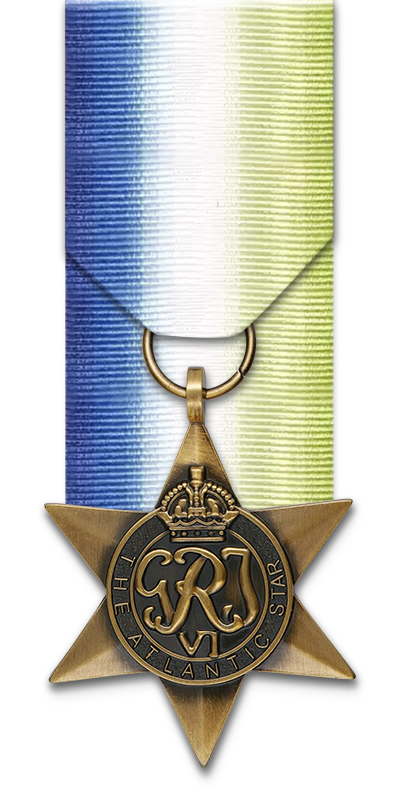
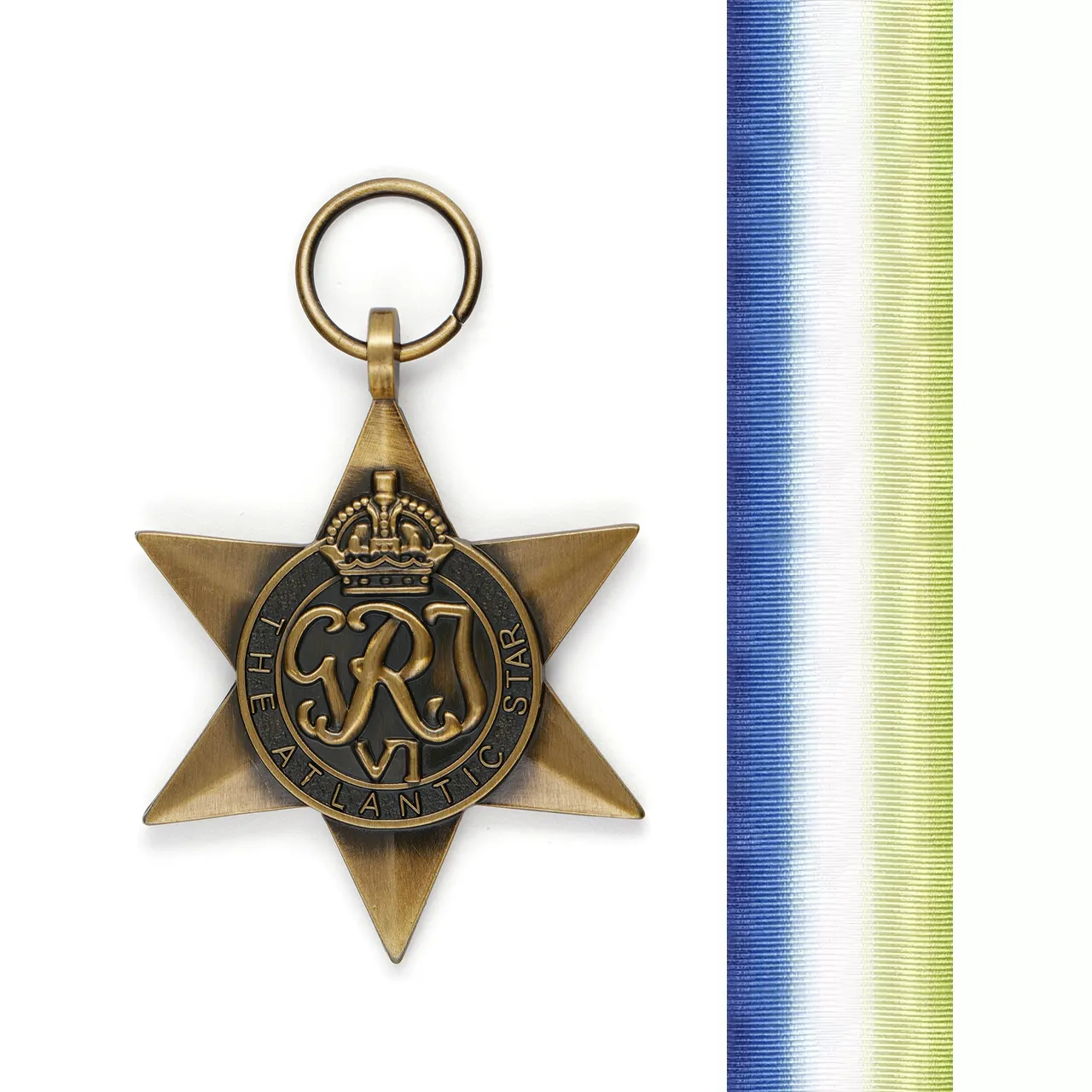
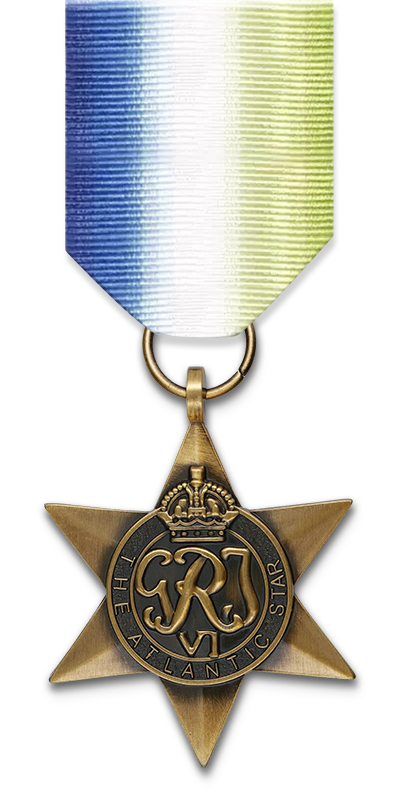
The Star is a six-pointed star of bright bronze, ensigned with a crown carrying a ring for suspension, its obverse bearing the royal cypher GRI VI within a circlet inscribed THE ATLANTIC STAR. The reverse is plain, and Australian issues are unnamed.
The ribbon

Shaded blue, white and green, the Atlantic Ocean.
The ribbon is shaded and watered in blue, white and green, the colours of the Atlantic Ocean, and is worn with the blue edge furthest from the left shoulder.
Clasps
The Atlantic Star was associated by clasp with two other campaign stars, only one clasp worn on the ribbon.

Air Crew Europe
Worn by recipients of the Atlantic Star who also qualified for the Air Crew Europe Star. Only one clasp is worn on the star, shown by a silver rosette when the ribbon alone is worn.

France and Germany
Worn by recipients of the Atlantic Star who also qualified for the France and Germany Star. Only one clasp is worn on the star, shown by a silver rosette when the ribbon alone is worn.
Eligibility
The Star was awarded for operational service in the Battle of the Atlantic between 3 September 1939 and 8 May 1945.
- Prior qualification for the 1939-1945 Star was required, together with a further period of operational service afloat, generally six months;
- Where a recipient also qualified for the France and Germany Star or the Air Crew Europe Star, the second earned was represented by a clasp on the ribbon of the first; only one clasp is worn on any star, and no more than five stars to one person;
- As an Imperial award it retains its place in the Australian Order of Wearing.
Order of wear
No more than five of the Second World War campaign stars could be awarded to one person; those who qualified for more wore a clasp on the ribbon of a star they held, naming a further star, with only one clasp worn on any star.
Frequently asked questions
What is the Atlantic Star awarded for?
Operational service in the Battle of the Atlantic between 3 September 1939 and 8 May 1945, after prior qualification for the 1939-1945 Star and a further period of service afloat.
What does its ribbon represent?
The Atlantic Ocean, in shaded blue, white and green.
Why might it carry a clasp?
Because the Atlantic, France and Germany and Air Crew Europe Stars were linked: a recipient who qualified for a second of these wore it as a clasp on the ribbon of the first earned, rather than as a second star.
How many campaign stars could one person receive?
No more than five, with further entitlements shown by clasps; only one clasp is worn on any star.
Is it named to the recipient?
Australian issues are unnamed, in common with the other Second World War stars.
Does it carry a post-nominal?
No; it is a campaign star and carries no post-nominal.