
History
The 1939-1945 Star is the first and most widely qualifying of the Second World War campaign stars, awarded for a period of operational service overseas between 3 September 1939 and the end of the war, 8 May 1945 in Europe and 2 September 1945 in the Far East. The qualifying period was generally six months of operational service, reduced to two months for aircrew and varying by service, and it was the star from which entitlement to the other campaign stars followed.
Its ribbon carries the colours of the three services, and it bears a single clasp, Battle of Britain, for the aircrew of Fighter Command in that battle. The whole family of Second World War stars was governed by a limit of five to any one person, with further entitlements shown by clasps. The ribbon colours are believed to have been chosen personally by King George VI. As an Imperial award it retains its place in the Australian Order of Wearing.
Design & ribbon
The medal
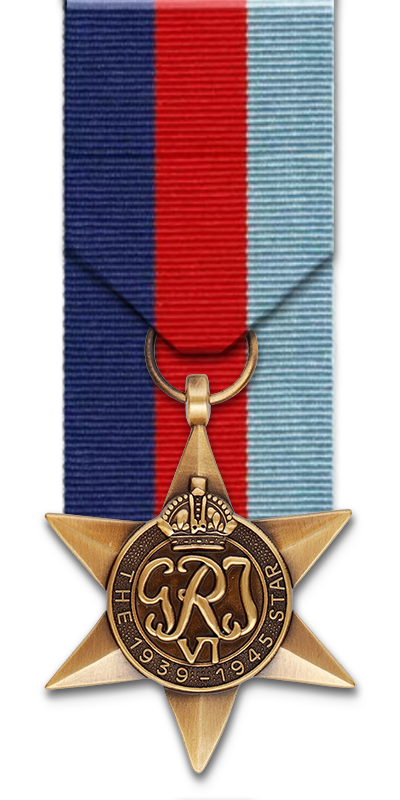
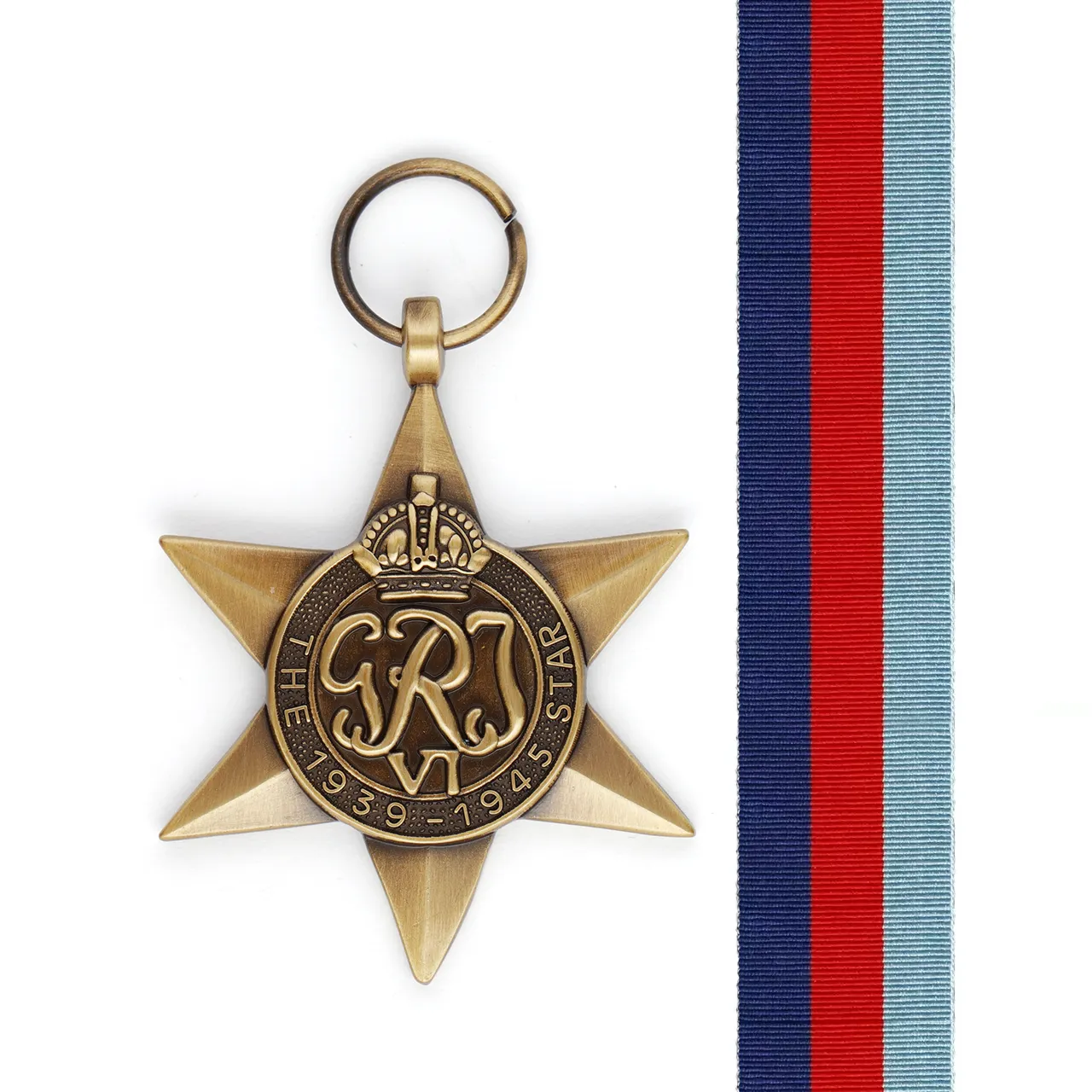
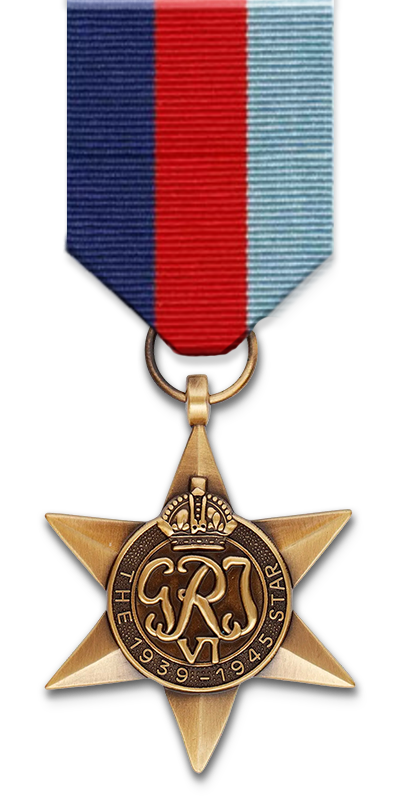
The Star is a six-pointed star of bright bronze, ensigned with a crown carrying a ring for suspension. The obverse bears the royal cypher GRI VI within a circlet inscribed THE 1939-1945 STAR. The reverse is plain. Australian issues in bronze are unnamed, in common with the other Second World War stars.
The ribbon
Dark blue, red and light blue, the three services.
The ribbon has three vertical bands of dark blue, red and light blue, representing the Royal Navy, the Army and the Royal Air Force, and is worn with the dark blue band furthest from the left shoulder.
Clasps
Two clasps were authorised for this star, worn on the ribbon.

Battle of Britain
Awarded to aircrew of Fighter Command who took part in the Battle of Britain between 10 July and 31 October 1940. A silver-gilt rosette denotes the clasp when the ribbon alone is worn.

Bomber Command
Instituted in 2013 for aircrew who served at least 60 days, or completed a tour of operations, on a Royal Air Force Bomber Command operational unit and flew at least one operational sortie between 3 September 1939 and 8 May 1945. A silver rosette denotes the clasp when the ribbon alone is worn.
Eligibility
The Star was awarded for a period of operational service overseas between 3 September 1939 and 8 May 1945, or 2 September 1945 in the Far East.
- The qualifying period was generally six months of operational service, with reduced periods for aircrew and variations by service; it was the foundation from which the other campaign stars followed;
- Two clasps, Battle of Britain and Bomber Command, were awarded to qualifying aircrew; no more than six Second World War stars could be worn by one person, with further entitlements shown by clasps;
- As an Imperial award it retains its place in the Australian Order of Wear.
Order of wear
No more than six of the Second World War campaign stars could be awarded to one person; those who qualified for more wore a clasp on the ribbon of a star they held, naming a further star, with only one clasp worn on any star.
Frequently asked questions
What is the 1939-1945 Star awarded for?
A period of operational service overseas in the Second World War, generally six months, between 3 September 1939 and the end of the war. It was the star from which entitlement to the other campaign stars followed.
What does its ribbon represent?
The three services: dark blue for the Royal Navy, red for the Army, and light blue for the Royal Air Force. The colours are believed to have been chosen by King George VI.
What is the Battle of Britain clasp?
The single clasp to this star, awarded to aircrew of Fighter Command who flew in the Battle of Britain in 1940; a rosette on the ribbon represents it when the ribbon alone is worn.
How many Second World War stars could one person receive?
No more than six. Those who qualified for more wore a clasp on a star they held, naming a further star, with only one clasp per star.
Is it named to the recipient?
The names of recipients are engraved on the rear of the medal.
Does it carry a post-nominal?
No; it is a campaign star and carries no post-nominal.