If you are ordering a replica rack in memory of a parent, grandparent or other relative, agree on one written record of that person's medals with the rest of the family before you build. A shared record avoids a rack that one relative believes is incomplete, a second order to fix it, and a difficult conversation on Anzac Day morning.
This guide sets out a practical way to do that: who should agree, where the official record comes from, how to separate documents from family memory, and what Rack Builder can and cannot confirm. It is general guidance only. Decisions about medal entitlement belong to Defence or the relevant awarding authority, not to a retailer or to the family.[5][9]
Why the recipient record comes first
Rack Builder arranges awards using the selected jurisdiction, current published guidance and award-specific rules, and unusual or conflicting groups are flagged for manual review before production.[2] That review checks the configuration you build. It does not decide what a person was entitled to. Rack Builder's FAQ is clear that its common groups are a starting point only, and that you should check the recipient's service record, award documents or the relevant authority before ordering.[2]
Families often hold different pieces of the story. Agreeing on the record first means the rack reflects the documents rather than whoever placed the order.
Step 1: Decide who is coordinating and who needs to agree
Pick one person to coordinate. That person collects documents, builds the rack and is the single contact for any questions after checkout. Rack Builder's Support page asks you to include the saved rack reference or order number when you have one, so a single coordinator holding those details keeps the conversation simple.[3]
Then agree who else should see the record before ordering. This is a family courtesy rather than a rule: usually the people who will wear the rack and anyone holding the original medals or papers. Rack Builder states that replicas can generally be purchased by anyone, and that replicas were introduced to preserve original medals and avoid family disputes over the original set.[2]
Keep this separate from any application for unissued medals. Defence lists the immediate family members who are entitled to be granted a deceased member's unissued awards, in descending priority: spouse or de facto spouse, child, grandchild, parent and sibling.[5][6] People outside that list can apply for special consideration.[5][7] A replica order does not change any of this.
Step 2: Gather the official record
Start with documents, not the medals in the drawer. Rack Builder's FAQ points families to the Honours and Awards division of Defence, where an application can be made digitally, and to the National Archives of Australia for researching a relative's service history.[2]
The National Archives explains that a basic search of its RecordSearch database uses the person's surname and service number.[9] Some records can be viewed online, including First World War Army and Navy records and some Second World War Army, Navy and Air Force records, and other records can be ordered as copies.[9] When requesting a copy, the Archives suggests including the full name, service and conflict, service number, date of birth, and enlistment and discharge details.[10]
Be aware of the limits. The Archives notes that service records may not show which service medals a person was entitled to, or whether they were ever issued, and that Defence Honours and Awards can help with those enquiries.[9][10] Defence's Medals Application Form has separate guidance for anyone applying on behalf of a deceased member, and notes that documentary evidence of awards may be required.[8]
Step 3: Separate what is documented from what is remembered
Once the papers are together, sort every item on the family's list into one of three groups: confirmed by an official document, shown only by physical medals or photographs, and remembered but not documented. The table below is a simple way to lay it out for everyone to review.
| Item on the family's list | Where the evidence comes from | What to do before ordering |
|---|---|---|
| Award shown on an official record | Defence advice or a National Archives record[2][9] | Add it to the rack in the builder |
| Medal the family physically holds | The medal itself, with no matching document yet | Check it against the official record, or ask Defence Honours and Awards[9] |
| Medal remembered but never seen | Family memory only | Leave it off the rack until Defence confirms it[5][9] |
| Clasps on a ribbon | Record or award documents | Add only the clasps the record supports; the medal library lists approved clasps per medal[4] |
| Personal details for a frame or box | Record for name, service number and unit | Agree spelling and wording; plaques fit three lines of 22 characters[1][2] |
If a remembered medal turns out to be unissued, Defence advises that medals for deceased veterans which have never been issued may be issued to the appropriate next of kin.[5] The National Archives also notes that medals are generally only reissued to a service person or their next of kin if the medal has never been issued.[9] That is a matter for Defence, so build the rack from what is confirmed and add to it later if needed.
Step 4: Agree the format and how the rack will be used
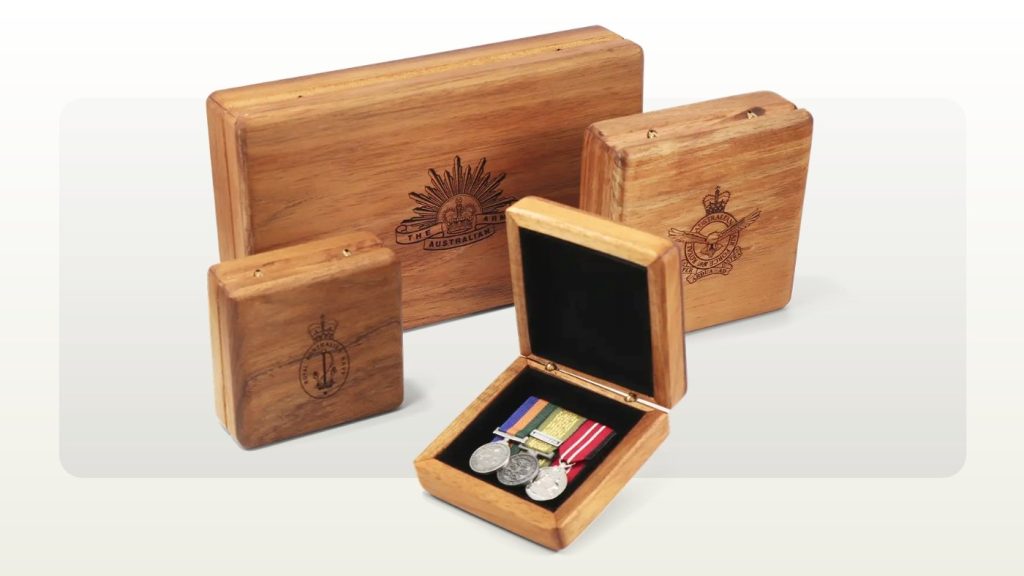
With the medal list settled, agree what the family is ordering. Rack Builder offers full-size medals, miniature medals, ribbon bars, frames, cases and keepsake boxes, and you can compare formats inside the builder.[1]
Full-size racks can be court mounted or swing mounted. Court mounting secures each medal to a firm backing so the row sits neatly and moves less, while swing mounting lets the medals hang and move freely from the mounting bar.[4] Both follow the same order of wear, so the choice is about presentation.[4]
Ask now whether one relative will wear the rack or several want their own, and whether it is for wear, display or both. Rack Builder describes its replica medals as wearable at ceremonies, parades and commemorative events, as well as suitable for display.[2] If the family wants names or dates on the piece, note that Rack Builder does not recommend engraving replica medals because the plating can chip, and suggests an engraved timber box or framed presentation instead.[2]
Agree before ordering:
- The recipient's full name and service number, spelt as on the official record
- The final list of medals and clasps, with the source for each
- Any item left off until Defence confirms it
- Format, and court or swing mounting for full-size racks
- Any plaque or box wording, checked for spelling and line length
- Who will receive the finished rack and who will wear it
Step 5: Build, save and review the rack together
Build the rack from the service record using the jurisdiction that matches the recipient's service, because that setting determines the award and order of wear rules the builder applies.[1] You can save the rack at any stage and return when you have the remaining details. An account is needed to save a rack, and saved racks expire after 90 days.[1][2] That gives the family time to review it.
At the review step, Rack Builder asks you to check names, service details, quantities, layout, delivery details and the configured price.[1] This is the moment to show the agreed record to the other relatives and confirm the rack matches it. After checkout, the team reviews the saved rack against the selected jurisdiction and published order of wear guidance, and contacts you when an award, clasp, layout or personal detail needs clarification.[1]
Share only what is needed. If the team asks a question, answer with the specific detail requested rather than sending a full service record.
A worked example of agreeing on the record
This is a hypothetical example, not a real customer or a real entitlement decision. Three grandchildren want replica racks of their late grandfather's medals for Anzac Day. The originals are with their aunt. One grandchild is sure there was an extra medal that never arrived.
The eldest grandchild agrees to coordinate. She finds his service record through the National Archives using his surname and service number, and the family compares it with the original medals.[9] The record and the originals match, but the extra medal appears on neither. Rather than add it to the racks, the family agrees to raise it with Defence Honours and Awards and leave it off for now.[5][9]
She builds one rack, saves it and asks her aunt and cousins to check the names, layout and medal list before checkout.[1] If Defence later confirms an additional award, the family can contact Rack Builder support.[3]
What the guidance says about wearing a relative's medals
If a relative will wear the replica rack, follow the published guidance. Defence states that family members of a deceased recipient may wear that person's medals on commemorative occasions, worn on the right side to show the wearer is not the original recipient.[5] The Australian War Memorial and RSL Australia give the same right-breast guidance.[11][12]
RSL Australia adds that it is respectful to wear only one set of an ancestor's medals at a time, and that medals worn around the neck, such as some Order of Australia awards, cannot be worn by family members.[12] Rack Builder's FAQ also advises never wearing someone else's medals on the left chest.[2]
Defence notes that it cannot provide replica medals and that replicas can be purchased from reputable medal dealers.[5]
How Rack Builder can help
If the family has a question before ordering, use the Rack Builder Support form and include the saved rack reference if you have one.[3] The FAQ covers order of wear, product formats, personalisation, and orders and delivery.[2] If an award is not in the library, report it through the missing medal form with the full award name, issuing authority and a reliable source.[1] If the family wants the original medals mounted or framed instead of replicas, Rack Builder handles original medal mounting and framing of customer-supplied originals through its support page.[2][4]
A short enquiry can look like this: "We are ordering a replica rack for [relative's name, relationship]. Our saved rack reference is [reference]. The medal list matches [source, for example a National Archives record]. We have left [item] off until Defence confirms it. Could you check [specific question] before we check out?"
If the family's question is about an unusual group rather than the record itself, see our guide on when to request an expert review of a medal group.
Start with the agreed record, save the rack and check it together before you order.
Frequently asked questions
Who in the family should agree on the medal record before ordering a replica rack?
Pick one family member to coordinate, then agree who else should review the record before ordering, usually the people who will wear the rack and anyone holding the original medals or papers. This is a family courtesy rather than a rule. Replicas can generally be purchased by anyone, and a replica order does not change who is entitled to a deceased member's unissued awards.[2][5]
Where can I find my grandfather's war service record in Australia?
Start with the National Archives of Australia, where a basic RecordSearch search uses the person's surname and service number. Some First World War and Second World War records can be viewed online, and other records can be ordered as copies. Service records may not show which medals a person was entitled to, so Defence Honours and Awards can help with those enquiries.[9][10]
What if the family remembers a medal that is not on the official record?
Leave it off the replica rack until Defence confirms it. Family memory alone is not enough to add an award. Defence advises that medals for deceased veterans which have never been issued may be issued to the appropriate next of kin, so raise the question with Defence Honours and Awards, build the rack from what is confirmed and add to it later if needed.[5][9]
Can family members wear a deceased relative's replica medals on Anzac Day?
Yes, on the right side. Defence states that family members of a deceased recipient may wear that person's medals on commemorative occasions, worn on the right side to show the wearer is not the original recipient. RSL Australia adds that it is respectful to wear only one set of an ancestor's medals at a time, and that medals worn around the neck cannot be worn by family members.[5][12]
Can I save a replica medal rack so my family can check the recipient record first?
Yes. You can save a rack at any stage in the Rack Builder builder and return when you have the remaining details. An account is needed to save a rack, and saved racks expire after 90 days. At the review step, check names, service details, quantities and layout against the agreed record with your relatives before checkout.[1][2]
Does Rack Builder confirm which medals my relative was entitled to?
No. Rack Builder's review checks the configuration you build against the selected jurisdiction and published guidance, and unusual or conflicting groups are flagged for manual review. It does not decide what a person was entitled to. Check the recipient's service record, award documents or the relevant authority before ordering, because entitlement belongs to Defence or the relevant awarding authority.[2]
Should I engrave my relative's name on replica medals?
No, Rack Builder does not recommend engraving replica medals because the plating can chip. It suggests an engraved timber box or a framed presentation instead. If the family wants a plaque, agree the spelling and wording first, taking the name and service number from the official record, and note that plaques fit three lines of 22 characters.[1][2]
Sources
Source pages reviewed 13 October 2026. Numbered citations in the article open the sources below.
- Rack Builder: How it works Jurisdiction sets award and order of wear rules; formats; saving (account, 90-day expiry); review step; post-checkout review; missing medal form; plaque line limits.
- Rack Builder: FAQ Arrangement and manual review; common groups as a starting point; replicas for everyone; preserving originals; Defence and NAA research; engraving; saving; relatives' medals on the right chest.
- Rack Builder: Support Support form asks for the order number or saved Rack Builder reference.
- Rack Builder: Full-size Replica Medals and Medal Mounting Court and swing mounting, same order of wear, approved clasps per library record, original medal mounting.
- Department of Defence: Frequently asked questions (Honours and Awards) Unissued medals to next of kin, priority list, special consideration, wearing a relative's medals on the right side, no replicas from Defence.
- Department of Defence: Granting of Unissued Service Awards of Deceased Members Immediate family list in descending priority of entitlement.
- Department of Defence: DHA Fact Sheet, Unissued Service Awards of Deceased Members (PDF) Version 2, August 2017; exceptional cases for other relatives decided case by case.
- Department of Defence: Defence Medals Application Form Separate guidance for deceased members; documentary evidence may be required.
- National Archives of Australia: Finding a service record Basic RecordSearch by surname and service number; online records; medal information limits; reissue only if never issued.
- National Archives of Australia: Fact sheet 177, World War I and World War II service records (PDF) Details to include when requesting a copy; medal enquiries go to Defence Honours and Awards.
- Australian War Memorial: Dress protocols and traditions for Anzac Day 20 March 2015, last updated 30 March 2021; relatives may wear medals on the right breast.
- RSL Australia: A Guide to Wearing Medals on Commemorative Occasions Right side; one set of an ancestor's medals at a time; neck awards not worn by family members.