
History
The Khedive's Star was a campaign star established by Khedive Tewfik Pasha, the British-backed ruler of Egypt, to reward those who took part in the military campaigns in Egypt and the Sudan between 1882 and 1891. It was given to the British, Indian and colonial forces who had received the British Egypt Medal, as an allied award in the tradition of the Turkish Crimea medals, and it was never awarded alone: it always accompanied the silver Egypt Medal.
A recipient received only one Star, for the earliest campaign in which he served, so that an Egypt Medal with much later clasps may still be paired with an 1882 Star. It exists in four versions distinguished by their dates, and the men of the New South Wales Contingent to the Sudan in 1885 received it with their Egypt Medals. As an Imperial-era award worn with the Egypt Medal, it retains its place in the Australian Order of Wearing.
Design & ribbon
The medal
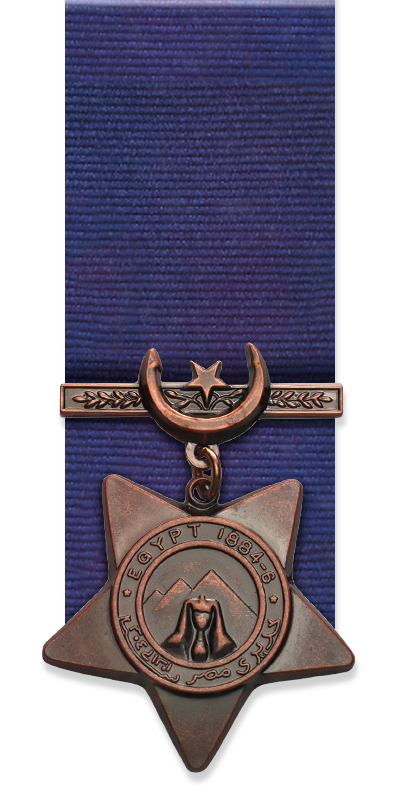
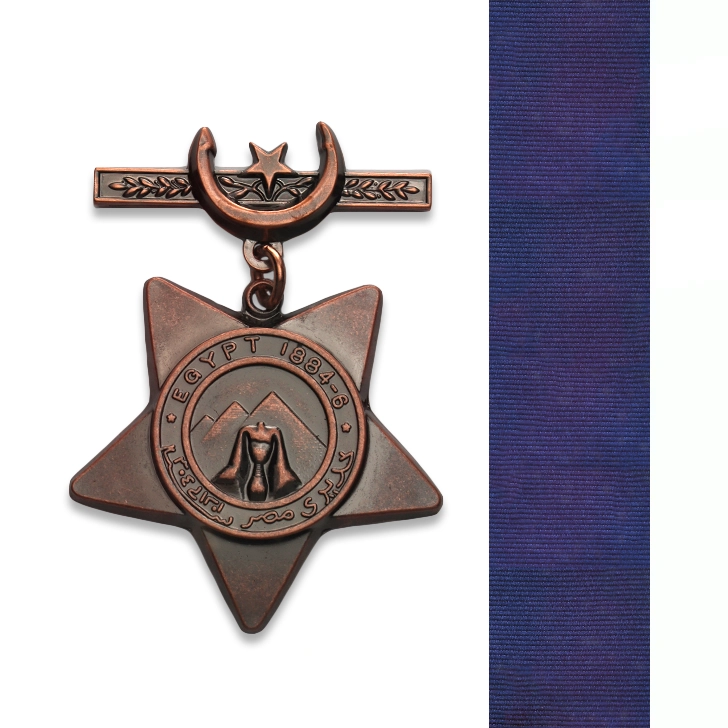
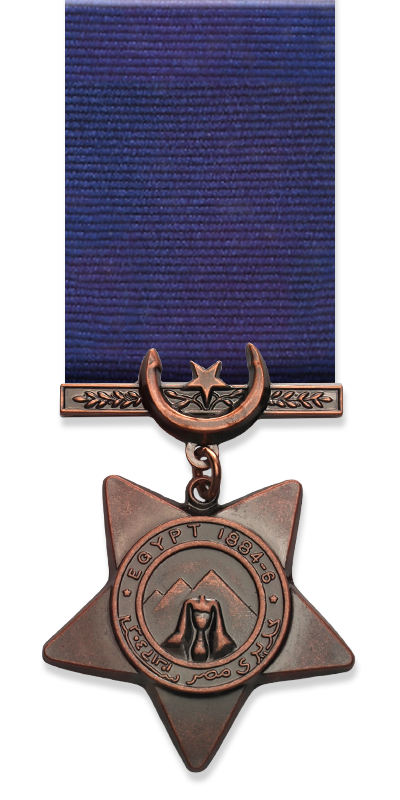
The star is a heavy five-pointed bronze star, originally chemically darkened but usually found polished to a brassy colour. The obverse shows the Sphinx and pyramids within a circle inscribed EGYPT and the date, with Arabic inscriptions of the Khedive of Egypt and the Islamic date; the reverse is plain but for a sunken central roundel bearing the Khedive's crowned monogram. It hangs from a dark blue ribbon by a suspender bearing a crescent and star, and was issued unnamed.
The ribbon
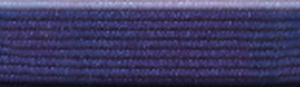
Dark blue, with a crescent-and-star suspender.
The ribbon is dark blue, suspended by a bar bearing a crescent and a star.
Clasps
The star was issued in four dated versions; only one, the earliest qualified for, was awarded to each recipient.
Eligibility
The star was awarded to recipients of the Egypt Medal for the campaigns in Egypt and the Sudan.
- It was given to those who had received the British Egypt Medal, and was never awarded alone, always accompanying that medal;
- Only one star was awarded to each recipient, for the earliest campaign in which he served, in versions dated 1882, 1884, 1884-6 or undated;
- The men of the New South Wales Contingent to the Sudan received it in 1885. As an Imperial-era award it retains its place in the Australian Order of Wearing.
Order of wear
Imperial awards were the honours of Australia before the Australian honours system was established in 1975, and they retain their place in the Order of Wearing. They are worn after the Australian honours of their kind and among the Imperial awards in the order set by the Australian Order of Wearing, which follows the British order of precedence.
Frequently asked questions
What is the Khedive's Star?
A bronze campaign star given by the ruler of Egypt to recipients of the British Egypt Medal for the Egyptian and Sudan campaigns between 1882 and 1891, an allied award always worn with that medal.
Why is it always seen with the Egypt Medal?
It was never awarded alone; it accompanied the silver Egypt Medal, so the two form a pair. A recipient received one star for the earliest campaign in which he served.
What is its Australian connection?
The men of the New South Wales Contingent sent to the Sudan in 1885, Australia's first overseas military expedition, received the Khedive's Star with their Egypt Medals.
What are the four versions?
Stars dated 1882, 1884 and 1884-6, and an undated version for later service; only one was awarded to each recipient.
Is it named to the recipient?
It was issued unnamed, though some recipients had their details privately engraved on the reverse.
Does it carry a post-nominal?
No; it is a campaign star and carries no post-nominal.