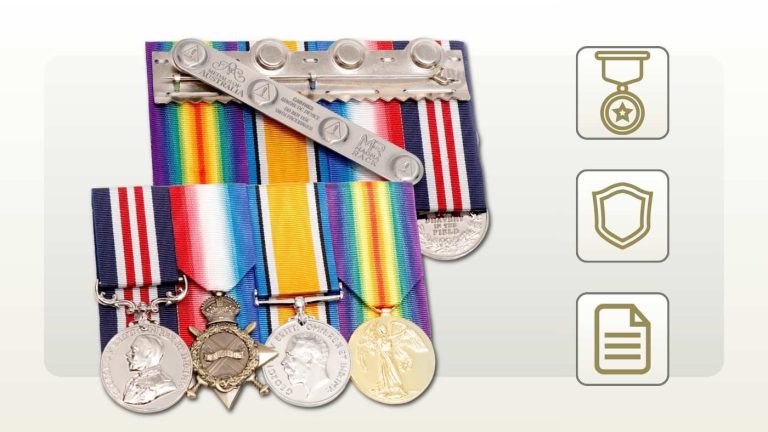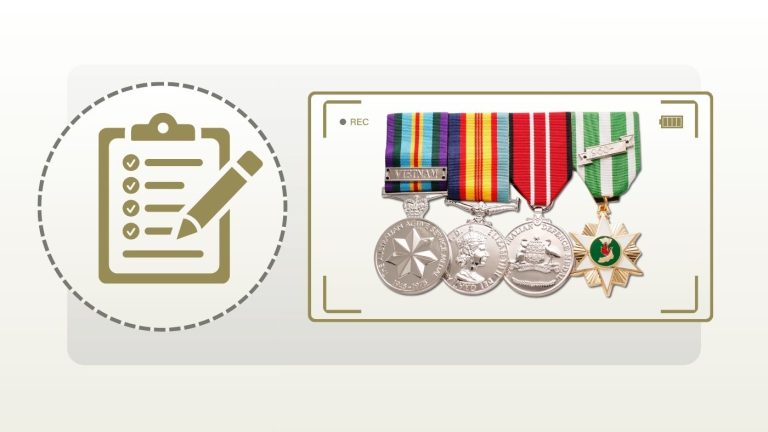
The short answer: give each recipient their own medal group, their own plaque and, where possible, their own frame. Order of wear rules apply to one person's awards, not to a family, so medals from a grandfather, a mother and a son should never be merged into a single row. Research and confirm each person's awards separately, build each group separately, then decide how the groups hang together on the wall.[1][4]
This guide covers displays that bring together more than one family member. If you are planning a display for one person with medals, citations and badges, see our separate guide on separating medals, citations and badges.
Why should each recipient's medals stay separate?
A medal group tells the story of one person's service. Rack Builder arranges awards using the selected jurisdiction, current published guidance and award-specific rules, and its frames are mounted to the published order of wear.[2][4] Those rules describe how one recipient's awards sit in relation to each other. They say nothing about how a father's medals relate to his daughter's, so a single combined row would have no correct order at all.
Keeping groups apart also protects the record. Rack Builder's medal frame page refers to the plaque carrying the recipient's name, in the singular, and neither the medal frame nor the photo frame page describes a frame holding more than one recipient's medals.[4][5] If you want two people in one frame, ask the team before you plan around it.[3]
Step 1: Research each family member's service separately
Start with records, not memory or photographs. The Australian War Memorial describes a service record as the most authoritative source on an individual's military career, and notes that the Memorial itself does not hold these records; the National Archives of Australia does.[7]
The National Archives holds Army, Navy and Air Force service records, including First and Second World War records. For a basic search it suggests entering the person's surname and service number, and notes that service numbers can be found by searching the relevant nominal rolls.[6] Records of service after the Second World War are held by both the National Archives and Defence; if you cannot find a record in RecordSearch, the National Archives suggests submitting a "Defence service after WWII" enquiry.[6]
Medals are not always listed on the record. The Memorial notes that campaign medals are recorded on First World War service records, but that for later conflicts this information is not usually included, and suggests an enquiry to Defence Honours and Awards.[7]
Rack Builder's FAQ gives the same direction: apply to the Honours and Awards division of the Department of Defence, and use the National Archives website to research a relative's service history.[2]
Rack Builder's common groups are a starting point only. They do not confirm entitlement, and the FAQ says to check the recipient's service record, award documents or relevant authority before ordering.[2] Any entitlement question for a family member is a matter for Defence or the awarding authority, not for a retail builder.
Step 2: Build one rack per recipient
The builder's first step is choosing the service or jurisdiction, which sets the award and order of wear rules it uses.[1] Because that choice belongs to one person's service, build a separate rack for each family member. You can save a rack at any stage; an account is needed to save, and saved racks expire after 90 days.[1]
Use a naming habit that keeps the generations clear when you return to the builder, for example the recipient's surname, first name and conflict. When you contact support about a rack, include the saved rack reference or order number.[3]
Step 3: Choose a display format for each recipient
Rack Builder lists full-size medals, miniature medals, ribbon bars, medal frames, photo frames, presentation sets, and cases and boxes.[1] For a family wall, the two framed options are the most relevant.
| Format | What the live page states | Fit for a multi-generation display |
|---|---|---|
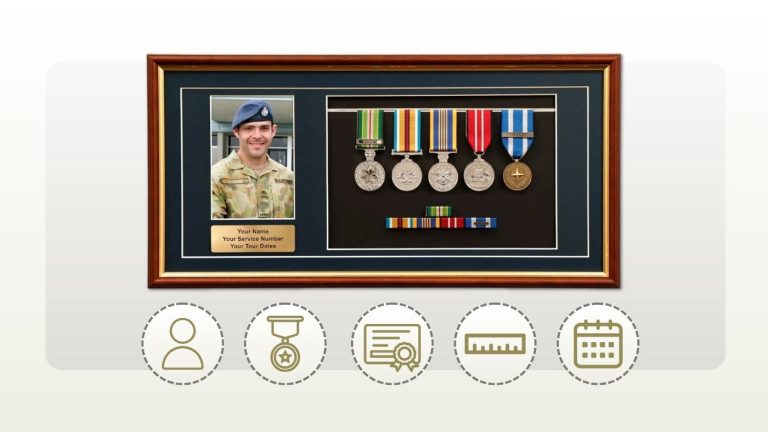
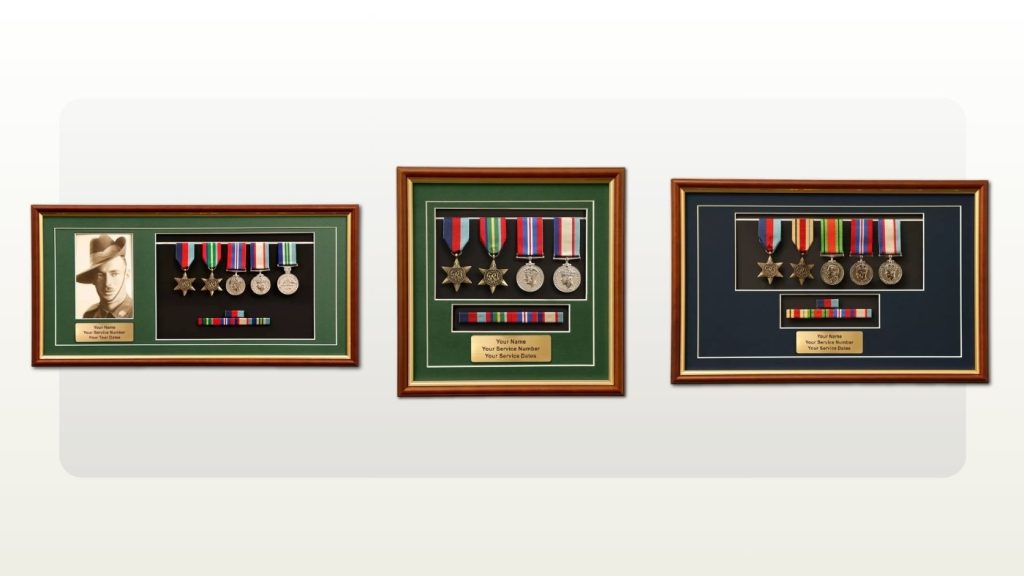
| Medal frame | Built around the medal group, 1 to 12 medals, with an engraved plaque of three lines of up to 22 characters each[4] | One frame per recipient keeps each group and plaque distinct |
| Photo frame | Combines a photograph, the medal group and a plaque; designed for a standard 4 x 6 photo[1][5] | Pairs each recipient's portrait with their own medals |
| Original medals | Customer-supplied originals can be framed, arranged through the support page[2][4] | Ask support first, and say which recipient each original belongs to |
| More than one recipient in one frame | Not described on the medal frame or photo frame pages[4][5] | Ask support before planning a combined layout[3] |
Medal frame sizes follow medal count: small holds up to 4 medals, medium 5 to 8, and large 9 to 12.[4] In a family display the groups will often differ in size. A grandparent with a short group and a parent with a long one can still look balanced if the frames share a style and are hung on a common centre line.
Step 4: Give each recipient a clear plaque
The plaque is what separates one person from the next on the wall. Rack Builder's plaques take three lines of up to 22 characters each, including spaces, and the FAQ suggests name, service number, rank, unit, service dates or a short dedication.[2] You approve the engraving preview before production, which lets you check spelling and line breaks.[4]
For a family wall, keep the plaque structure the same on every frame so visitors can compare like with like, for example name on line one, service and unit on line two, and conflict or service dates on line three. Check every detail against the records found in Step 1, not against family recollection. Our guide to planning engraving and service details covers wording in more depth.
Step 5: Handle photographs and originals with care
Family displays often mix generations of photographs and original medals. A few principles from the Australian War Memorial apply:
- Display copies, not originals. The Memorial says that preferably only copy prints should be displayed to protect originals from light.[12]
- Keep original photographs out of direct sunlight, and avoid touching them, because oils and acids on fingers can damage the emulsion.[12]
- Keep medals clean and dry, away from extremes of temperature, humidity and light, and handle them as little as possible.[11]
- Avoid polishing unless it is essential, because repeated polishing wears the design.[11]
For Rack Builder photo frames, upload a JPEG or PNG of at least 1200 by 1800 pixels, and avoid screenshots and compressed social media copies.[2] The team checks image quality, crop and layout before production and contacts you if the photograph will not display or print properly.[2][5] A good scan of an older portrait therefore does double duty: it protects the original and gives the frame a usable image. Before cleaning or repairing an original photograph or document, the National Archives suggests consulting a conservator.[13]
Step 6: Agree as a family who holds what
A multi-generation display often brings together items held in different households. Rack Builder's FAQ notes that replicas were introduced to preserve original medals and avoid family disputes over the original set.[2] A replica group for each recipient can let one relative keep the originals while the wider family shares the display.
Families sometimes also want a set to wear on commemorative days. As background only: the Australian War Memorial says relatives of people awarded medals may wear them on the right breast[9], and Defence says that when medals are worn by others they are worn on the right side, to show the wearer is not the original recipient.[8] RSL Australia adds that it is respectful to wear only one set of an ancestor's medals at a time.[10] A framed display is a separate decision, so a family can frame several recipients while each person chooses one ancestor's set to wear.
A worked example: three generations on one wall
This is a hypothetical example, not a real family and not a statement of any person's entitlement.
A family wants to honour a great-grandfather who served in the First World War, a grandmother who served after the Second World War, and a father with recent service. They research each person separately: the great-grandfather's record through the National Archives, the grandmother's through a "Defence service after WWII" enquiry, and the father's medals through his own Defence correspondence.[6][7]
They build three racks, each with its own jurisdiction choice.[1] The great-grandfather's group goes into a photo frame with a scanned copy of his portrait, while the original photograph stays in an archival album.[5][12] The grandmother's and father's groups go into medal frames of the size their medal counts require.[4] Each plaque follows the same three-line pattern.[2]
Because the family also wants to include the grandmother's original medals, they contact support first with the saved rack reference.[2][3] The three frames are hung side by side, oldest service on the left, on a shared centre line.
How Rack Builder can help
Start in the builder with one recipient: choose the jurisdiction, add the medals and clasps, choose a format, then review names, service details and layout before ordering.[1] After checkout, the order enters a review and production process, and the team contacts you if an award, clasp, layout or personal detail needs clarification.[2] That is a retail configuration review, not an official decision on anyone's entitlement.
For anything the product pages do not describe, such as more than one recipient in a single frame or framing original medals, ask support first.[3] Share only what the team needs; full service records are not required to ask about layout. A short enquiry could read:
"Hello, I am planning a display for [number] family members. I have saved racks [saved rack references] for [recipient names]. Can [describe the layout you have in mind], or would you suggest separate frames? I also hold original medals for [recipient name]. My required date is [date]."
The FAQ answers many common questions, and the support page lists the ways to talk to a person.[2][3]
If you are starting each recipient's rack from their paperwork, our guide to building a medal rack from a service record walks through the process.
Frequently asked questions
How do I set up a multi-generation medal display for my family?
Give each family member their own medal group, their own plaque and, where possible, their own frame. Research and confirm each person's awards separately, build a separate rack for each person, then decide how the groups hang together on the wall.[1][4] Medals from different relatives should never be merged into a single row.
Can my grandfather's and father's medals go in the same frame?
Keep them as separate groups. Order of wear rules describe how one recipient's awards sit in relation to each other, so a combined row has no correct order. Rack Builder's medal frame and photo frame pages do not describe a frame holding more than one recipient's medals, so ask support before planning a combined layout.[3][4][5]
Where can I find a relative's military service record in Australia?
Start with the National Archives of Australia, which holds Army, Navy and Air Force service records, including First and Second World War records.[6] Search by surname and service number. Records of service after the Second World War are held by both the National Archives and Defence; if you cannot find one in RecordSearch, submit a "Defence service after WWII" enquiry.[6]
Why aren't my relative's medals listed on their service record?
For conflicts after the First World War, medals are usually not recorded there. The Australian War Memorial notes that campaign medals are recorded on First World War service records, but for later conflicts this information is not usually included, and suggests an enquiry to Defence Honours and Awards.[7] Any entitlement question is a matter for Defence or the awarding authority.
What should each plaque say on a family medal display?
Use the same structure on every plaque so visitors can compare like with like. Rack Builder plaques take three lines of up to 22 characters each, including spaces, and the FAQ suggests name, service number, rank, unit, service dates or a short dedication.[2] Check every detail against the service records, not family recollection, and approve the engraving preview before production.[4]
Can family members wear a relative's medals on commemorative days?
Published guidance says relatives may wear them on the right side. The Australian War Memorial says relatives of people awarded medals may wear them on the right breast[9], and Defence says medals worn by others are worn on the right side to show the wearer is not the original recipient.[8] RSL Australia adds that it is respectful to wear only one set of an ancestor's medals at a time.[10] Check current RSL and Defence guidance and any event dress requirements before the day.
Should I use original photographs in a medal display?
Display a copy rather than the original where you can. The Australian War Memorial says that preferably only copy prints should be displayed, to protect originals from light.[12] For a Rack Builder photo frame, upload a JPEG or PNG of at least 1200 by 1800 pixels and avoid screenshots and compressed social media copies.[2] A good scan protects the original and gives the frame a usable image.
Sources
Source pages reviewed 13 October 2026. Numbered citations in the article open the sources below.
- Rack Builder: How it works Service or jurisdiction step, product formats, saved racks with an account and 90-day expiry.
- Rack Builder: FAQ Medals, products, orders and delivery: arrangement rules, common groups, relatives, replicas, plaques and photos.
- Rack Builder: Support Order, product and builder help; include the saved rack reference or order number; talk to a person.
- Rack Builder: Medal Display Frames with Engraved Plaques 1 to 12 medals, frame sizes by medal count, three-line plaque, preview approval, originals via support.
- Rack Builder: Photo and Medal Frames with Engraved Plaques Photograph, medal group and plaque; standard 4 x 6 photo; image checked before production.
- National Archives of Australia: Finding a service record Army, Navy and Air Force records; surname and service number search; Defence service after WWII enquiry.
- Australian War Memorial: Researching your military family history (Shannon Sutton) Published 27 August 2021, last updated 30 August 2021.
- Department of Defence: Frequently asked questions (Honours and Awards) Medals worn by others are worn on the right side to show the wearer is not the original recipient.
- Australian War Memorial: Dress protocols and traditions for Anzac Day Published 20 March 2015, last updated 30 March 2021.
- RSL Australia: A Guide to Wearing Medals on Commemorative Occasions Family medals on the right side; one set of an ancestor's medals at a time.
- Australian War Memorial: Conservation advice: Medals Last updated 22 December 2020.
- Australian War Memorial: Conservation advice: photographs Last updated 20 December 2019.
- National Archives of Australia: Caring for your personal physical collection Consult a conservator, particularly before cleaning or repairs.