
History
The War Medal 1939-1945 was instituted on 16 August 1945 for all who served full-time in the armed forces or the Merchant Navy for at least 28 days between 3 September 1939 and 2 September 1945, irrespective of where they served or whether they left their own country. In the Merchant Navy the 28 days had to be served at sea. It is the universal award of the war, granted in addition to any campaign stars and the Defence Medal, so that virtually every wartime group closes with it.
All recipients of the campaign stars also received the War Medal, and a small number of qualifying civilians, such as war correspondents and ferry pilots who flew in operational theatres, were eligible too. A mention in despatches or a King's Commendation is marked by an oak leaf on the ribbon. Australian issues were officially named, and as an Imperial award it retains its place in the Australian Order of Wearing.
Design & ribbon
The medal
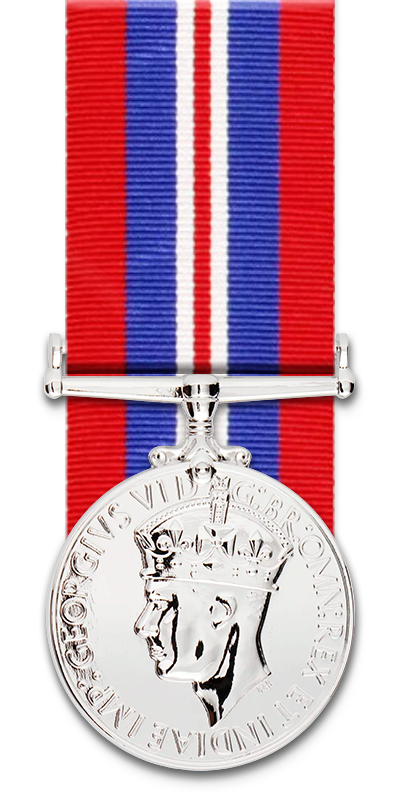
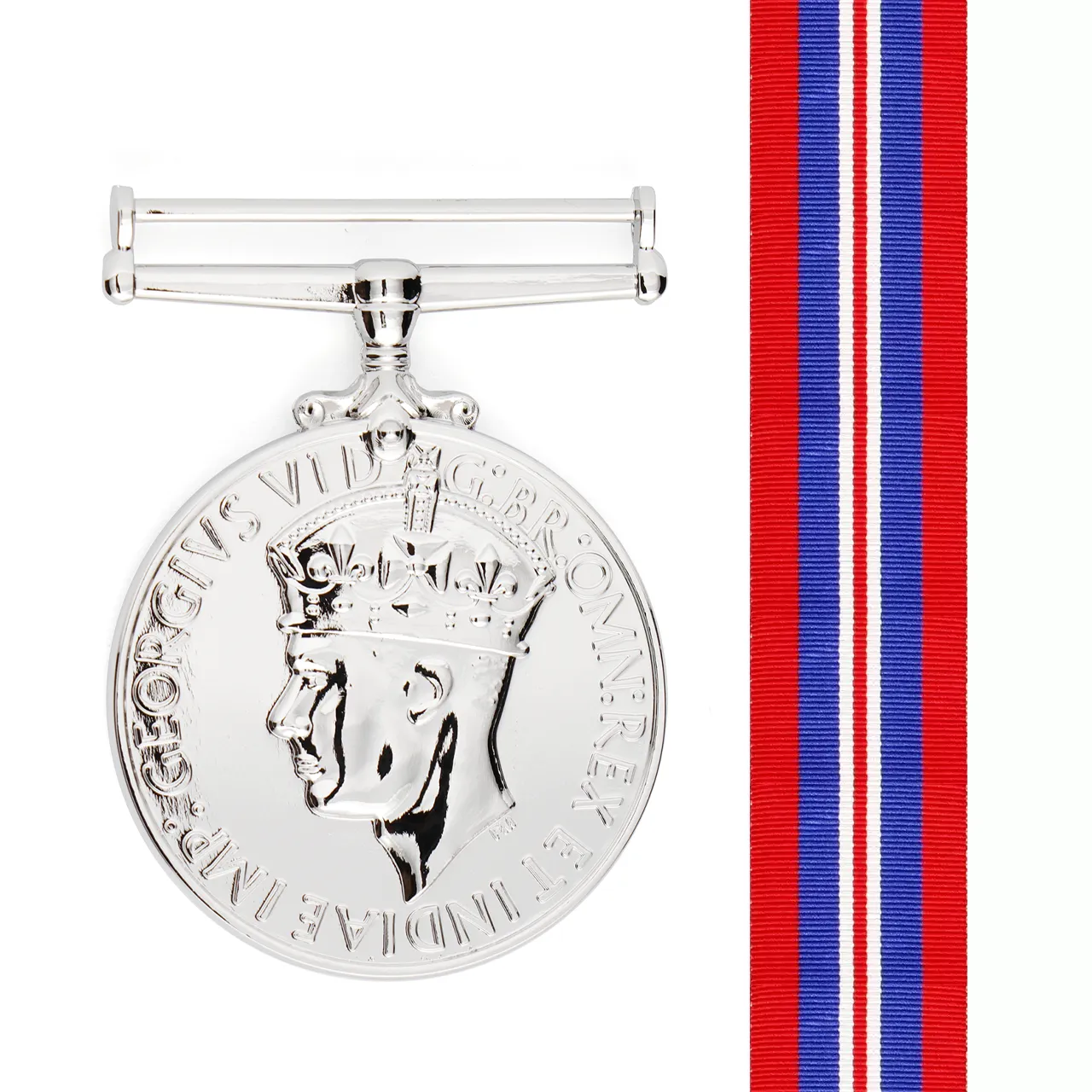
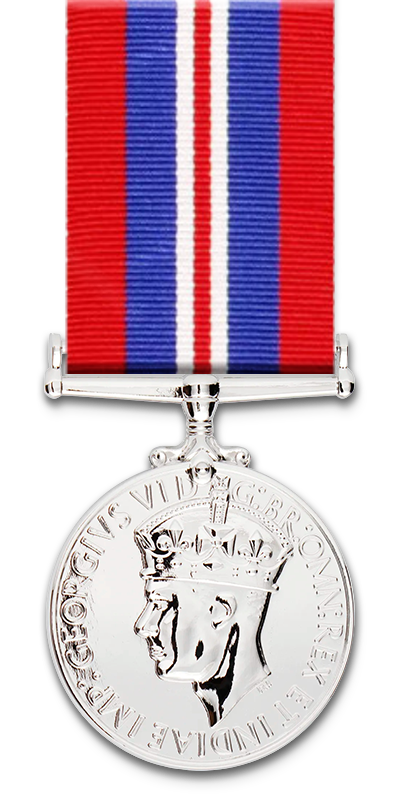
The medal is a cupro-nickel disk, 36 millimetres in diameter, its obverse bearing the crowned effigy of King George VI. The reverse shows a lion standing over a fallen double-headed dragon, with the dates 1939 and 1945 above. Australian issues were officially named on the rim, unlike the British issue.
The ribbon
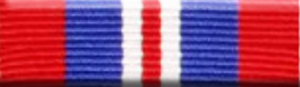
The red, white and blue of the Union Flag.
The ribbon carries the red, white and blue of the Union Flag: a narrow central red stripe edged in white, broad red stripes at each edge, and blue stripes between.
Clasps
No clasps were awarded; a mention in despatches is marked by an oak-leaf emblem on the ribbon.
WW2 Mention in Despatches (MID)
Denotes a mention in despatches for service in the Second World War. A single bronze oak-leaf emblem is worn on the ribbon of the War Medal, only one regardless of the number of mentions.
Eligibility
The medal was awarded for full-time service in the Second World War between 3 September 1939 and 2 September 1945.
- All full-time personnel of the armed forces and Merchant Navy qualified on 28 days of service, irrespective of location; in the Merchant Navy the 28 days had to be served at sea;
- It was granted in addition to the campaign stars and the Defence Medal, and a few qualifying civilians such as war correspondents also received it; no clasps were awarded, but a mention in despatches is marked by an oak-leaf emblem;
- As an Imperial award it retains its place in the Australian Order of Wearing.
Order of wear
Imperial awards were the honours of Australia before the Australian honours system was established in 1975, and they retain their place in the Order of Wearing. They are worn after the Australian honours of their kind and among the Imperial awards in the order set by the Australian Order of Wearing, which follows the British order of precedence.
Frequently asked questions
What is the War Medal 1939-1945 awarded for?
Full-time service of at least 28 days in the armed forces or Merchant Navy between 3 September 1939 and 2 September 1945, irrespective of where the recipient served.
Who received it?
All full-time personnel of the forces and Merchant Navy who met the 28-day rule, in addition to any campaign stars and the Defence Medal, along with a few qualifying civilians such as war correspondents and ferry pilots.
What does the oak leaf mean?
A mention in despatches or a King's Commendation. A single bronze oak leaf is worn regardless of the number of mentions; no clasps were awarded.
What does the reverse show?
A lion standing over a fallen double-headed dragon, with the dates 1939 and 1945, symbolising the defeat of the Axis powers.
Is it named to the recipient?
Australian issues were officially named on the rim, unlike the British issue, which was unnamed.
Does it carry a post-nominal?
No; it is a campaign medal and carries no post-nominal.