
History
The Arctic Star is the last of the Second World War campaign stars, instituted on 19 December 2012 and first awarded in March 2013, more than sixty-seven years after the war it commemorates. It recognises the men of the Arctic convoys, who carried supplies to the Soviet Union around the north of Norway through some of the most brutal conditions of the war: pack ice, perpetual winter darkness, and the constant threat of U-boats, aircraft and surface raiders. Winston Churchill is said to have called it the worst journey in the world.
The Star is awarded for any length of operational service north of the Arctic Circle between 3 September 1939 and 8 May 1945, a deliberately generous rule acknowledging the extreme severity of the service. It is issued on application to veterans or their next of kin. Australians who served with the Royal Navy and Merchant Navy on the convoys are eligible where not recognised by a similar award of their own country. As an Imperial award it retains its place in the Australian Order of Wearing.
Design & ribbon
The medal
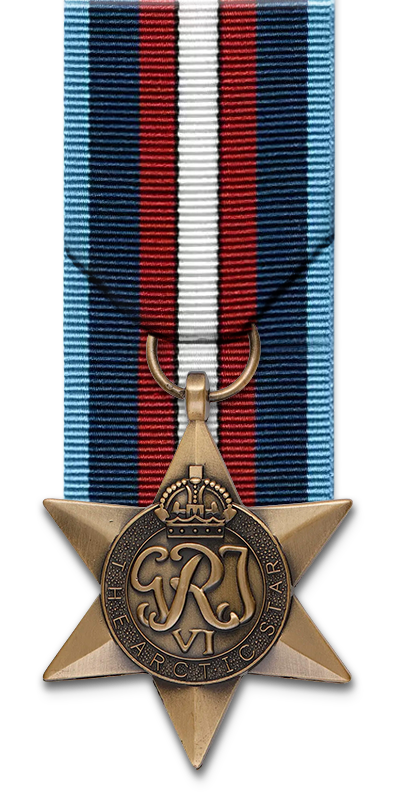
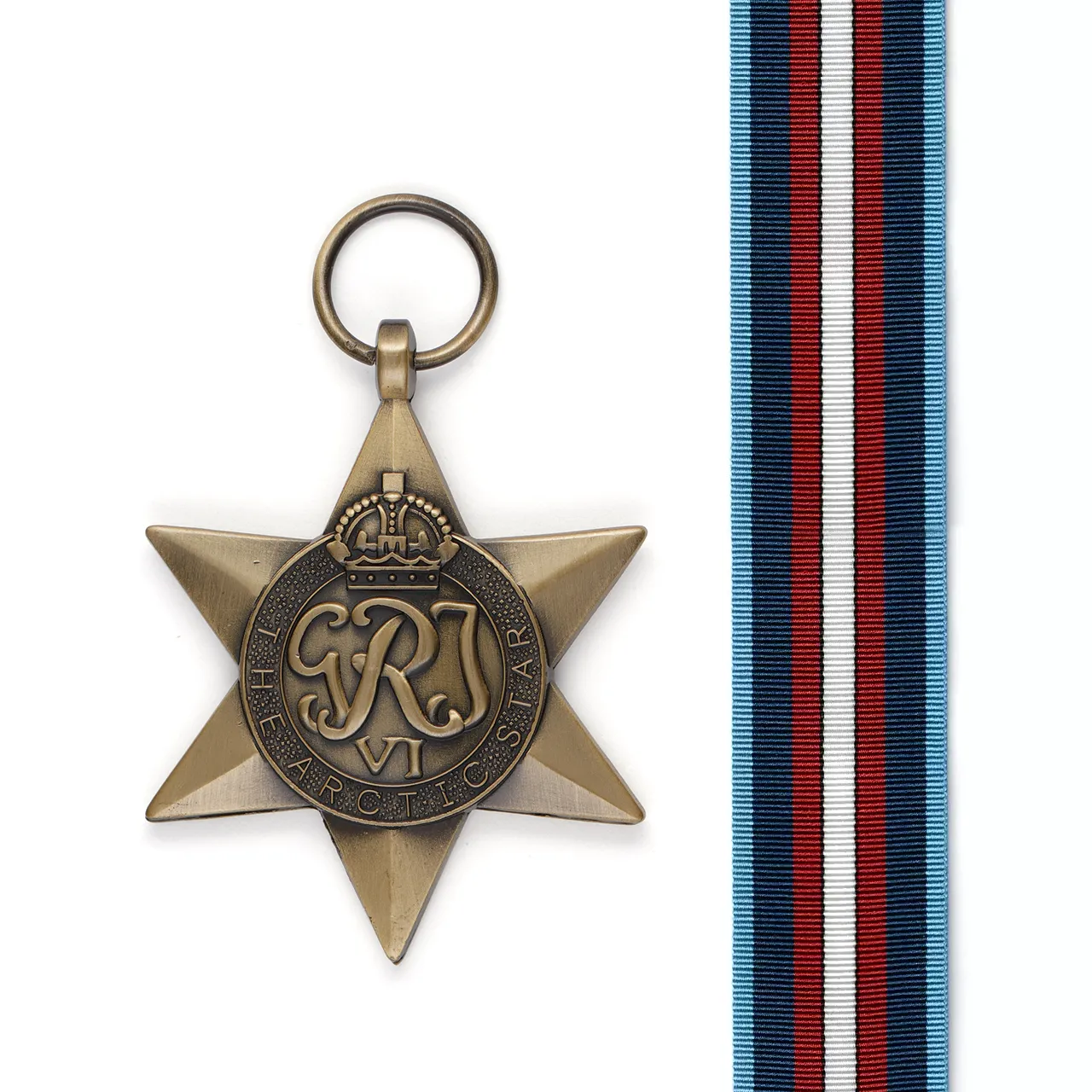
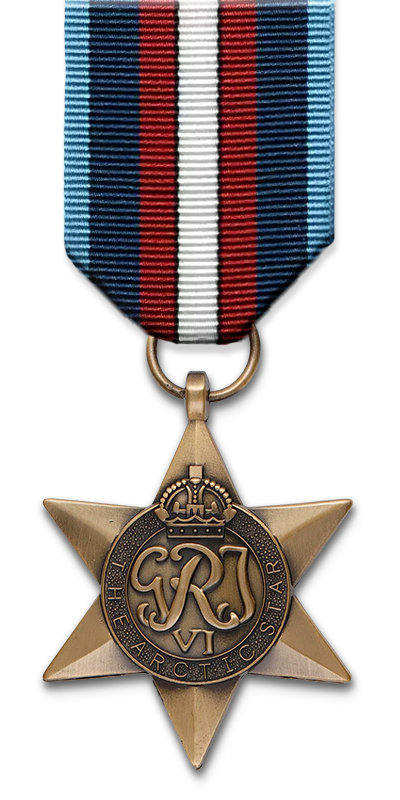
The Star is a six-pointed star of the same pattern as the wartime campaign stars, yellow copper-zinc alloy ensigned with a crown, its obverse bearing the royal cypher GRI VI within a circlet inscribed THE ARCTIC STAR. Unlike the wartime stars its ribbon was designed later, by the Ministry of Defence and the Royal Mint Advisory Committee.
The ribbon
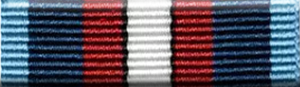
Service colours flanking a black-edged white Arctic band.
The ribbon carries bands of white, red, and Air Force and Navy blue with a black pinstripe, the three service colours and the Merchant Navy red flanking a central white band edged in black that represents the Arctic itself.
Eligibility
The Star recognises operational service north of the Arctic Circle in the Second World War.
- Any length of operational service north of the Arctic Circle, latitude 66 degrees 32 minutes north, between 3 September 1939 and 8 May 1945 qualifies, in recognition of the severity of the conditions;
- It is a retrospective award, issued on a self-nomination basis to eligible veterans or their next of kin; foreign nationals who served in British or Dominion forces qualify where not recognised by a similar award of their own government;
- As an Imperial award it retains its place in the Australian Order of Wearing.
Order of wear
No more than five of the Second World War campaign stars could be awarded to one person, six including the later Arctic Star; those who qualified for more wore a clasp on the ribbon of a star they held, naming a further star, with only one clasp worn on any star.
Frequently asked questions
What is the Arctic Star awarded for?
Any length of operational service north of the Arctic Circle between 3 September 1939 and 8 May 1945, recognising the men of the Arctic convoys to the Soviet Union.
Why was it instituted so late?
The Arctic convoy veterans had long sought distinct recognition, their service previously folded into the Atlantic Star; the campaign succeeded and the Star was instituted in 2012, first awarded in 2013.
Why is the qualifying period so short?
The rule is deliberately generous, requiring any operational service in the area rather than a set number of days, in acknowledgement of the extreme severity of the conditions.
How is it obtained?
As a retrospective award on a self-nomination basis, applied for by eligible veterans or their next of kin.
Can it be worn in addition to five other stars?
Yes. It is counted as a possible sixth campaign star, and only the Arctic Star may be worn as that sixth star.
Does it carry a post-nominal?
No; it is a campaign star and carries no post-nominal.