
History
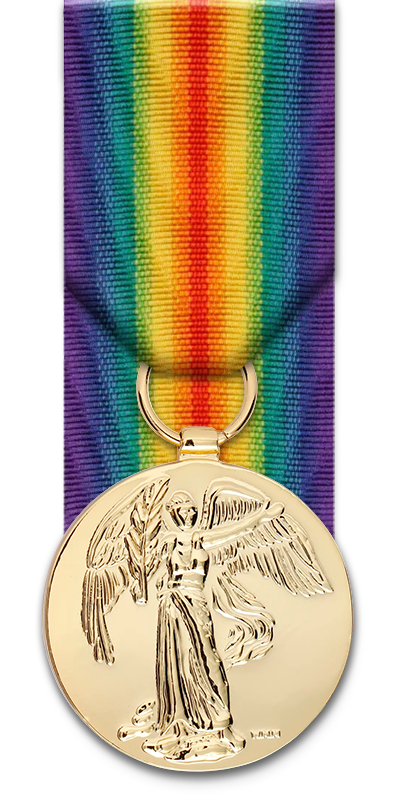
The Victory Medal grew out of a decision by an inter-allied committee in Paris in March 1919: rather than exchange campaign medals across the alliance, each allied nation would issue its own Victory Medal to its own people, all sharing a winged figure of Victory on the obverse and an identical rainbow ribbon. Fourteen countries did so, and the British version was designed by William McMillan.
It was issued to all who had received the 1914 Star or the 1914-1915 Star, and to most who received the British War Medal, provided they had entered a theatre of war between 5 August 1914 and 11 November 1918; home service alone did not qualify. About 5.7 million were awarded. Those mentioned in despatches during the war wear a bronze oak-leaf spray on its ribbon. It was never awarded alone, and as an Imperial award it retains its place in the Australian Order of Wearing.
Design & ribbon
The medal
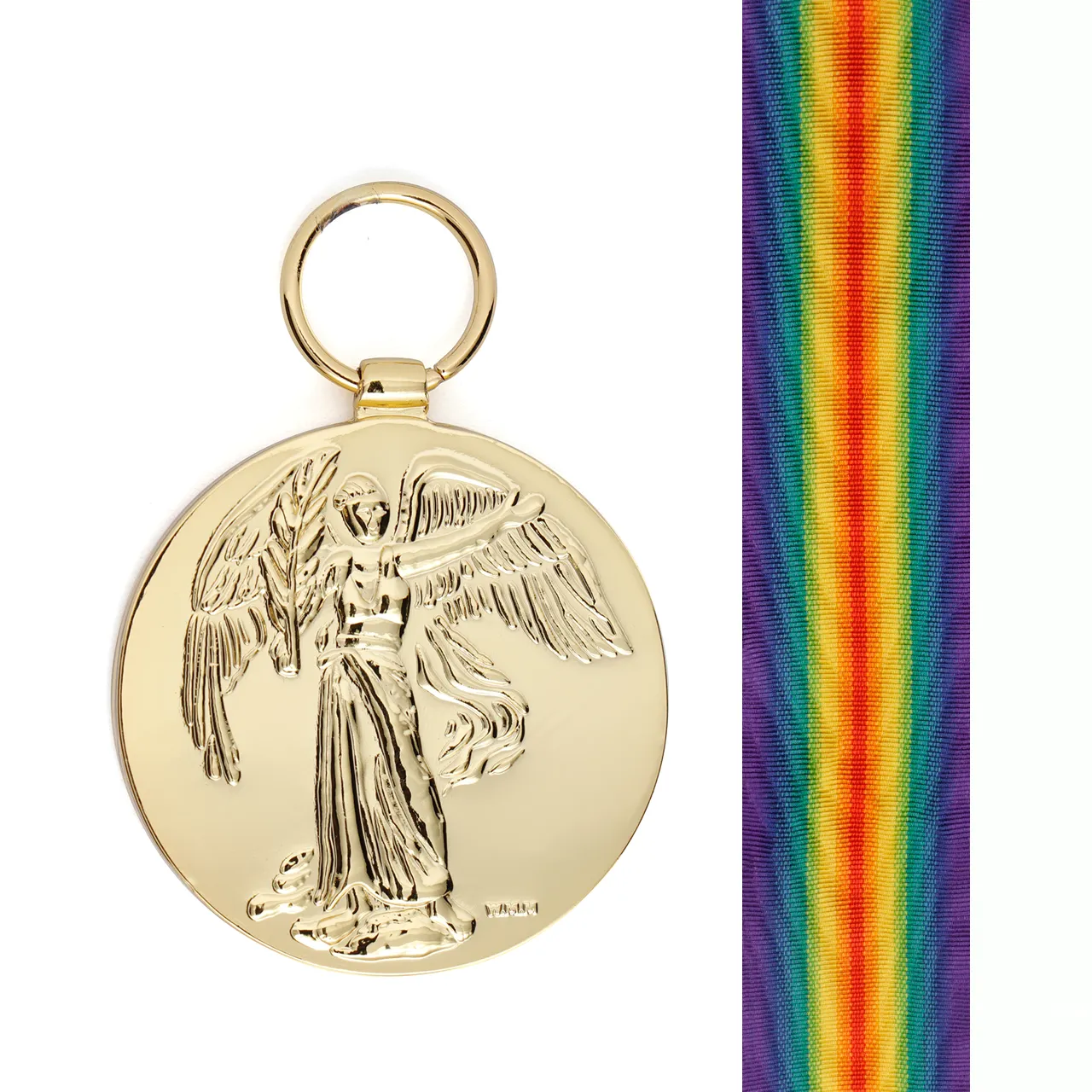
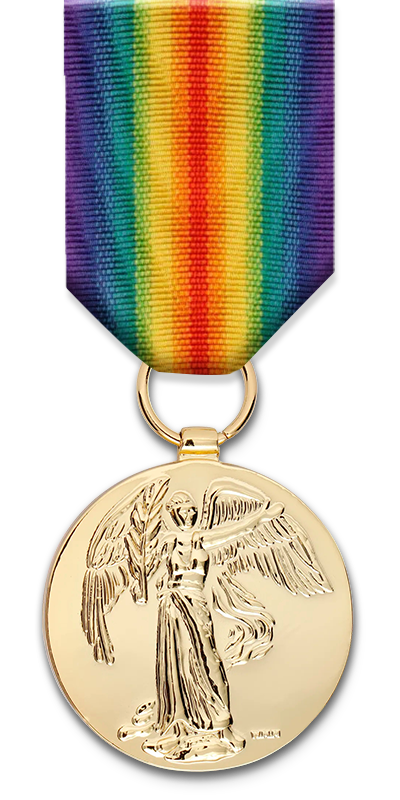
The medal is a bronze disk 36 millimetres in diameter. The obverse shows the winged, full-length figure of Victory with an outstretched arm, holding a palm branch. The reverse bears the inscription THE GREAT WAR FOR CIVILISATION 1914-1919 in four lines within a laurel wreath. The recipient's details are impressed on the rim. It is suspended by a ring.
The ribbon
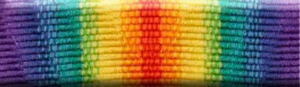
A double rainbow, red at the centre to violet at the edges.
The ribbon is watered in a double-rainbow pattern, the colours running from a central red through the spectrum to violet at each edge, representing the combined colours of the allied nations and the calm after the storm.
Clasps
No clasps were awarded; a mention in despatches is marked by an oak-leaf spray on the ribbon.
WW1 Mention in Despatches (MID)
Denotes a mention in despatches between 4 August 1914 and 10 August 1920. A single bronze oak-leaf spray is worn on the ribbon of the Victory Medal, only one regardless of the number of mentions, with a smaller emblem on the ribbon bar.
Eligibility
The medal was awarded for entering a theatre of war between 5 August 1914 and 11 November 1918.
- It was issued to all who received the 1914 Star or the 1914-1915 Star, and to most who received the British War Medal; home service alone did not qualify, though United Kingdom based airmen engaged against the enemy did;
- No clasps were awarded, but those mentioned in despatches between 1914 and 1920 wear a single bronze oak-leaf spray on the ribbon regardless of the number of mentions;
- It was never awarded alone. As an Imperial award it retains its place in the Australian Order of Wearing.
Order of wear
Imperial awards were the honours of Australia before the Australian honours system was established in 1975, and they retain their place in the Order of Wearing. They are worn after the Australian honours of their kind and among the Imperial awards in the order set by the Australian Order of Wearing, which follows the British order of precedence.
Frequently asked questions
What is the Victory Medal awarded for?
Entering a theatre of war between 5 August 1914 and 11 November 1918. It was issued to those who received a 1914 or 1914-1915 Star and most who received the British War Medal.
Why do allied nations have such similar medals?
An inter-allied committee agreed in 1919 that each nation would issue its own Victory Medal on a common theme, a winged Victory and an identical rainbow ribbon, to avoid exchanging medals across the alliance. Fourteen countries did so.
What does the oak leaf on the ribbon mean?
A mention in despatches. A single bronze oak-leaf spray is worn regardless of how many times the recipient was mentioned; no clasps were awarded.
Was it awarded alone?
No. It was always accompanied by the British War Medal and, usually, a campaign star.
Where does it sit among the trio?
It is Wilfred, worn last, after the star, Pip, and the British War Medal, Squeak.
Does it carry a post-nominal?
No; it is a campaign medal and carries no post-nominal.