
History
The 1914 Star, colloquially the Mons Star, was authorised in November 1917 for the officers and men of the British and Indian Expeditionary Forces who served in France or Belgium between 5 August 1914, the day after Britain's declaration of war, and midnight of 22 to 23 November 1914, the end of the First Battle of Ypres. Its recipients were largely the pre-war regular army, the Old Contemptibles, who fought the retreat from Mons, together with the medical and nursing services and small numbers of the Royal Flying Corps and Royal Navy who served ashore.
About 378,000 were awarded. In 1919 a clasp inscribed 5th Aug to 22nd Nov 1914 was instituted for those who had actually served under fire or within range of enemy mobile artillery in that period; those without the medal wore a small silver rosette on the ribbon in its place. The Star was never awarded alone, its recipients also receiving the British War Medal and Victory Medal, the trio nicknamed Pip, Squeak and Wilfred. As an Imperial award it retains its place in the Australian Order of Wearing.
Design & ribbon
The medal
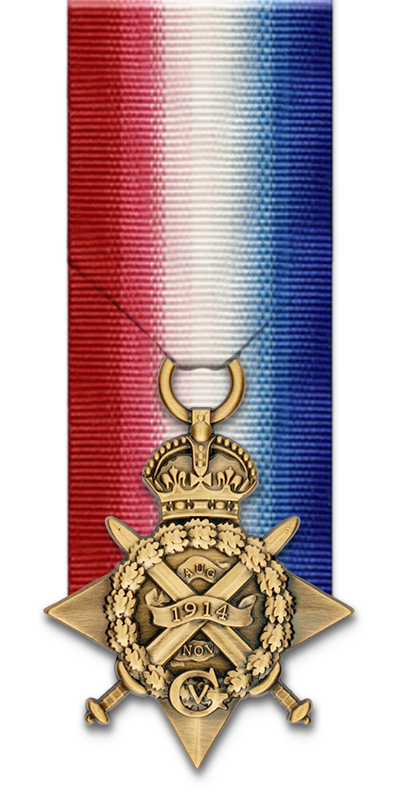
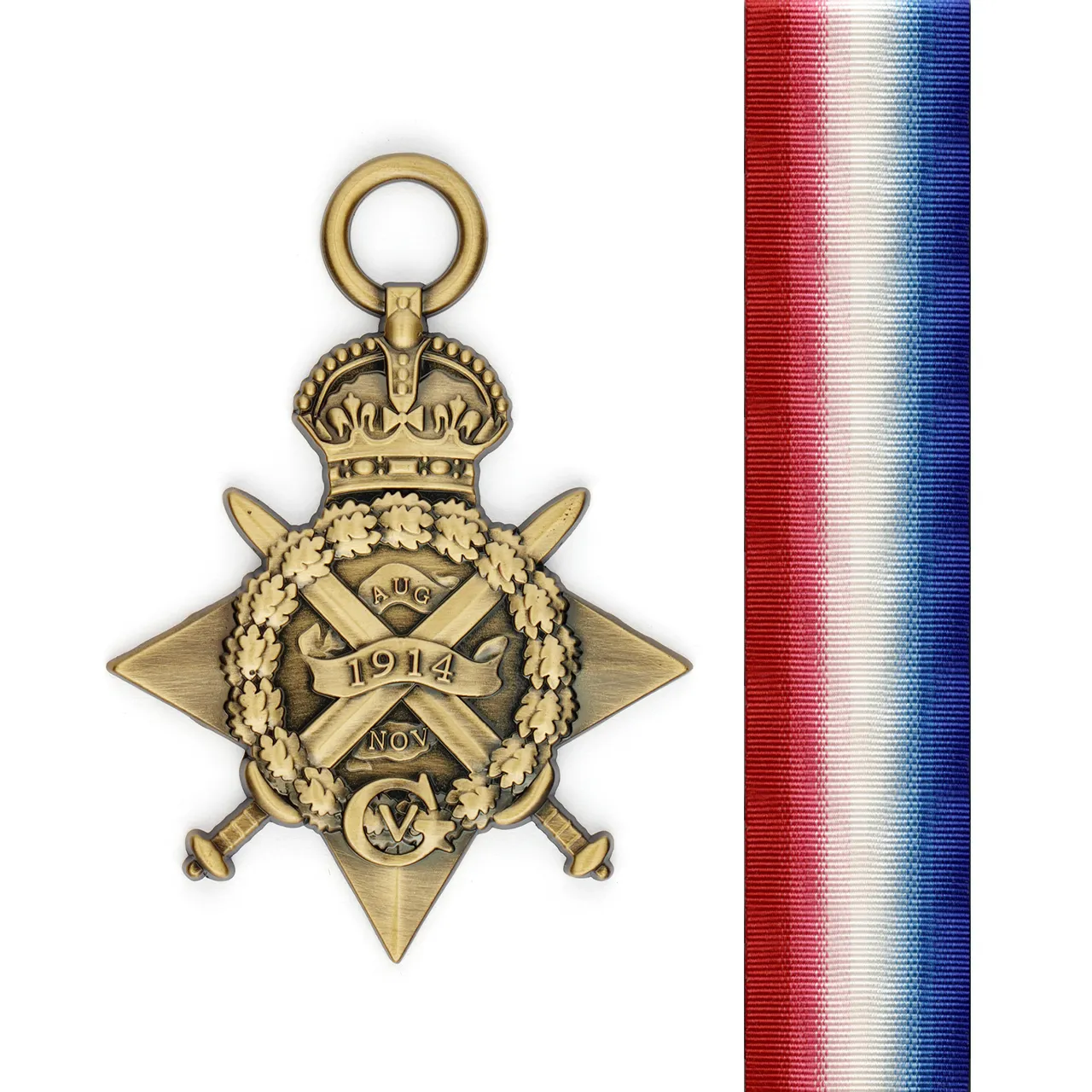
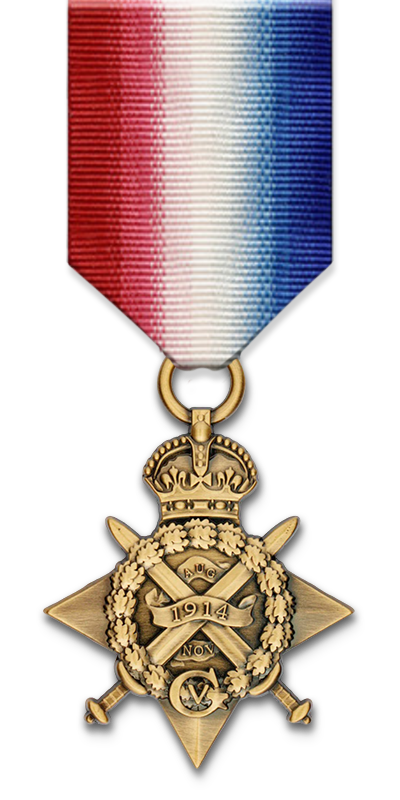
The Star is a four-pointed star of bright bronze, ensigned with a crown carrying the ring for suspension. The obverse shows two crossed swords, blades upward, overlaid by a wreath of oak leaves, with the royal cypher of King George V at its base and a central scroll inscribed AUG 1914 NOV. The reverse is plain and impressed with the recipient's number, rank, name and unit.
The ribbon

Shaded red, white and blue, the allied colours.
The ribbon is 32 millimetres wide, of red, white and blue in shaded and watered bands, echoing the colours of the flags of the allied nations, with red worn nearest the centre of the chest.
Clasps
Service under fire in the qualifying period is marked by a clasp on the ribbon.

5th Aug to 22nd Nov 1914
A bronze clasp inscribed 5th Aug to 22nd Nov 1914 was instituted in 1919 for those who served under fire, or within range of the enemy's mobile artillery, in France or Belgium during the qualifying period. When the ribbon alone is worn, a small silver rosette denotes the clasp.
Eligibility
The Star was awarded for service in France or Belgium between 5 August and midnight of 22 to 23 November 1914.
- Officers and men of the British and Indian Expeditionary Forces qualified, together with civilian medical staff, nurses and others attached to military hospitals, and naval and air personnel who served ashore in the theatre;
- A clasp inscribed 5th Aug to 22nd Nov 1914 was awarded for service under fire in the period, replaced by a small silver rosette when the ribbon alone is worn;
- The Star was never awarded alone, recipients also receiving the British War Medal and Victory Medal. As an Imperial award it retains its place in the Australian Order of Wearing.
Order of wear
Imperial awards were the honours of Australia before the Australian honours system was established in 1975, and they retain their place in the Order of Wearing. They are worn after the Australian honours of their kind and among the Imperial awards in the order set by the Australian Order of Wearing, which follows the British order of precedence.
Frequently asked questions
What is the 1914 Star awarded for?
Service in France or Belgium between 5 August and midnight of 22 to 23 November 1914: the opening months of the war, from the declaration of war to the end of the First Battle of Ypres.
Why is it called the Mons Star?
Its recipients were largely the original British Expeditionary Force, the Old Contemptibles, who fought the retreat from Mons in those first months, though the Star is for service across the theatre, not the battle alone.
What is the clasp?
A clasp inscribed 5th Aug to 22nd Nov 1914, awarded for service under fire in the qualifying period; a small silver rosette represents it when the ribbon alone is worn.
Was it ever awarded alone?
No. Recipients also received the British War Medal and Victory Medal, and no one could receive both the 1914 Star and the 1914-1915 Star.
What are Pip, Squeak and Wilfred?
The affectionate nickname for the trio: the Star as Pip, the British War Medal as Squeak, and the Victory Medal as Wilfred, after popular comic-strip characters of the era.
Is it named to the recipient?
Yes, impressed on the reverse with number, rank, name and unit.