You may have served in the Australian Defence Force (ADF), moved into policing and volunteered with an emergency service. When you bring those medals together, the question is not simply which job came first. It is which awards belong together, and where each one should be worn.
A mixed-service medal rack can include national awards earned through different organisations. However, not every service-issued medal belongs on the same bar. Start with the Australian Order of Wearing Honours and Awards, then check any separate agency requirements.[1][2][4]
Start with the exact award names, not the jobs you held
Write down each confirmed medal, including its full name and any awarded clasps, the small bars attached to its ribbon. Keep a note of the organisation responsible for it. This simple checklist helps you separate awards that sound similar but follow different rules.
For example, the National Police Service Medal and the Queensland Police Service Medal are different awards. The first is a national award recognising ethical and diligent service as a sworn police officer. The Queensland Police Service (QPS) identifies its own medal as outside the Australian Honours System and directs recipients to wear it on the right breast.[3][4]
Do not add medals just because someone served in a particular role. Where Defence entitlement is unclear, its full-assessment pathway allows members, former members and families to request a list of entitled awards. Take questions about other awards to the organisation responsible for them.[11]
National awards follow one sequence, not separate career blocks
Defence explains that the Australian Order of Wearing includes awards administered by different organisations, not only Defence. Your national awards therefore need to be considered together, rather than arranged in an Army section, a police section and an emergency service section.[2]
The schedule determines their relative positions. Starting your career in the ADF does not mean every ADF medal goes ahead of every police award. Likewise, changing employers does not move your newest service's medals to the front. Use the current schedule for the awards you actually hold.[1]
Some agency medals must stay separate from national awards
QPS classifies the Queensland Police Service Medal as an unofficial award for Australian honours purposes and directs recipients to wear it on the right breast. Do not add it to the end of a left-breast national awards group.[4]
That classification does not diminish the service it recognises. It tells you how to distinguish it from national honours when planning your presentation.
Check other state, territory and internal awards individually. Do not assume that Queensland's instruction authorises the wearing of another agency's medal, or that an award permitted on one uniform is automatically permitted on another. Ask the relevant service for its current direction before mounting an uncertain item.
Check the uniform and occasion before approving the layout
Write down where you intend to wear the set: on an ADF uniform, on a police or emergency service uniform, or on civilian clothing at a commemorative event. Tell your mounter which setting you are preparing for.
Uniform rules need their own check. The Army, for example, publishes an Army Dress Manual covering occasions, orders of dress, medals, badges and unit citations. A general honours guide does not replace the instructions for the uniform you are wearing.[5]
The Department of the Prime Minister and Cabinet says most Australian awards are worn above the left breast, with multiple awards arranged according to the Australian Order of Wearing. That does not make every medal in your collection a left-breast award. Keep any separate agency requirements in view.[6][4]
Different roles do not automatically create extra medals or clasps
Look at what each award recognises. The National Medal recognises long and diligent service in eligible organisations, including police, fire, ambulance and emergency services. Nominations are made by the organisation's chief officer. The Australian Fire Service Medal, by contrast, recognises distinguished service by paid or volunteer fire service members. It is not simply another name for a long service medal.[7][8]
Be especially careful when one emergency involved more than one role. The Governor-General's National Emergency Medal guidance says a person who responds to the same declared emergency through two organisations can receive only one clasp for that emergency. Qualifying service in another declared emergency is recognised by an additional clasp, not another physical medal.[9]
Keep your planning list tied to confirmed awards and clasps, not the number of employers, deployments or uniforms in the service history.
This example separates four national awards from a QPS medal
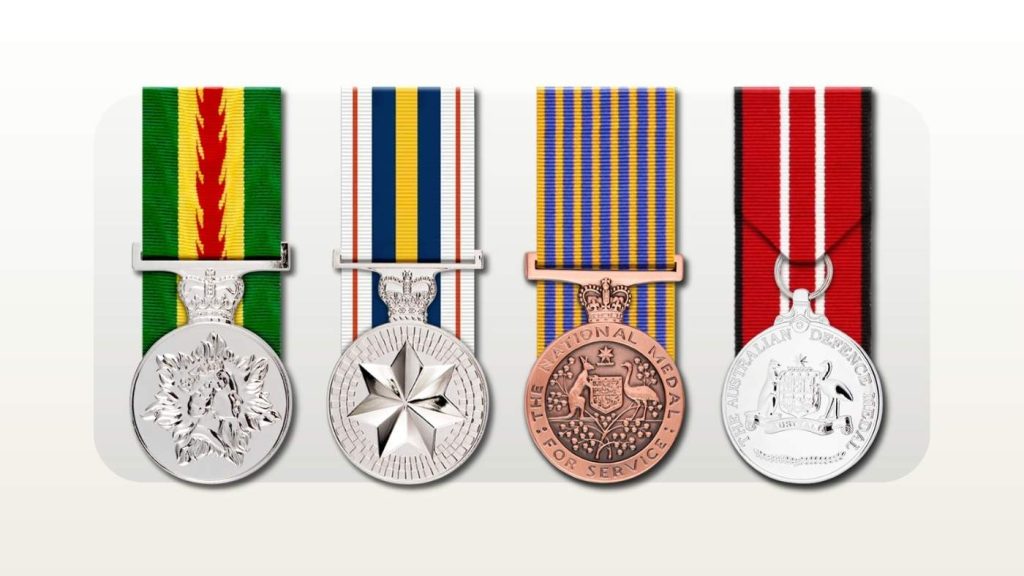
Consider a hypothetical recipient with ADF, police and volunteer fire service experience. Assume their entitlement has already been confirmed for the five medals below. This is a layout example, not a suggestion that everyone with those roles qualifies for these awards.
For a setting in which the four national medals are authorised for wear, their relative order is:[10]
| Position within this example | National award |
|---|---|
| 1. Highest precedence | Australian Fire Service Medal |
| 2. | National Police Service Medal |
| 3. | National Medal |
| 4. | Australian Defence Medal |
The positions above are a subset of the national order, not the complete schedule.[10]
The fifth medal, the Queensland Police Service Medal, stays separate under QPS's right-breast instruction. It does not become position five on that national awards bar.[4]
The four-medal sequence follows the 2025 national schedule. Any additional awards would need to be inserted in their own positions, and the complete set would still need to meet the relevant dress requirements.[10][5]
Check foreign awards and citations separately from the medal list
An overseas police deployment or military posting may introduce another question: whether an award is a national Australian award or a foreign award. Do not classify it solely by where the service took place. Defence publishes specific foreign award wearing guidance, and the national schedule directs ADF personnel to their service for applicable exceptions.[2][10]
Unit citations also need separate attention. The national schedule states that the Unit Citation for Gallantry, Meritorious Unit Citation and Group Bravery Citation are not positioned within its medal sequence. For uniformed personnel, their placement follows service dress rules. Do not turn a citation into an extra medal on the bar.[10]
Give your mounter a brief that distinguishes each group
Before ordering, bring your decisions together in one short brief. Include:
- The intended uniform or civilian occasion, and the medal format required.
- The confirmed award list, with national and separate agency groups clearly identified.
- The exact clasps or devices to include, supported by the recipient's records.
- Any written service advice resolving an unusual combination or wearing restriction.
Mark unanswered questions clearly rather than asking the mounter to infer an entitlement. Ask for clarification before the final layout is approved. Keeping the grouping decision separate from spacing and attachment choices makes the brief easier to follow.
Use Rack Builder to plan presentation after the rules are clear
With Rack Builder, you can choose a service or jurisdiction, add medals and clasps, compare formats and review your arrangement before ordering. For a mixed career, ask the support team which selection suits the intended set if that is not clear. Do not assume the choice automatically resolves every cross-service exception.[12][13]
Use Rack Builder support for builder, format, mounting and product questions. Keep decisions about entitlement and permission to wear awards with the responsible authorities. A commercial preview helps you plan the presentation; it is not an official authorisation to wear an award.[11][12][13]
If you are unsure whether an award has been formally made, issued or approved to wear, read our guide to what awarded, issued and approved to wear mean first.
Explore how Rack Builder works when your award list is confirmed, or contact Rack Builder support before ordering a complicated group. The aim is not to squeeze a whole career onto one bar. It is to present each part of that service in its proper place.[12][13]
Sources
Source pages reviewed 13 October 2026. Numbered citations in the article open the sources below.
- Governor-General: Australian Order of Wearing Honours and Awards Current schedule landing page; 15 October 2025 schedule, gazetted 7 November 2025.
- Department of Defence: Wearing honours and awards Cross-organisation national order and Defence foreign award guidance.
- Governor-General: National Police Service Medal National recognition of ethical and diligent service as a sworn police officer.
- Queensland Police Service: Queensland Police Service Medal Award status and explicit right-breast wearing instruction.
- Australian Army: Uniforms Army Dress Manual scope, including orders of dress, medals and unit citations.
- Department of the Prime Minister and Cabinet: Wearing awards General left-breast convention and ordering of multiple Australian awards.
- Department of the Prime Minister and Cabinet: National Medal Eligible service organisations and chief officer nomination pathway.
- Governor-General: Australian Fire Service Medal Distinguished service; paid and volunteer fire service members.
- Governor-General: National Emergency Medal FAQs (PDF) One clasp per declared emergency; subsequent emergencies use additional clasps.
- Federal Register of Legislation: Australian Order of Wearing 2025 (PDF) Gazette C2025G00607. PDF pages 3 to 4: example order; page 6: foreign awards and citations.
- Department of Defence: Application process Full assessment of entitled Defence awards and related application pathways.
- Rack Builder: How it works Published service selection, medal and clasp entry, format comparison and review workflow.
- Rack Builder: Support Builder, product, mounting and format enquiries.