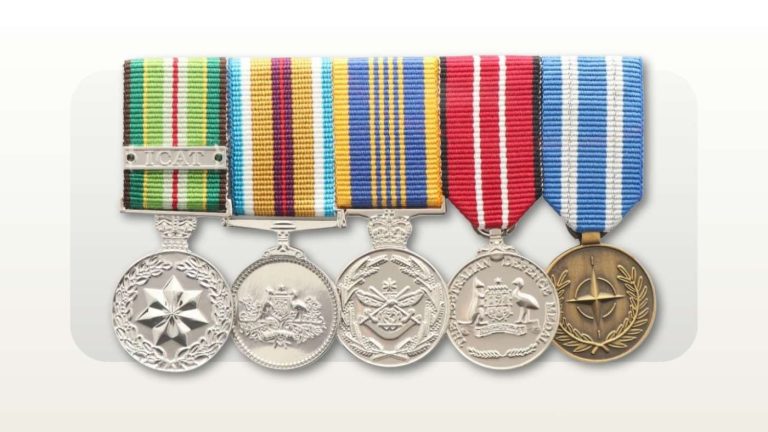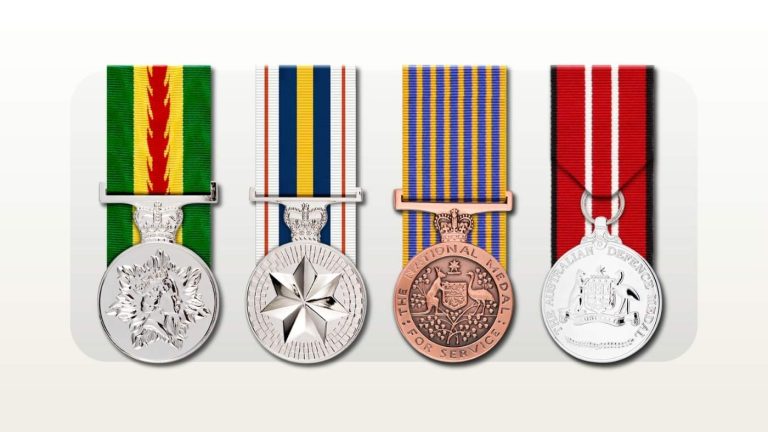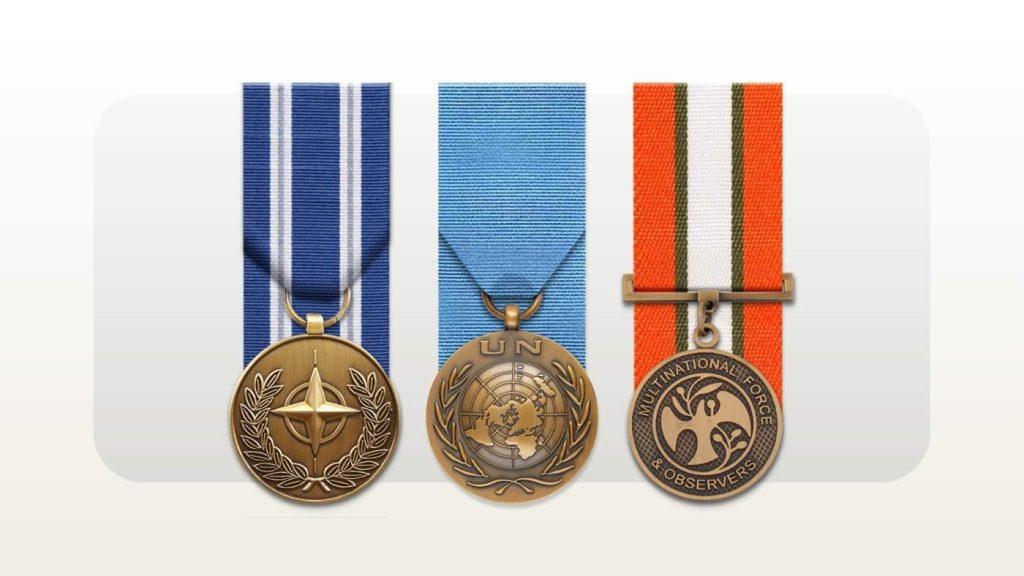
You may know where you served but still be unsure which mission name, ribbon or clasp to select for your medal rack. Start with the exact award, not a broad description such as "peacekeeping medal".
United Nations (UN), North Atlantic Treaty Organization (NATO) and Multinational Force and Observers (MFO) awards appear on Australia's approved foreign award schedule. Their inclusion does not replace an individual's award evidence or the rules for wearing an official uniform.[1][2]
This guide helps Australian Defence Force (ADF) members, veterans and families turn that evidence into a clear mounting brief. It does not determine your entitlement.
Record the organisation, mission and award name separately
Copy the full award name from your certificate or official record. Then note the issuing organisation, mission, service dates and any authorised clasp or numeral. A clasp is an attachment to a ribbon; a numeral is a numbered device. Their meaning depends on the particular award.[4][8]
Keep similar names on separate lines. A country name alone is not enough to identify an award. For example, Australia's Afghanistan Medal is a different award from the NATO Medal with Clasp Afghanistan. Do not substitute one for the other because both refer to Afghanistan.[5][6]
Match a UN ribbon to the mission, not just the medal face
Many UN mission medals look alike. The New Zealand Defence Force's medal reference explains that a standard UN medal is used with different mission ribbons. Some related missions also share a ribbon. The standard medal's reverse carries the words "IN THE SERVICE OF PEACE".[3]
This makes the paperwork important. Matching a bronze medal face or a blue ribbon does not, by itself, identify the recipient's mission. Use the complete mission name and any recorded device when selecting the entry for your rack.
For a family set, photograph the ribbon and any attachments before changing anything. Where the records and physical set do not match, flag the difference for review rather than choosing the closest-looking product. The overseas reference helps explain the design; Australian sources govern Australian wearing arrangements.
Keep NATO ISAF and Afghanistan medals as separate awards
ISAF means International Security Assistance Force. Defence names its award the Non-article 5 NATO Medal for Service on NATO-led ISAF Operations. The later NATO Medal with Clasp Afghanistan relates to Resolute Support, launched on 1 January 2015.[4][5]
There is a specific mounting instruction here: a recipient who has received both NATO medals may wear both once approved. Defence says the ISAF and Afghanistan clasps must not be attached to just one medal.[5]
Record two medal entries when both awards are confirmed. Do not combine them to save space, and do not add either simply because the recipient served somewhere in Afghanistan.
Keep an MFO medal distinct from a UN medal
The MFO is an independent international organisation associated with the peace treaty between Egypt and Israel. It was established as an alternative when the proposed UN peacekeeping force could not be arranged. An MFO medal is therefore not a UN mission medal.[7]
Defence describes the MFO Medal as a single award, with subsequent qualifying service recognised by numerals. If the recipient's record confirms a numeral, record it with that medal instead of adding another MFO medal to the rack.[8]
Do not calculate an extra numeral from a deployment count alone. Ask for confirmation of the device actually awarded, and retain the supporting record with your order notes.
Use Australian precedence and check the Korea exception
Precedence means the order in which awards are worn. Under the Australian schedule, approved foreign awards generally follow the Australian honours and awards. Do not place a UN, NATO or MFO medal beside an Australian campaign medal merely because they relate to the same deployment.[9]
The United Nations Service Medal for Korea is a specific exception: it is worn immediately after the Korea Medal. That placement does not extend to other UN medals.[9]
There is also an important wording difference to check. The national schedule uses the date an award was awarded and expressly allows ADF exceptions. Defence's webpage uses the date of approval to wear. Keep both dates and ask the relevant service to resolve any uncertain sequence. Do not invent a universal "UN, then NATO, then MFO" order.[9][10]
Check the devices for full-size medals and ribbon bars separately
A numeral or clasp is not simply an optional decoration. Defence's ISAF guidance includes conditions for multiple-tour indicators and says the medal and indicators must be approved for wear and recorded on PMKeyS, Defence's personnel management system, before mounting or wear.[4]
That guidance also specifies a small ribbon-bar clasp for eligible personnel deploying from 1 January 2011. Check the instructions relevant to the recipient rather than copying another person's ribbon bar.[4]
Miniatures also need a separate check. Defence says the NATO ISAF and Afghanistan medals were supplied without a miniature, whereas the MFO medal set includes one. Confirm the format and matching devices you need before ordering.[4][5][8]
This example separates medal entries from devices and placement
Imagine a veteran whose documents confirm both NATO awards and an MFO Medal with an authorised numeral 2. Assume the relevant wearing requirements have been met. This is a hypothetical selection checklist, not an entitlement list or an order-of-wear diagram.
| Confirmed item in this example | Instruction for the mounting brief |
|---|---|
| NATO Medal with Clasp ISAF | Keep as its own medal entry.[5] |
| NATO Medal with Clasp Afghanistan | Keep as a second NATO medal, not a second clasp on the ISAF medal.[5] |
| MFO Medal with numeral 2 | Keep one MFO medal with the documented numeral.[8] |
Next, place these entries within the recipient's complete, checked award sequence. The table is not a reason to omit Australian medals, invent service dates or assume the foreign medals belong in the order shown.
Resolve missing award evidence before finalising the rack
For applications to wear foreign service awards on ADF uniforms, Defence requires documentary evidence of the award and asks for award details, service dates and locations. It also requests English translations of certificates and associated documents where needed.[11]
Ask which process applies to an unissued international medal or a missing device. Defence's NATO and MFO pages state that Defence is not the awarding authority for those awards. Australian wearing approval and the original international award are separate matters. A commercial replica does not resolve missing award evidence.[4][5][8]
Give Rack Builder a checked list and flag unresolved details
Your mounting brief should bring together the recipient's exact awards, mission names, authorised devices, required formats and confirmed sequence. Identify any point still awaiting official advice instead of leaving the mounter to guess.
Rack Builder's published process lets you choose a service or jurisdiction, add medals and clasps, compare formats and review the arrangement before ordering. Use that preview to check the presentation against your confirmed list.[12]
If the exact medal or device is unavailable, contact Rack Builder support with the full name and your saved rack or order reference, if available. Do not select a similar-looking substitute just to complete the order.[13]
For the general rules on placing foreign awards after Australian ones, see our guide to arranging Australian and approved foreign awards on one rack.
Explore how Rack Builder works or contact the support team to discuss the mounting. Keep entitlement and official wearing questions with the responsible authority. A clear record gives your service group a sound starting point.[11][12][13]
Sources
Source pages reviewed 13 October 2026. Numbered citations in the article open the sources below.
- Governor-General: Accepting and wearing of foreign awards by Australians Approved schedule displayed as at 1 May 2026; UN, NATO and MFO entries.
- Governor-General: Foreign Award Guidelines, February 2026 (PDF) Gazette C2026G00100, paragraphs 8 and 13: national status and official-duty requirements.
- New Zealand Defence Force: The United Nations Medal Standard medal and mission ribbons only; New Zealand wearing rules are not applied here.
- Department of Defence: NATO Medal with Clasp ISAF Exact award name, multiple-tour indicators, ribbon-bar clasp and Defence record requirements.
- Department of Defence: NATO Medal with Clasp Afghanistan Resolute Support; two separate NATO medals where both have been awarded and approved.
- Department of Defence: Afghanistan Medal Identifies the separate Australian campaign award, not the NATO award.
- Multinational Force and Observers: About us Independent international organisation established as an alternative to the proposed UN force.
- Department of Defence: Multinational Force and Observers Medal One medal, subsequent numerals, included miniature and awarding authority distinction.
- Federal Register of Legislation: Australian Order of Wearing 2025 (PDF) Gazette C2025G00607, schedule note 8 and Annex 1 note 7: sequencing and Korea exception.
- Department of Defence: Wearing honours and awards Published foreign award sequencing uses date of approval to wear; contains exceptions.
- Department of Defence: Application process Foreign award applications: documents, service details and English translations.
- Rack Builder: How it works Published service selection, medal and clasp entry, format comparison and review workflow.
- Rack Builder: Support Product, mounting and missing-medal enquiries; saved rack and order references.