You have found a service record, gathered a few certificates or opened a box of family medals. Now you want to turn that information into a medal rack. Where do you begin?
Start with the evidence, not the layout. The National Archives of Australia explains that service records may mention medals, but may not show every award a person was entitled to or whether it was issued. A service record is a starting point, not necessarily a complete medal list.[1]
This guide shows you how to build a medal rack from a service record by separating what you know from what needs checking. You can then use your checked list to plan the arrangement in Rack Builder.
Step 1: Confirm whose service record you are using
Before selecting any medals, check the recipient's full name, service branch and service number against the documents you have. Note any name changes or different service numbers rather than assuming that similar names belong to the same person.
For historical records, the National Archives recommends searching RecordSearch using the person's surname and service number. Where a file is available online, you can open its digital copy. Some records require a separate copy or access request.[1]
For records held by Defence, follow its personal information request process. Defence provides a My Service Records pathway through ServiceConnect. Requests made for someone else may require consent or evidence of your relationship to them. Check the official requirements before applying.[2]
Keep each recipient's documents in a separate folder. That simple habit helps prevent two relatives' awards from being combined by mistake.
Step 2: Make an award checklist that records the evidence
Before opening the builder, create a simple checklist in a notebook or spreadsheet. Use one line for each medal, and record these four details:
- Award name: copy the full name rather than relying on an abbreviation.
- Clasp or device: record any named bar, rosette or other ribbon device shown in the evidence.
- Source: note the document, page number or official correspondence supporting the entry.
- Status: mark the entry as documented or needing clarification, and write down the next question.
These are suggested research labels, not official award statuses or Rack Builder features. An entry marked 'documented' tells you where the information came from; it does not itself confirm current entitlement.
Treat photographs and family memories as research clues. Record them, but do not turn an uncertain recollection into a confirmed medal selection. You should be able to explain why each award is on your list.
Step 3: Check the medal and its clasps, not just the deployment
A posting or deployment entry is useful evidence, but the award's own rules still need to be checked. Avoid assuming that everyone who visited the same country received the same medal.
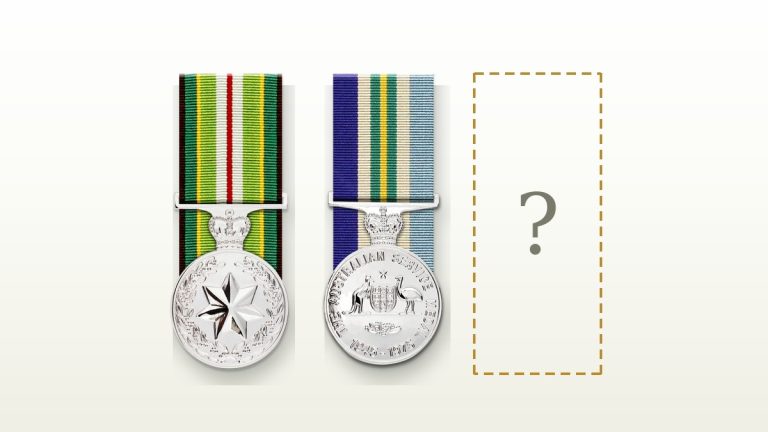
For example, Defence's Australian Service Medal page lists different operations, qualifying dates and service requirements. It also explains that further awards for service in other areas are recognised by additional clasps. That means another qualifying operation may require a clasp on the existing medal, not a second copy of the medal.[3]
The medal pages in our Medal Library, such as the Australian Service Medal, summarise each award's history and clasps alongside links to the official sources.
Check the full award name and the clasp together. Where an abbreviation, date or device is unclear, leave a question in your checklist rather than choosing the closest-looking option.
Keep this distinction in mind: identifying a possible award helps you research it. Confirming entitlement establishes whether it belongs in that person's set.
Step 4: Ask Defence to clarify entitlement before finalising the set
You do not need to solve every unclear entry yourself. Defence allows members, former serving members and families to request a full assessment to obtain a list of entitled awards through its Awards application form.[4]
Prepare the questions first. Identify the award or service period you are asking about and note the evidence you hold. Defence asks applicants to provide as much useful supporting information as possible and to keep the application reference number.[4]
For example, instead of asking 'Which medals should I buy?', ask 'Does this recipient's recorded service qualify for this award or clasp?' That keeps the enquiry focused on entitlement rather than a shopping decision.
A commercial medal order is not a substitute for this assessment. Keep unresolved awards off the final order until the relevant authority has clarified them.
If a medal you expected to see does not appear in the record at all, see our guide on what to do when a service record does not list every medal.
Step 5: Use the official order of wear to arrange confirmed awards
Once you have a checked award list, work out the sequence. The Australian Order of Wearing Honours and Awards sets out where honours and awards belong. The Governor-General's website provides access to the schedule and explains that it is reviewed periodically.[5]
Do not simply arrange the medals by size, sentimental importance or the order in which you found them. Use the official schedule for the awards concerned.
Defence also cautions that commercial medal ribbon posters are visual reference guides, not authorities for wearing awards. Its guidance includes specific provisions for foreign awards and older Imperial awards, so avoid assuming every overseas medal follows the same rule.[6]
For a complex group, keep a copy of the official guidance alongside your checklist. This gives you a clear basis for any layout questions.
Step 6: Use your checked list to plan the rack in Rack Builder
Now move from research to presentation. Rack Builder's published process lets you choose a service or jurisdiction, add medals and clasps, compare formats and review the arrangement before ordering. Options include full-size medals, miniatures and ribbon bars.[7]
Use the full award names from your checklist and check each selection against its source. A common medal group may help you get started, but it should not replace your recipient's own award record.
You can save a rack and return to it with an account. Rack Builder currently states that saved racks expire after 90 days, so keep your research checklist separately rather than treating the saved design as a permanent archive.[7]
For an unfamiliar award, clasp or layout, contact Rack Builder support and include your saved-rack reference when available. Start with the question and relevant award details, rather than sending an entire personal or health file.[8]
A hypothetical example shows what to include and what to hold back
Imagine you are preparing a family member's set. You have official correspondence confirming two medals, a service-record entry mentioning an overseas posting, and a photograph with a ribbon you cannot identify.
Your checklist records the two confirmed medals and their supporting correspondence. The posting and unidentified ribbon remain separate research questions. You do not add a third medal simply to make the preview resemble the photograph.
After the outstanding questions are resolved, update the list, confirm the sequence and review the complete design. This is an illustrative workflow, not an assessment of any person's entitlement.
Check the evidence and order details once more before checkout
Before ordering, compare the final preview with your checklist. Make sure the recipient, award names, clasps, devices, sequence, chosen format and quantities agree. Check any engraving text separately, including names and service numbers.
Rack Builder states that its team reviews the saved rack against the selected jurisdiction and published order-of-wear guidance after checkout, and contacts customers when details need clarification. That review supports the order; it does not replace official confirmation of entitlement.[7][4]
The aim is not to create the fullest rack. It is to create one that accurately represents the recipient's confirmed awards.
Ready to begin? Explore how Rack Builder works, then use your checked award list to start planning your rack. For questions about which Defence awards a person is entitled to, use Defence's official application guidance.
Sources
Source pages reviewed 30 September 2026. Numbered citations in the article open the sources below.
- National Archives of Australia: Researching war service Finding records and the limits of medal information in service files.
- Department of Defence: Personal information requests Service-record access and requirements for requests on another person's behalf.
- Department of Defence: Australian Service Medal Operation-specific criteria and additional clasps rather than duplicate medals.
- Department of Defence: Application process Full entitlement assessments, supporting information and reference numbers.
- Governor-General: Australian Order of Wearing Honours and Awards The official order of wearing and access to its published schedule.
- Department of Defence: Wearing honours and awards Status of commercial ribbon posters and foreign and Imperial award guidance.
- Rack Builder: How it works Published workflow, formats, saved-rack limits and post-checkout review.
- Rack Builder: Support Support enquiries and use of saved-rack references.