
History
The United Nations Transitional Authority in Cambodia, UNTAC, was established in February 1992, taking over from the earlier Advance Mission, to guide Cambodia through its transition to peace and democracy after decades of civil war and the horrors of the Khmer Rouge. Its sweeping mandate covered human rights, the organisation of free elections, civil administration, law and order, the repatriation of refugees and the rehabilitation of the country. It ran until late 1993, and is remembered as one of the most successful peacekeeping operations in United Nations history.
Australia's role was central. The Force Commander of UNTAC was an Australian, Lieutenant General John Sanderson, and Australia provided the Force Communications Unit that gave the whole mission its signals and communications backbone, one of the largest Australian peacekeeping contributions of its time. The medal was awarded for ninety days' service. As a foreign award it takes its place in the Australian Order of Wearing among the United Nations medals.
Design & ribbon
The medal
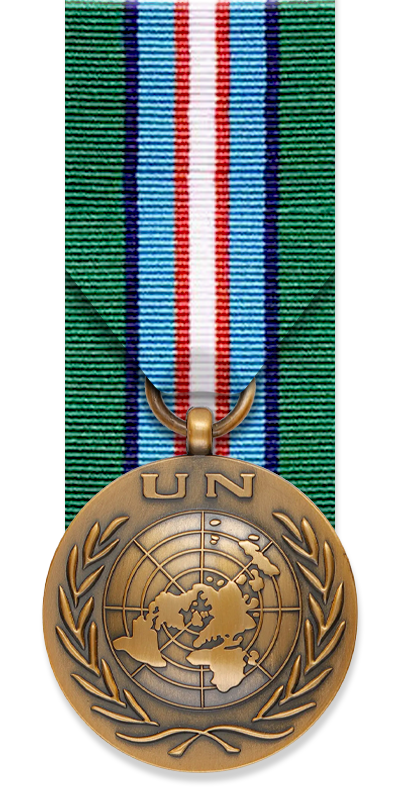
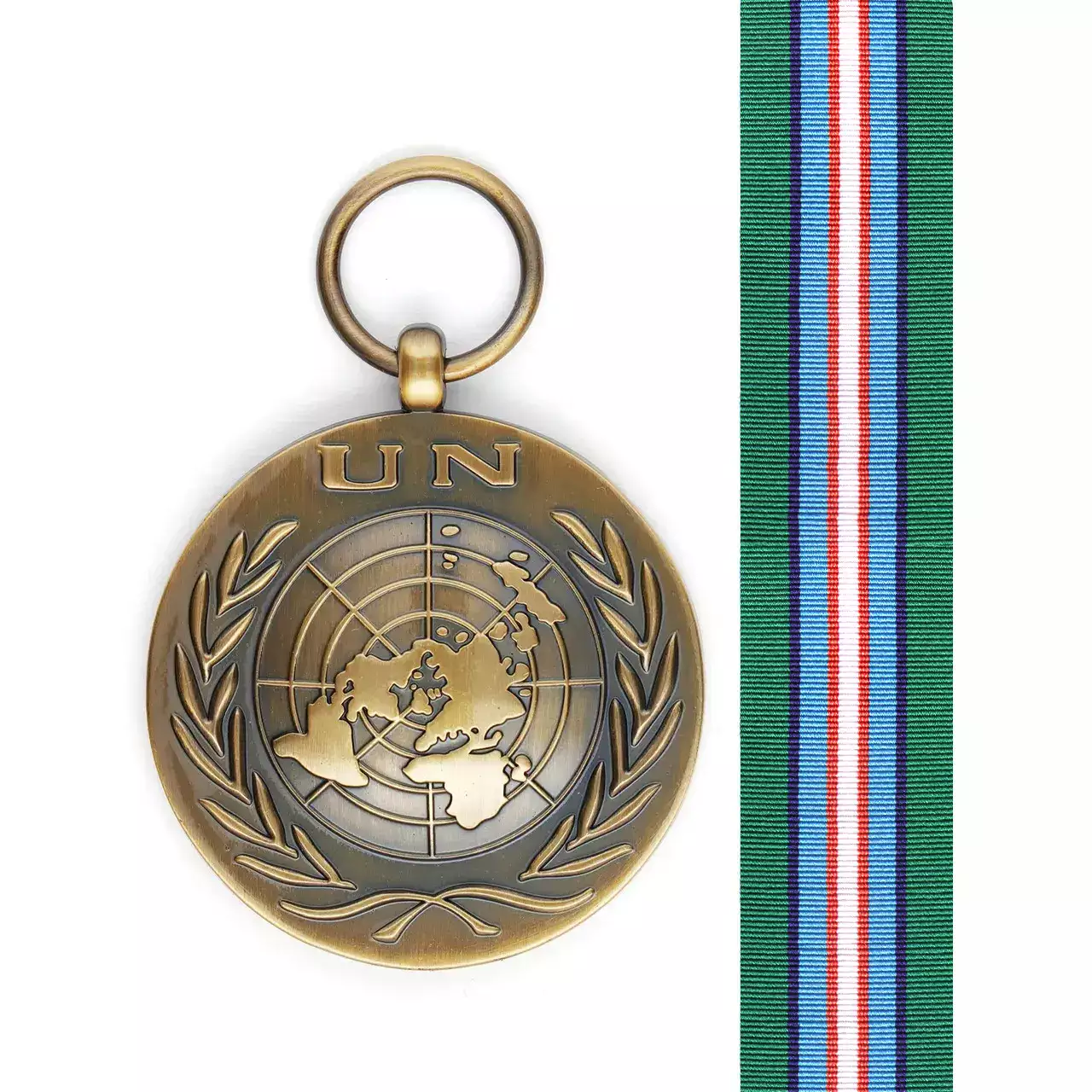
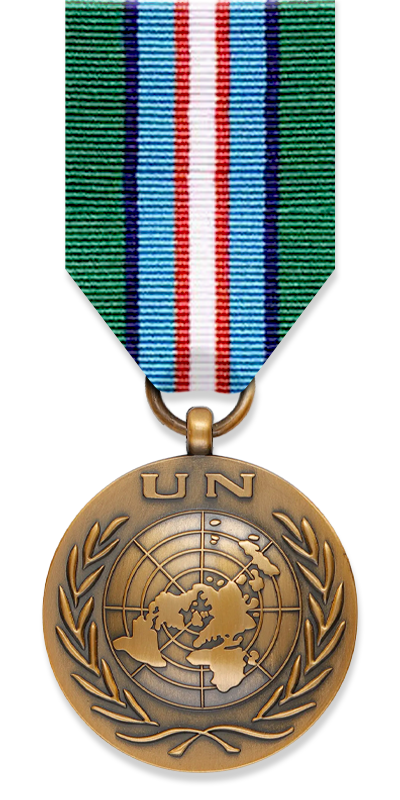
The medal follows the standard United Nations design: a circular bronze medallion 35 millimetres in diameter, the obverse bearing the emblem of the United Nations, a world map seen from the north pole within a wreath of olive branches, surmounted by the letters UN. The reverse carries the words IN THE SERVICE OF PEACE in relief. United Nations medals are issued unnamed, and the mission is identified by the colours of the ribbon.
The ribbon
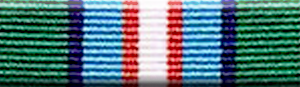
Green with a white centre edged red and blue.
The ribbon is green with a central white stripe edged with red, and with pale United Nations blue and dark blue, the blues representing the United Nations and the Supreme National Council of Cambodia.
Clasps
United Nations Number 1
A silver numeral worn on the ribbon of the medal. United Nations numerals record the number of qualifying periods of service completed with the mission.
United Nations Number 2
A silver numeral recording a second qualifying period of service with the mission.
United Nations Number 3
A silver numeral recording a third qualifying period of service with the mission.
United Nations Number 4
A silver numeral recording a fourth qualifying period of service with the mission.
Eligibility
The medal is awarded for service with the United Nations Transitional Authority in Cambodia.
- Ninety days' service with the mission between 1992 and 1993 qualifies; the Force Commander was Australian and Australia provided the Force Communications Unit;
- A numeral on the ribbon marks a further tour of the same mission;
- As a foreign award it takes its place in the Australian Order of Wearing among the United Nations medals.
Order of wear
United Nations medals are awarded by the United Nations and accepted and worn by Australians who served the mission. In the Australian Order of Wearing they are worn after Australian honours and campaign awards, among the foreign awards, in the sequence set for United Nations service, which generally follows the dates of the missions.
Frequently asked questions
What is the UN Cambodia Medal awarded for?
Service with the United Nations Transitional Authority in Cambodia, UNTAC, which guided Cambodia from civil war to democratic elections between 1992 and 1993.
What was Australia's role?
Central: the Force Commander of UNTAC was the Australian Lieutenant General John Sanderson, and Australia provided the Force Communications Unit, one of its largest peacekeeping contributions of the era.
What do the ribbon colours mean?
Green for Cambodia, a white centre edged with red, and pale and dark blue for the United Nations and the Supreme National Council of Cambodia.
How does it relate to Australian medals?
Australians who served also received the Australian Active Service Medal with the Cambodia clasp; the United Nations medal is worn as a foreign award.
What is the qualifying period?
Ninety days' service with the mission.
Is it named to the recipient?
No; United Nations medals are issued unnamed.