
History
The United Nations Truce Supervision Organization was established in 1948 to supervise the truce in Palestine after the first Arab-Israeli war, and it was the first peacekeeping operation the United Nations ever mounted; the day it began, 29 May, is now the International Day of United Nations Peacekeepers. Its unarmed military observers have watched over the ceasefire lines of the Middle East ever since, the oldest continuing United Nations mission.
For Australia the mission holds a special place: Australian military observers have served with UNTSO from 1956, under the name Operation Paladin, in what has become Australia's longest unbroken peacekeeping commitment. The medal is awarded for six months' service, and the same ribbon has been used for several related observer missions and their bars. As a foreign award it takes its place in the Australian Order of Wearing among the United Nations medals.
Design & ribbon
The medal
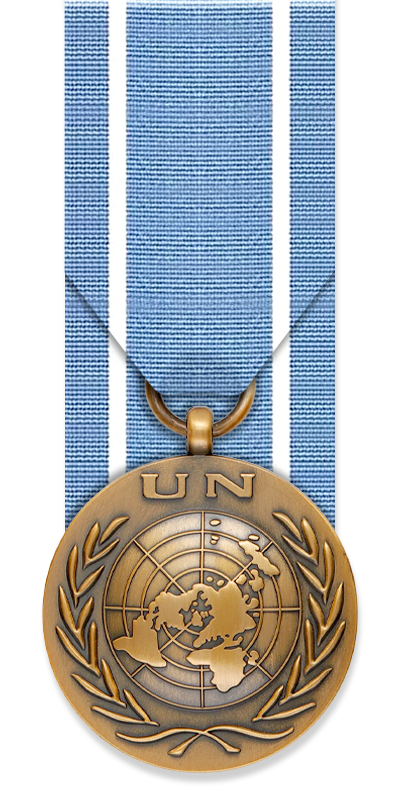
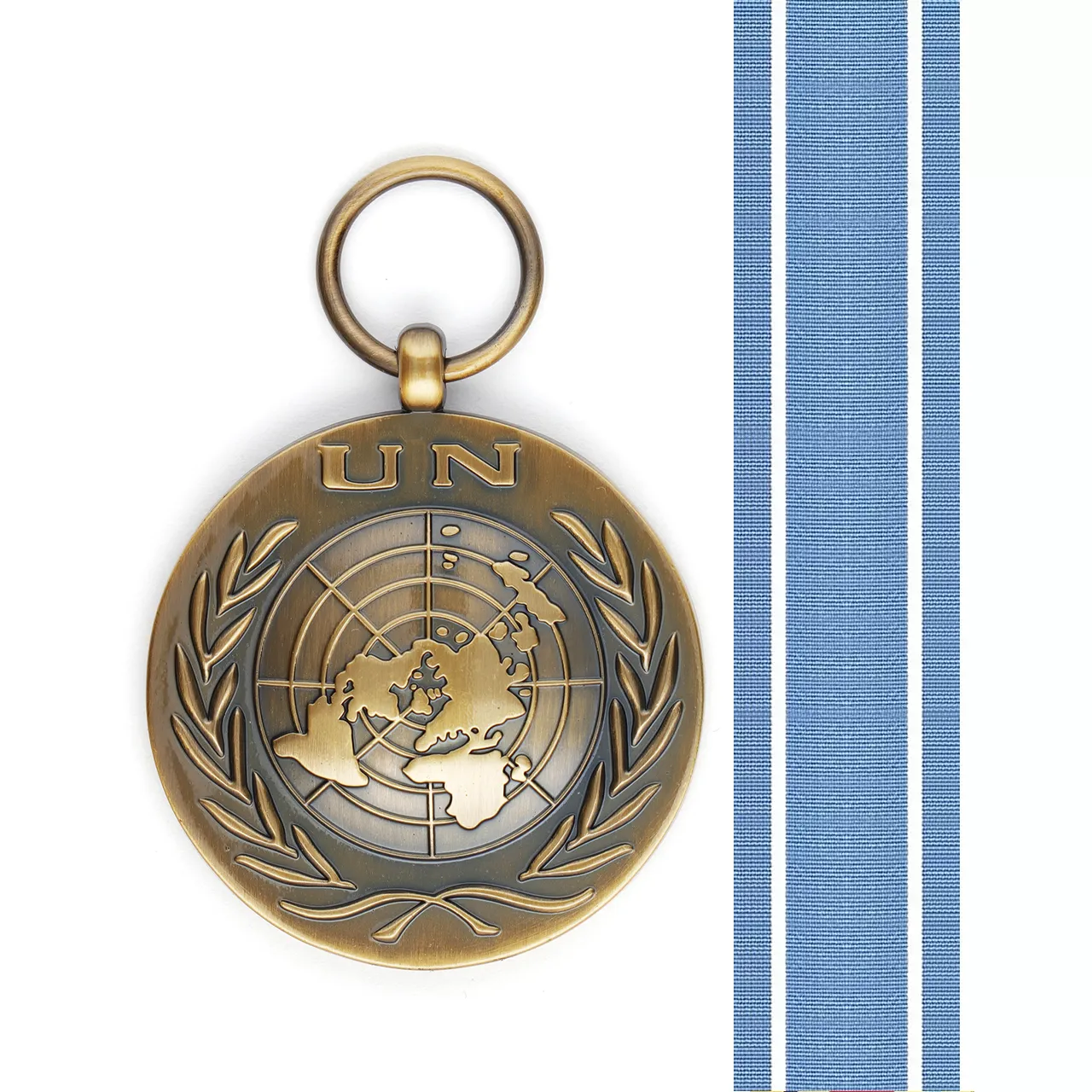
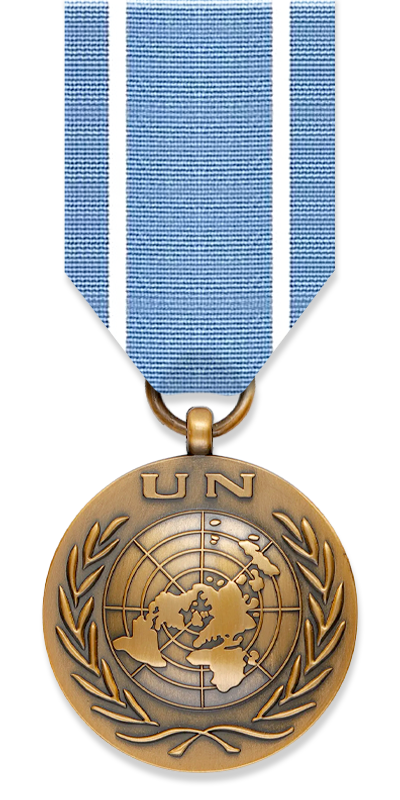
The medal follows the standard United Nations design: a circular bronze medallion 35 millimetres in diameter, the obverse bearing the emblem of the United Nations, a world map seen from the north pole within a wreath of olive branches, surmounted by the letters UN. The reverse carries the words IN THE SERVICE OF PEACE in relief. United Nations medals are issued unnamed, and the mission is identified by the colours of the ribbon.
The ribbon

UN blue with two narrow white stripes.
The ribbon is United Nations blue with two narrow white stripes, the colours of the United Nations.
Clasps
United Nations Number 1
A silver numeral worn on the ribbon of the medal. United Nations numerals record the number of qualifying periods of service completed with the mission.
United Nations Number 2
A silver numeral recording a second qualifying period of service with the mission.
United Nations Number 3
A silver numeral recording a third qualifying period of service with the mission.
United Nations Number 4
A silver numeral recording a fourth qualifying period of service with the mission.
Eligibility
The medal is awarded for service with the United Nations Truce Supervision Organization in the Middle East.
- Six months' service with the mission qualifies; Australian observers have served continuously since 1956 under Operation Paladin;
- The same ribbon has been used for related observer missions, whose service was marked by a bar; further qualifying service may be marked by a numeral;
- As a foreign award it takes its place in the Australian Order of Wearing among the United Nations medals.
Order of wear
United Nations medals are awarded by the United Nations and accepted and worn by Australians who served the mission. In the Australian Order of Wearing they are worn after Australian honours and campaign awards, among the foreign awards, in the sequence set for United Nations service, which generally follows the dates of the missions.
Frequently asked questions
What is the UNTSO Medal awarded for?
Service with the United Nations Truce Supervision Organization, the observer mission in the Middle East established in 1948, the first United Nations peacekeeping operation.
Why is the mission significant?
It was the first peacekeeping mission the United Nations ever mounted and remains the oldest continuing one; the date it began is now the International Day of United Nations Peacekeepers.
What is its Australian connection?
Australian military observers have served with UNTSO from 1956 under Operation Paladin, Australia's longest unbroken peacekeeping commitment.
What is the qualifying period?
Six months' service with the mission.
What does the ribbon look like?
United Nations blue with two narrow white stripes, the colours of the United Nations.
Is it named to the recipient?
No; United Nations medals are issued unnamed.