
History
After the coalition drove Iraqi forces from Kuwait in early 1991, King Fahd of Saudi Arabia instituted the Medal for the Liberation of Kuwait for the forces that fought the campaign. Australians earned it in the ships of the Royal Australian Navy task group enforcing the blockade and screening the fleet, and in the other Australian elements serving in the prescribed operational area of the Persian Gulf during the liberation itself, from 17 January to 28 February 1991.
In 1998 the Kingdom formally offered the medal to the Australian Government, which accepted it, and it stands as the only foreign award officially approved for wear for the conflict. It is worn after all Australian medals with the other approved international awards, in order of the date of award. The separate Kuwaiti liberation medal of 1995, offered later, could not be accepted under Australian policy and remains an unofficial keepsake.
Design & ribbon
The medal
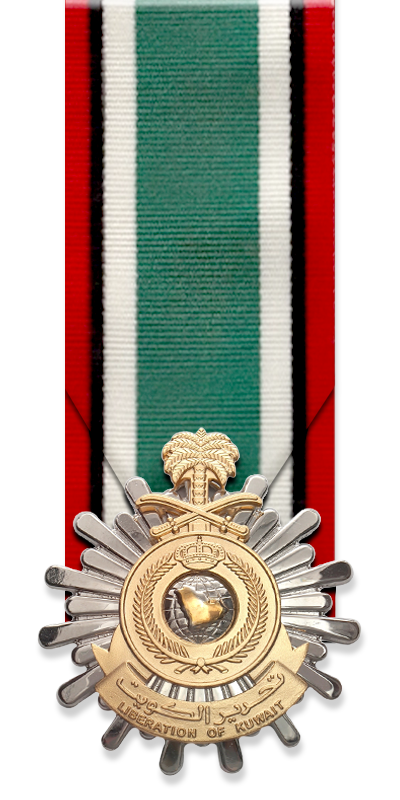
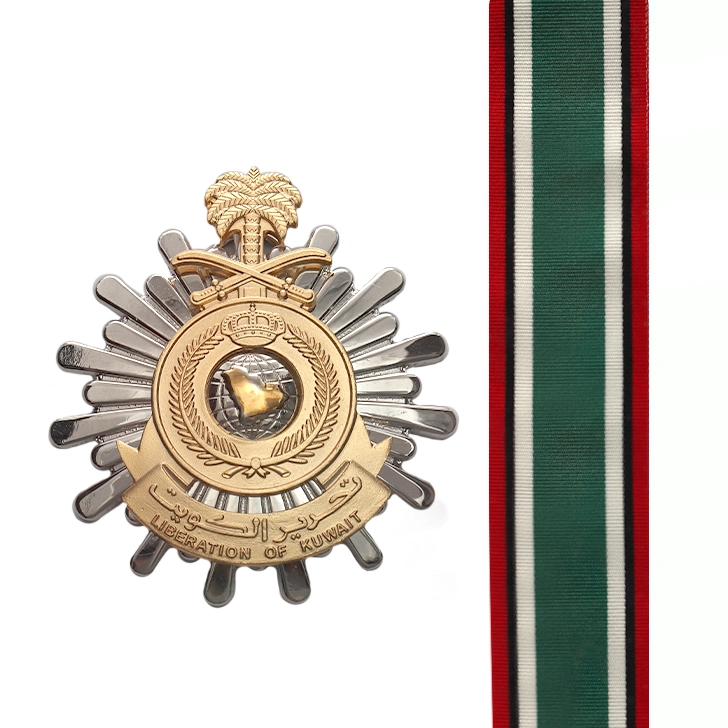
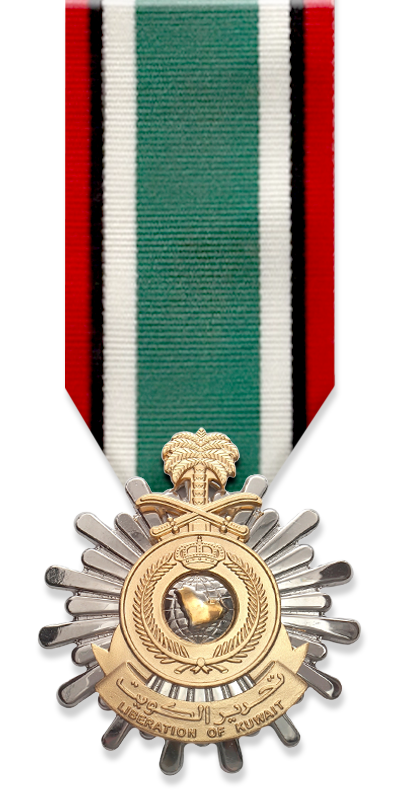
The medal is a stylised silver sunburst, the light of freedom, bearing at its centre a globe depicting the Arabian Peninsula, the theatre of operations, encircled by a gold wreath of palm for victory. Above the wreath sit the crossed sabres and palm tree of the Kingdom of Saudi Arabia, and beneath it a scroll carries LIBERATION OF KUWAIT in English below the same words in Arabic. The reverse is plain.
The ribbon
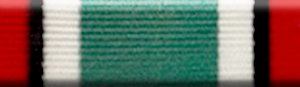
The colours of Kuwait's flag: green, white, black and red.
The ribbon has a central broad band of green flanked by white stripes, narrow black stripes and red edges: green, white, red and black, the colours of the flag of Kuwait.
Eligibility
The medal was awarded to members of the coalition forces who participated in Operation Desert Storm and the liberation of Kuwait, and was accepted by the Australian Government in 1998 for award to eligible ADF members.
- For Australians, the qualifying service is service in the prescribed operational area of the Persian Gulf between 17 January and 28 February 1991; other nations, including the United States, applied broader windows;
- It is the only foreign award officially approved for wear for this conflict, worn after all Australian medals with other international awards in order of the date of award;
- Applications for approval to accept and wear are made through Defence with a certified copy of the award certificate. There is no post-nominal.
Order of wear
Foreign and international awards approved for acceptance and wearing are worn after all Australian honours and awards, in order of the date of award. The precise arrangement should be confirmed against the current Australian Order of Wear.
Frequently asked questions
What is the Saudi Arabian Medal for the Liberation of Kuwait awarded for?
Coalition service in Operation Desert Storm and the liberation of Kuwait. For Australians, service in the prescribed operational area of the Persian Gulf between 17 January and 28 February 1991.
Can Australians wear it?
Yes. Saudi Arabia formally offered the medal to Australia in 1998 and the government accepted it, making it the only foreign award officially approved for wear for the conflict.
Where does it sit on a rack?
After all Australian medals, with the other approved foreign and international awards, in order of the date of award.
What about the Kuwaiti liberation medal?
Kuwait's own 1995 medal could not be accepted under the policy of one foreign award per conflict. It is unofficial for Australians: a keepsake that may be worn on civilian clothes on commemorative occasions, but never on uniform or among official awards.
What Australian awards cover the same service?
The Australian Active Service Medal with the Kuwait clasp recognises the warlike phase of the Gulf deployment within the Australian system.
Does it carry a post-nominal?
No.