
History
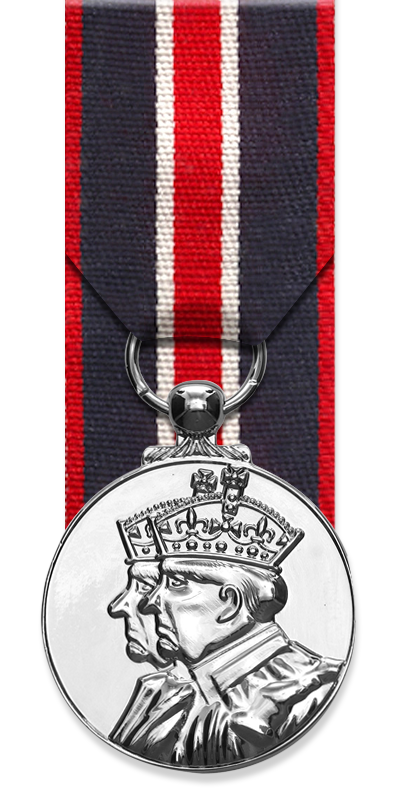
The King Charles III Coronation Medal was created to mark the coronation of King Charles III and Queen Camilla on 6 May 2023, the first British coronation medal in seventy years. In the United Kingdom more than 400,000 were awarded, to those who contributed to the coronation events, to serving members of the armed forces, frontline emergency services and prison staff with five years' service, to members of the Royal Household, and to living holders of the Victoria Cross and George Cross.
For Australians the medal is much rarer and its award unusual: the British medal was conferred on only a small number of Australians as a personal gift of the King, a decision of Buckingham Palace rather than the Australian Government, in keeping with the practice for all coronation and jubilee medals awarded to Australians. Those Australian recipients were living holders of the highest decorations. As an Imperial award of the current reign it takes its place in the Australian Order of Wearing among the coronation and jubilee medals.
Design & ribbon
The medal
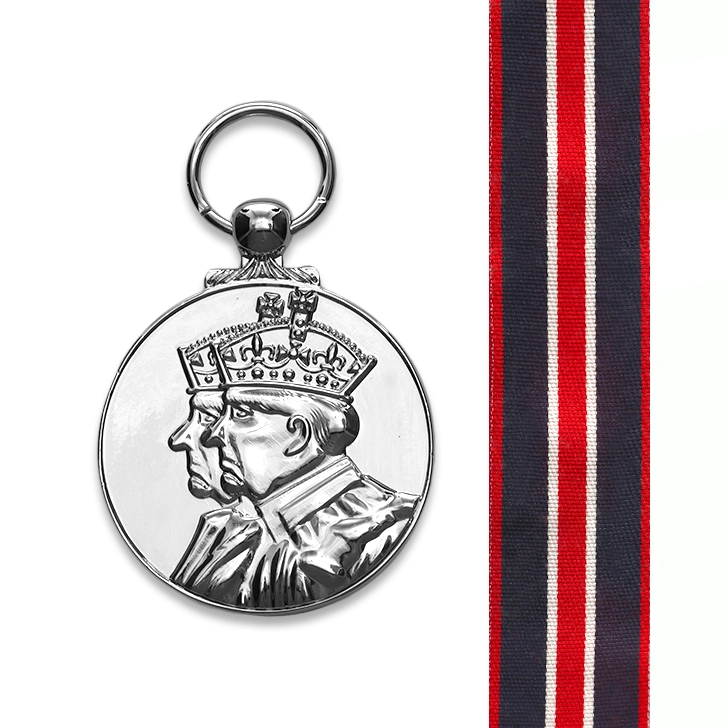
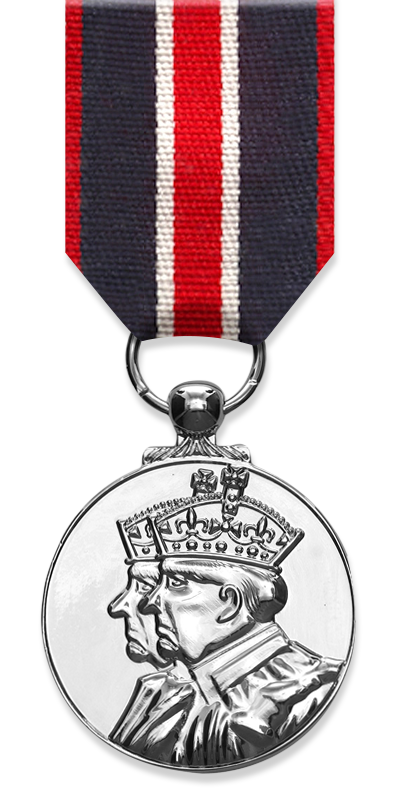
The medal is nickel silver, 32 millimetres in diameter, its obverse bearing the conjoined left-facing effigies of King Charles III and Queen Camilla by Martin Jennings. The reverse shows the royal cypher CIIIR surmounted by the Tudor Crown within a laurel wreath, with the coronation date 6 May 2023. It is suspended by a ring.
The ribbon
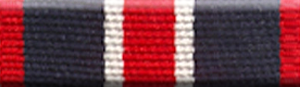
Union Flag colours, echoing the 1902 coronation ribbon.
The ribbon has a central red stripe edged in white on a dark blue field, with red edge stripes, the red, white and blue of the Union Flag, its design inspired by the ribbon of the 1902 King Edward VII Coronation Medal.
Eligibility
The medal marks the coronation of King Charles III on 6 May 2023.
- In the United Kingdom it was awarded to contributors to the coronation, to armed forces, emergency services and prison staff with five years' service, to the Royal Household, and to living holders of the Victoria Cross and George Cross;
- For Australians it was conferred on a small number of high-level decoration holders as a personal gift of the King, an act of Buckingham Palace rather than the Australian Government;
- It was awarded unnamed and carries no clasps. As an Imperial award of the current reign it takes its place in the Australian Order of Wearing.
Order of wear
Coronation and jubilee medals commemorate a royal occasion rather than service or gallantry. In the Australian Order of Wearing they are worn after campaign medals and before long service awards, and among themselves in the date order of the occasions they mark.
Frequently asked questions
What is the King Charles III Coronation Medal?
A commemorative medal created to mark the coronation of King Charles III and Queen Camilla on 6 May 2023, the first British coronation medal in seventy years.
Who received it in the United Kingdom?
More than 400,000 people: contributors to the coronation, armed forces, emergency and prison staff with five years' service, the Royal Household, and living holders of the Victoria Cross and George Cross.
How many Australians received it?
Only a small number, as a personal gift of the King to living holders of the highest decorations; it was an act of Buckingham Palace, not an Australian Government award.
What does its ribbon recall?
The ribbon uses the Union Flag colours and its design is inspired by that of the 1902 King Edward VII Coronation Medal.
Is it named to the recipient?
No; it was awarded unnamed.
Does it carry a post-nominal?
No; commemorative medals carry no post-nominal.