
History
The Australian Operational Service Medal was established on 22 May 2012 by Letters Patent and the Australian Operational Service Medal Regulations 2012, replacing the Australian Active Service Medal and the Australian Service Medal for future operations. The Greater Middle East Operation instrument was made in 2014, recognising service on Operations Manitou, Accordion and Okra from 1 July 2014, with Operation Highroad added from 1 January 2015.
The declaration has grown with the commitment. Amendments extended eligibility to allied foreign defence force members and to Defence members on third country deployments, and the minimum period of service was reduced for the Afghanistan non-combatant evacuation operation, recognising the personnel who assisted the emergency evacuations from Afghanistan. From 1 November 2023 the long running Middle East commitments previously recognised by the Australian Service Medal with clasps Middle East and Sinai, Operations Paladin and Mazurka, transitioned to this medal.
Design & ribbon
The medal
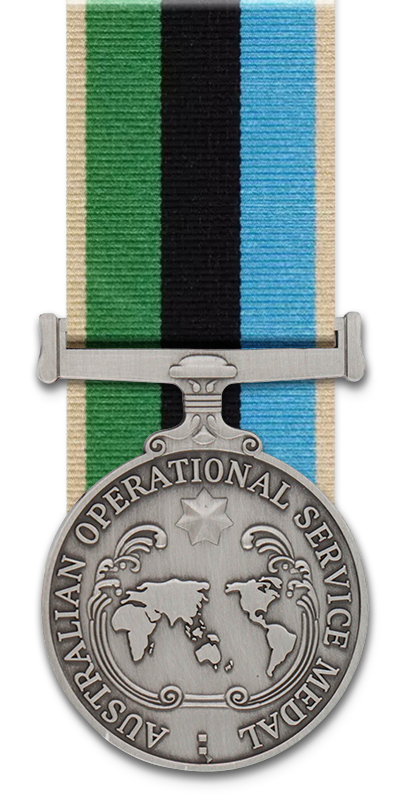
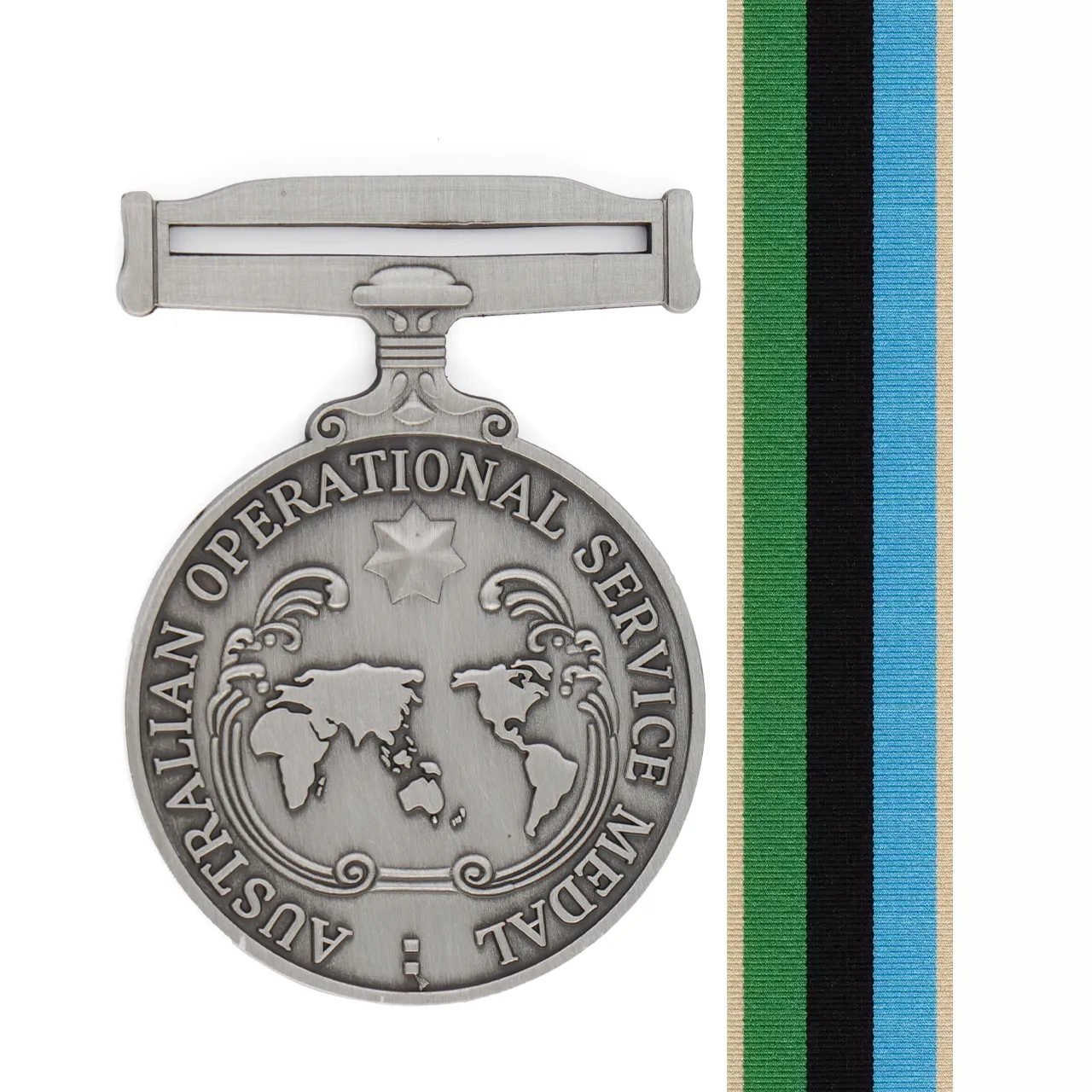
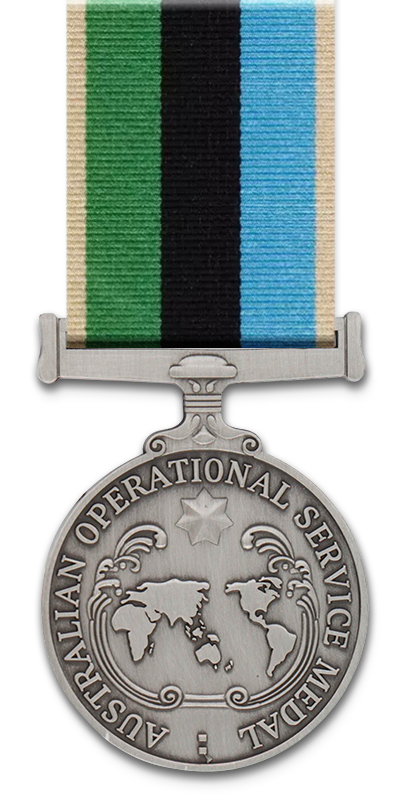
The Australian Operational Service Medal is a cupro-nickel medal finished in antique silver. The obverse bears an old-world stylised world globe signifying global operations, interlinked with a Federation Star, the globe surrounded by the words AUSTRALIAN OPERATIONAL SERVICE MEDAL. The reverse bears a central horizontal stylised scroll with the words Defending Australia and its national interests, overlaying a wreath of mimosa, above which sits an hourglass motif signifying the ongoing vigilance and timely response of Defence.
The ribbon
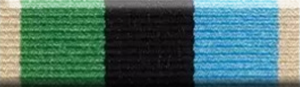
Bone for sand, green for Australia and hope, black for the anti-piracy role, blue for the maritime and air aspects.
The ribbon colours were chosen to represent specific aspects of the Greater Middle East Operation. Bone represents sand, green represents Australia and hope, black represents the anti-piracy role, and blue represents the maritime and air aspects of the operation.
Clasps
Multiple Tour Indicator 2
An accumulated service device worn as a numeral on the ribbon, awarded on completion of a second qualifying deployment.
Multiple Tour Indicator 3
An accumulated service device worn as a numeral on the ribbon, awarded on completion of a third qualifying deployment.
Multiple Tour Indicator 4
An accumulated service device worn as a numeral on the ribbon, awarded on completion of a fourth qualifying deployment.
Eligibility
The medal is awarded by the Governor-General on the recommendation of the Chief of the Defence Force or a delegate, for thirty days of continuous or aggregated service on a declared operation in the greater Middle East region.
- Declared operations include Manitou, Accordion and Okra from 1 July 2014, and Highroad from 1 January 2015;
- The minimum period of service was reduced for the Afghanistan non-combatant evacuation operation only; eligibility for other declared operations remains at thirty days;
- A member is not eligible for service during the same period for which they received another Operational Service Medal or the Australian Service Medal;
- A second or subsequent qualifying period on the operation is recognised by an accumulated service device.
Order of wear
The Operational Service Medals are worn among the Australian campaign and operational awards, after the Australian Service Medal. Where a person holds more than one Operational Service Medal, they are worn in order of date of qualifying service. The precise neighbours should be confirmed against the current Australian Order of Wear.
Frequently asked questions
Which operations does the medal cover?
Operations Manitou, Accordion and Okra from 1 July 2014, and Operation Highroad from 1 January 2015. From 1 November 2023 it also recognises service on Operations Paladin and Mazurka, which previously earned the Australian Service Medal with clasps Middle East and Sinai.
How does it relate to the Afghanistan and Iraq Medals?
Those medals, together with the Active Service Medal clasp ICAT, cover the earlier phases of the same commitments. From mid 2014 the Operational Service Medal took over recognition of new service in the region.
Was there special provision for the Kabul evacuation?
Yes. The minimum period of service was reduced for the Afghanistan non-combatant evacuation operation of August 2021, recognising the significant contribution of ADF personnel and public service civilians to the emergency evacuations. Eligibility for all other declared operations remains at thirty days.
Can allied or civilian personnel receive it?
Amendments to the instrument allow allied foreign defence force members to be eligible, and for issue to Defence members on third country deployments. Eligible Defence civilians receive the Operational Service Medal on the civilian ribbon with a clasp for the operation.
What happens on a second deployment?
A second or subsequent qualifying period on the operation is recognised by an accumulated service device worn on the medal.
Can I receive this medal and the Service Medal for the same service?
No. A member is not eligible for the same period of service for which they received another Operational Service Medal or the Australian Service Medal, and transitional provisions apply where Operation Paladin or Mazurka service spans the 2023 changeover.