
History
The Afghanistan Medal was instituted in 2004, announced by the Prime Minister on Anzac Day that year alongside the Iraq Medal. It recognises the service of Australian Defence Force personnel in military operations in Afghanistan and other prescribed areas on or after 11 October 2001.
The medal covers service within Operation Slipper, the Australian contribution to the International Coalition Against Terrorism, and the related Operations Palate and Palate II supporting the United Nations mission in Afghanistan. It marks the beginning of what became Australia's longest continuous military commitment.
Design & ribbon
The medal
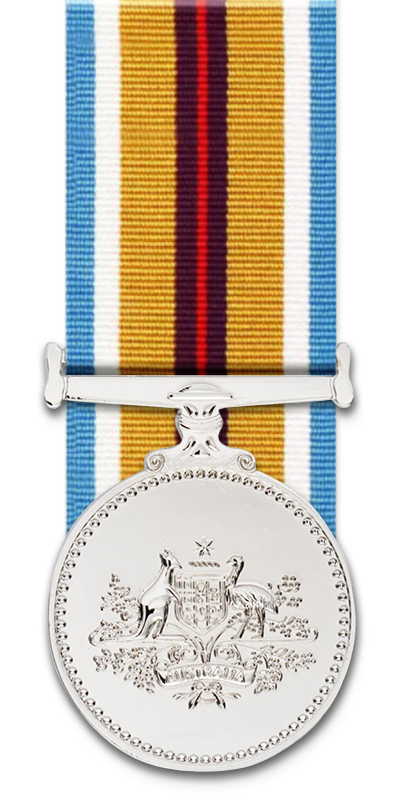
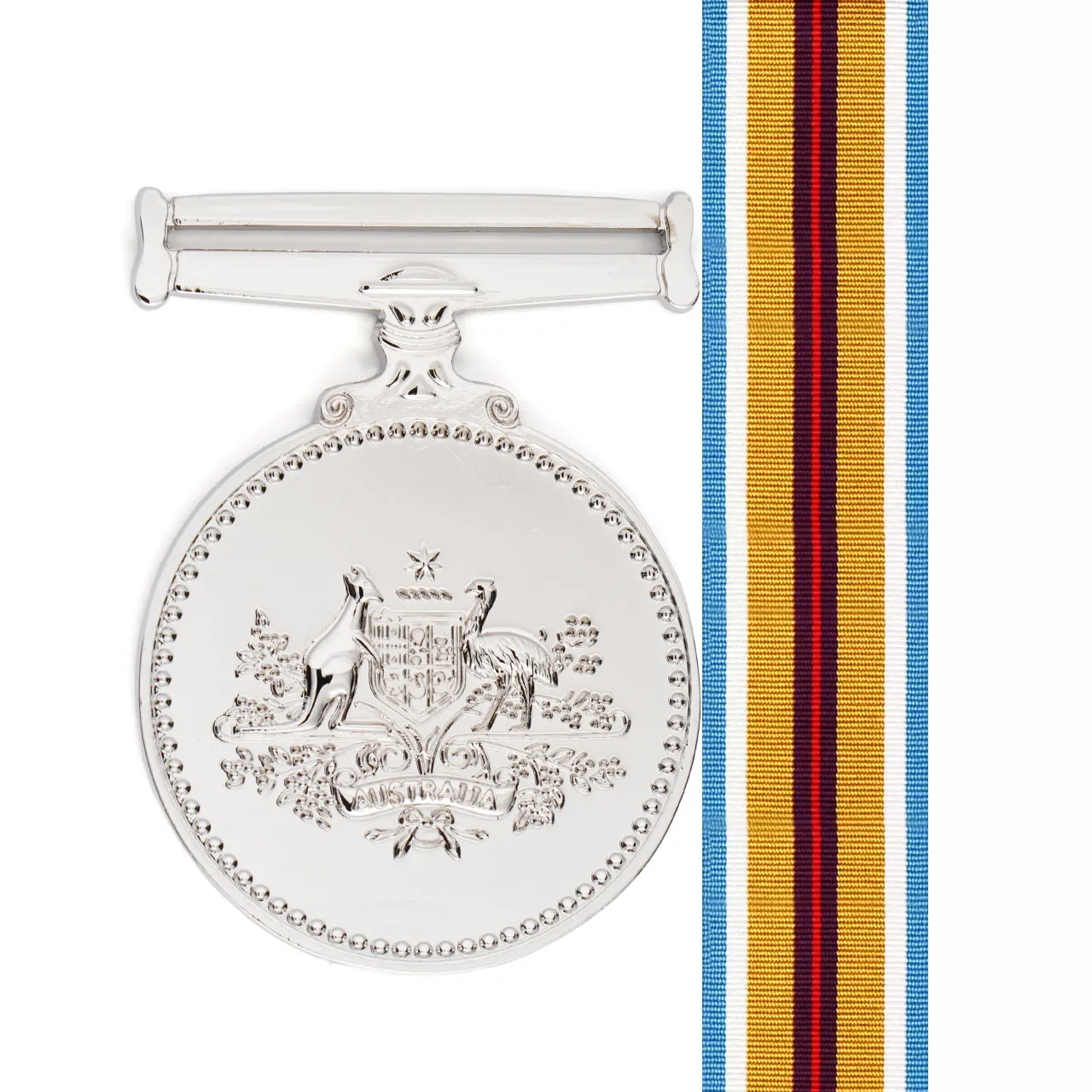
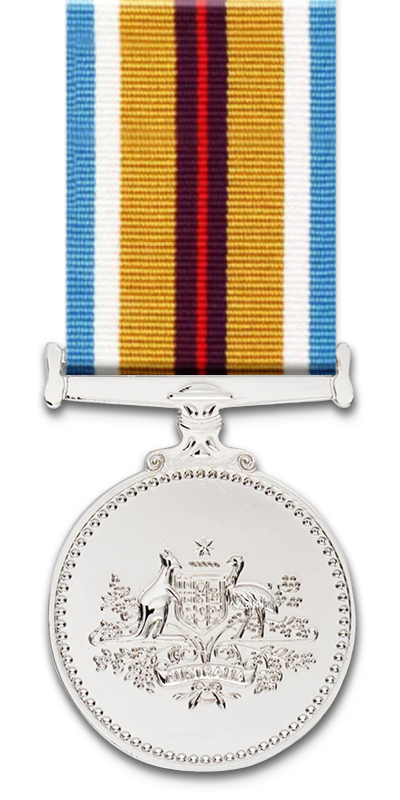
The Afghanistan Medal is a cupro-nickel circular medal. The obverse features the Commonwealth Coat of Arms. The reverse shows a snow-capped mountain range with a multi-rayed sun rising behind it. The word AFGHANISTAN is inscribed in English and in the Arabic script of Dari and Pashto.
The ribbon
Khaki for the terrain, blue and white for sky and snow, and central purple and red for the ADF and the conflict.
The ribbon is khaki, representing the dominant ground colour of the terrain, edged with light blue and white stripes for the sky above the mountains and the snow on the peaks. Central stripes of purple and red represent the Australian Defence Force and the conflict in Afghanistan.
Eligibility
The medal is awarded by the Governor-General on the recommendation of the Chief of the Defence Force. The basic requirement is thirty days of service, or thirty sorties, in the prescribed area on or after 11 October 2001.
- Qualifying service is within Operation Slipper and Operations Palate and Palate II;
- The medal may be awarded posthumously to the next of kin of a member who dies while deployed;
- The exact areas and periods are set out in the Letters Patent and Determination.
Order of wear
The medal is worn among the Australian campaign and operational awards. The precise neighbours should be confirmed against the current Australian Order of Wear.
Frequently asked questions
When was the Afghanistan Medal established?
It was instituted in 2004 and announced by the Prime Minister on Anzac Day that year. It recognises qualifying service on or after 11 October 2001.
What service does it recognise?
Service by Australian Defence Force personnel in Afghanistan and prescribed areas within Operation Slipper and Operations Palate and Palate II.
How much service is needed?
Thirty days of service, or thirty sorties, in the prescribed area.
Is it the same as the Active Service Medal clasp?
They recognise related service. ADF members are also recognised by the Australian Active Service Medal with clasp ICAT and the NATO Non-Article 5 Medal with clasp ISAF.
Can it be awarded posthumously?
Yes, it may be awarded to the next of kin of a member who dies while deployed on the qualifying operations.
Does it have a post-nominal?
No.