
History
The United Nations Advance Mission in Cambodia, UNAMIC, was established in October 1991 to help the Cambodian factions keep the ceasefire, to link their military headquarters, and to begin mine-awareness and mine-clearance training. It paved the way for the larger Transitional Authority, and its mandate ended in March 1992 when that mission took over.
Australia contributed a Force Communications Unit of sixty five personnel, among the first United Nations troops in Cambodia, who built the communications network between the factions and the mission headquarters. Their service was recognised by Australia with the Australian Service Medal, later upgraded to the Australian Active Service Medal; those who served ninety days also qualified for this United Nations medal. As a foreign award it takes its place among the United Nations medals in the Australian Order of Wearing.
Design & ribbon
The medal
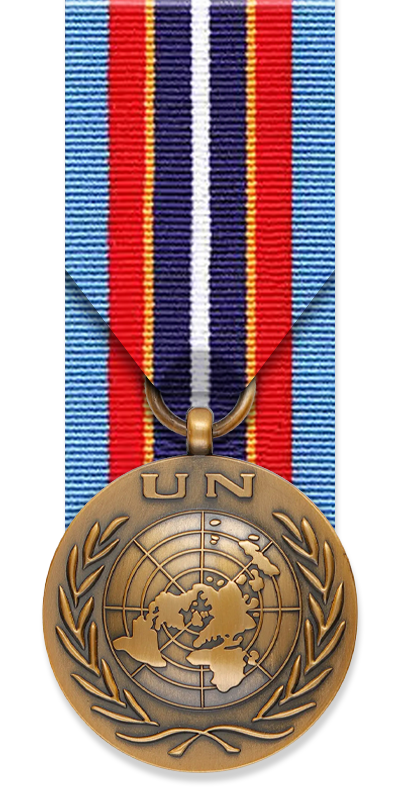
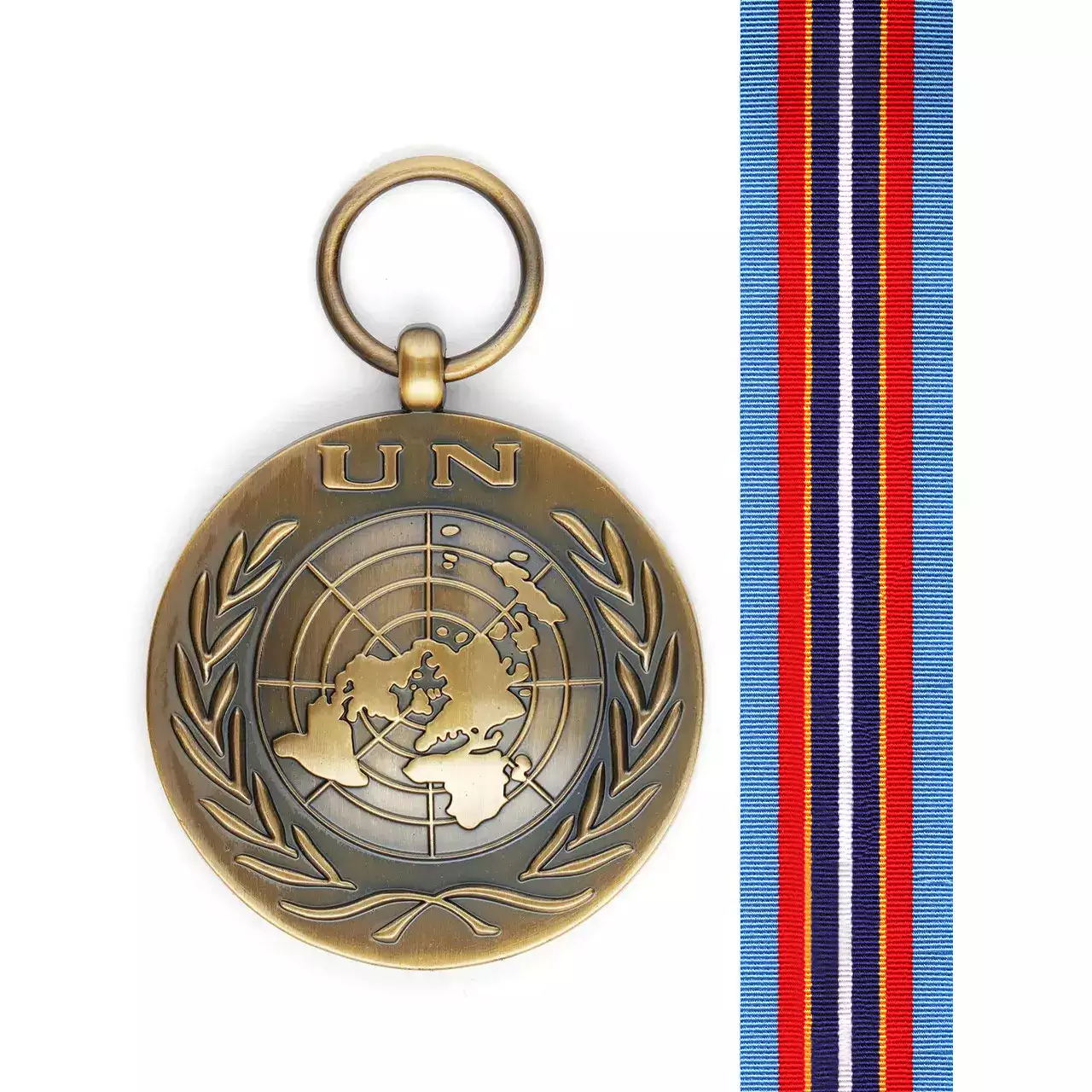
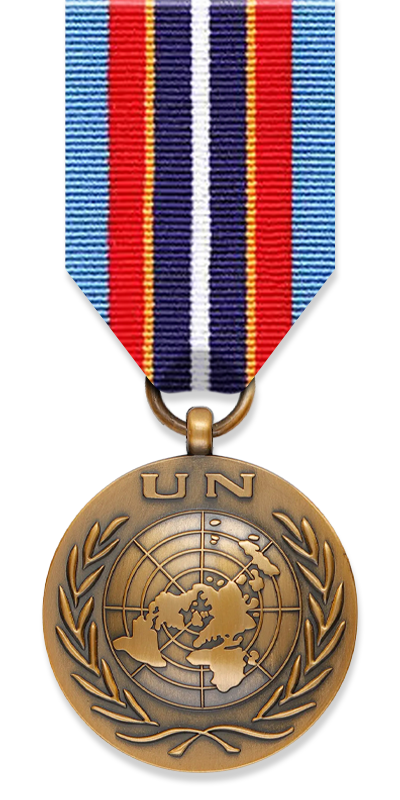
The medal follows the standard United Nations design: a circular bronze medallion 35 millimetres in diameter, the obverse bearing the emblem of the United Nations, a world map seen from the north pole within a wreath of olive branches, surmounted by the letters UN. The reverse carries the words IN THE SERVICE OF PEACE in relief. United Nations medals are issued unnamed, and the mission is identified by the colours of the ribbon.
The ribbon
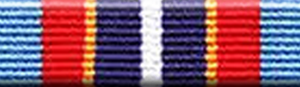
UN blue edges with a white centre flanked by blue, gold and red.
The ribbon has a white central stripe flanked by dark blue, gold and red stripes, the colours of the Cambodian factions, bordered on each side by a band of United Nations blue.
Clasps
The United Nations marks additional qualifying service with a numeral worn on the ribbon rather than a lettered bar.
United Nations Number 1 Medal Clasp
A numeral 1 worn on the ribbon to mark the completion of one additional qualifying period of service beyond the first award.
United Nations Number 2 Medal Clasp
A numeral 2 worn on the ribbon to mark the completion of two additional qualifying periods of service.
United Nations Number 3 Medal Clasp
A numeral 3 worn on the ribbon to mark the completion of three additional qualifying periods of service.
United Nations Number 4 Medal Clasp
A numeral 4 worn on the ribbon to mark the completion of four additional qualifying periods of service.
Eligibility
The medal is awarded for service with the United Nations Advance Mission in Cambodia.
- Ninety days' consecutive service between 1 October 1991 and 15 March 1992 qualifies;
- Australia contributed a Force Communications Unit whose members were among the first peacekeepers in Cambodia;
- Additional qualifying service is marked by a numeral on the ribbon;
- As a foreign award it takes its place among the United Nations medals in the Australian Order of Wearing.
Order of wear
United Nations medals are awarded by the United Nations and accepted and worn by Australians who served the mission. In the Australian Order of Wearing they are worn after Australian honours and campaign awards, among the foreign awards, in the sequence set for United Nations service, which generally follows the dates of the missions.
Frequently asked questions
What is the UNAMIC Medal awarded for?
Service with the United Nations Advance Mission in Cambodia, established in 1991 to help keep the ceasefire and begin mine clearance, ahead of the Transitional Authority.
What was Australia's role?
Australia provided a Force Communications Unit of sixty five personnel who were among the first United Nations troops in Cambodia.
How is it different from the UNTAC medal?
UNAMIC was the advance mission of 1991 to 1992; UNTAC was the larger Transitional Authority that took over from it in 1992, with its own medal.
What did Australians receive for this service?
Australia recognised the service with the Australian Service Medal, later upgraded to the Australian Active Service Medal; ninety days' service also qualified for this United Nations medal.
What are the ribbon colours?
A white centre flanked by dark blue, gold and red for the Cambodian factions, bordered by bands of United Nations blue.
Is it named to the recipient?
No; United Nations medals are issued unnamed.