
History
The National Emergency Medal was instituted in October 2011 to recognise those who rendered service in response to nationally significant emergencies within Australia. It was created in the aftermath of a period of major disasters, where large numbers of emergency workers, volunteers and Defence personnel responded to events whose scale was beyond ordinary experience, and where the existing awards did not capture that service.
An event does not qualify automatically. It becomes eligible only when it is formally declared a nationally significant emergency. That decision rests on the advice of the National Emergency Medal Committee, an independent body of five members that advises the responsible Minister on whether an event should be declared. In forming its advice the Committee weighs the impact on the population, the number of casualties, the displacement of people, and the destruction of or disruption to critical infrastructure.
Design & ribbon
The medal
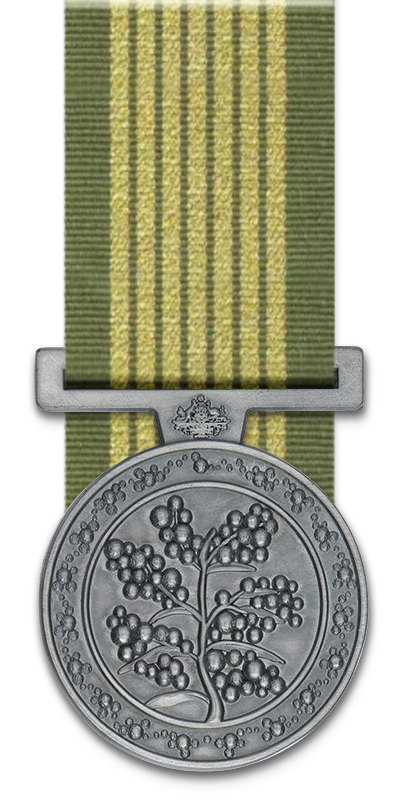
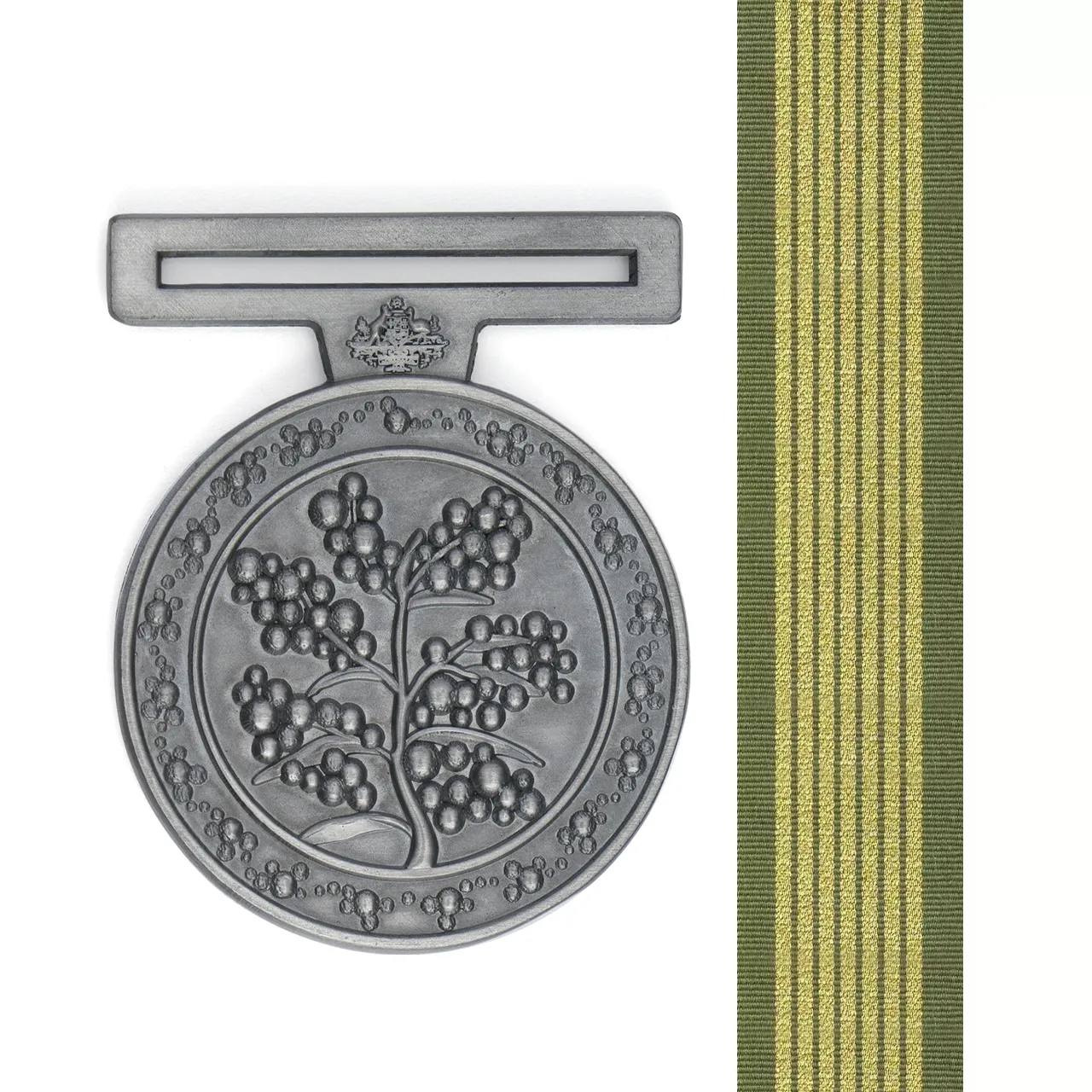
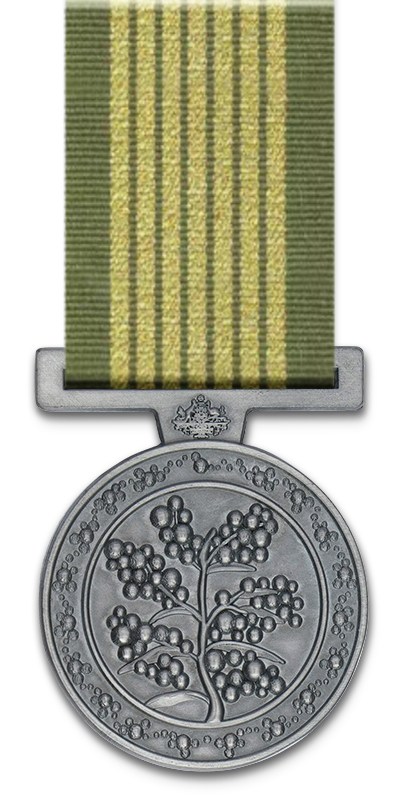
The medal is circular and struck in nickel-silver, ensigned with the Australian coat of arms. The obverse depicts a stylised flowering branch of golden wattle, with the flowering wattle continuing around the edge. The wattle motif carries to the reverse, around the circular inscription FOR SERVICE TO OTHERS IN A NATIONAL EMERGENCY and a central panel left blank for the recipient's name.
The ribbon
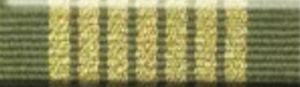
Eucalyptus green carrying seven gold stripes, one for each state and one for the territories.
The ribbon is eucalyptus green carrying seven vertical gold stripes. The gold symbolises the Australian sun, optimism and hope, and the eucalyptus green complements the wattle of the medal. The seven stripes represent Australia's six states, with the seventh standing for the territories. The colours match those of the Humanitarian Overseas Service Medal, linking the two awards for service to others.
Clasps
The National Emergency Medal is always issued with a clasp, and the clasp names the specific declared emergency in which the service was given. Because the award is tied to a particular event, the medal is never worn bare. A person who gives qualifying service in more than one declared emergency can receive an additional clasp for each, worn on the ribbon of the medal they already hold.

VIC FIRES 09
For qualifying service during the Black Saturday Victorian bushfires of 2009, one of the deadliest bushfire events in Australian history.

QLD 2010-11
For qualifying service during the Queensland floods of 2010 and 2011, the first declared nationally significant emergency for the medal.

TC Debbie 2017
For qualifying service during Tropical Cyclone Debbie in 2017, which crossed the north Queensland coast and brought severe flooding to Queensland and northern New South Wales.

NTH QLD 2019
For qualifying service during the 2019 North Queensland monsoon floods, centred on Townsville, which caused widespread inundation across the region.

BUSHFIRES 19-20
For qualifying service during the 2019 to 2020 Australian bushfire season, across more than one hundred nominated local government areas in New South Wales, Queensland, South Australia, Victoria and the Australian Capital Territory.

FLOOD FEB 2022
For qualifying service during the February 2022 floods across eastern Australia. This clasp was announced in 2024, extending recognition to responders of that emergency.
Eligibility
The medal is awarded to members of approved organisations, or to individuals, who rendered qualifying service during the response phase of a declared nationally significant emergency. There are two paths to the award: sustained service and significant service.
- Sustained service generally requires a minimum period of service, commonly five days, during the dates and within the geographic areas set out in the declaration for that emergency;
- Significant service recognises extraordinary service, and does not require the minimum duration or the eligible dates that apply to sustained service;
- Service need not be on the frontline, but it must be in direct response to the emergency, which can include support that enables or facilitates that response.
Order of wear
The National Emergency Medal is worn among the Australian service awards, after the campaign and operational awards and before the long service medals. Its clasps are worn on the ribbon, and where the ribbon alone is worn the clasps are indicated in the usual way.
Frequently asked questions
Why is the National Emergency Medal always worn with a clasp?
The medal recognises service in a national emergency, and the clasp names the specific declared emergency. Because every award is tied to a particular event, the medal is always issued with the relevant clasp and is never worn bare.
Does recovery or clean-up work qualify?
No. The medal recognises service in the direct response or active phase of the emergency. Service in the recovery phase that follows, such as clean-up or restoring infrastructure, is not eligible.
Can a person receive more than one clasp?
Yes. A person who gives qualifying service in more than one declared nationally significant emergency can receive an additional clasp for each, worn on the ribbon of the medal they already hold.
How much service is needed?
For sustained service, a minimum period is set for each emergency, commonly five days, served during the specified dates and places. For significant service, which recognises extraordinary service, the minimum duration and date criteria do not apply.
Which clasps have been issued?
Four clasps have been issued to date: VIC FIRES 09 for the 2009 Black Saturday bushfires, NTH QLD 2019 for the 2019 Townsville floods, BUSHFIRES 19-20 for the 2019 to 2020 bushfire season, and FLOOD FEB 2022 for the February 2022 floods.
Was COVID-19 a qualifying emergency for this medal?
No. Although it was a declared human biosecurity emergency, the COVID-19 pandemic was not declared a nationally significant emergency for the purpose of this medal. Some agencies created their own state awards instead.