
History
The Humanitarian Overseas Service Medal was established on 16 April 1999 by Letters Patent, following the 1995 Review of Australian Honours and Awards, to recognise Australians who give frontline humanitarian service overseas in circumstances of risk and danger. The regulations define humanitarian service as service that gives immediate remedy to needy or distressed persons in order to sustain their life or dignity: it is an award for the emergency response, not for development aid.
The medal was conceived as a civilian companion to the Service Medal and the Police Overseas Service Medal, awarded to members of recognised Australian organisations during peacekeeping operations and periods of strife or war. Letters Patent and regulations of April 2005 extended it to natural disaster responses, beginning with the 2004 Indian Ocean tsunami, when the Australian Defence Force was declared an eligible organisation for the first time for Operation Sumatra Assist. The regulations were consolidated and strengthened in 2011, and the list of declared events has grown with each major disaster since.
Design & ribbon
The medal
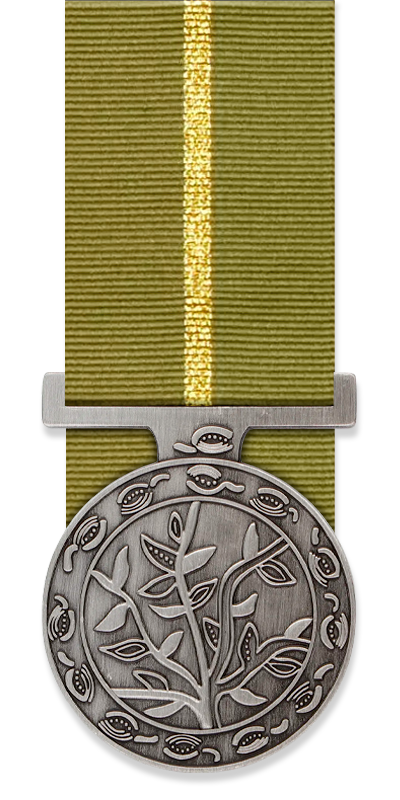
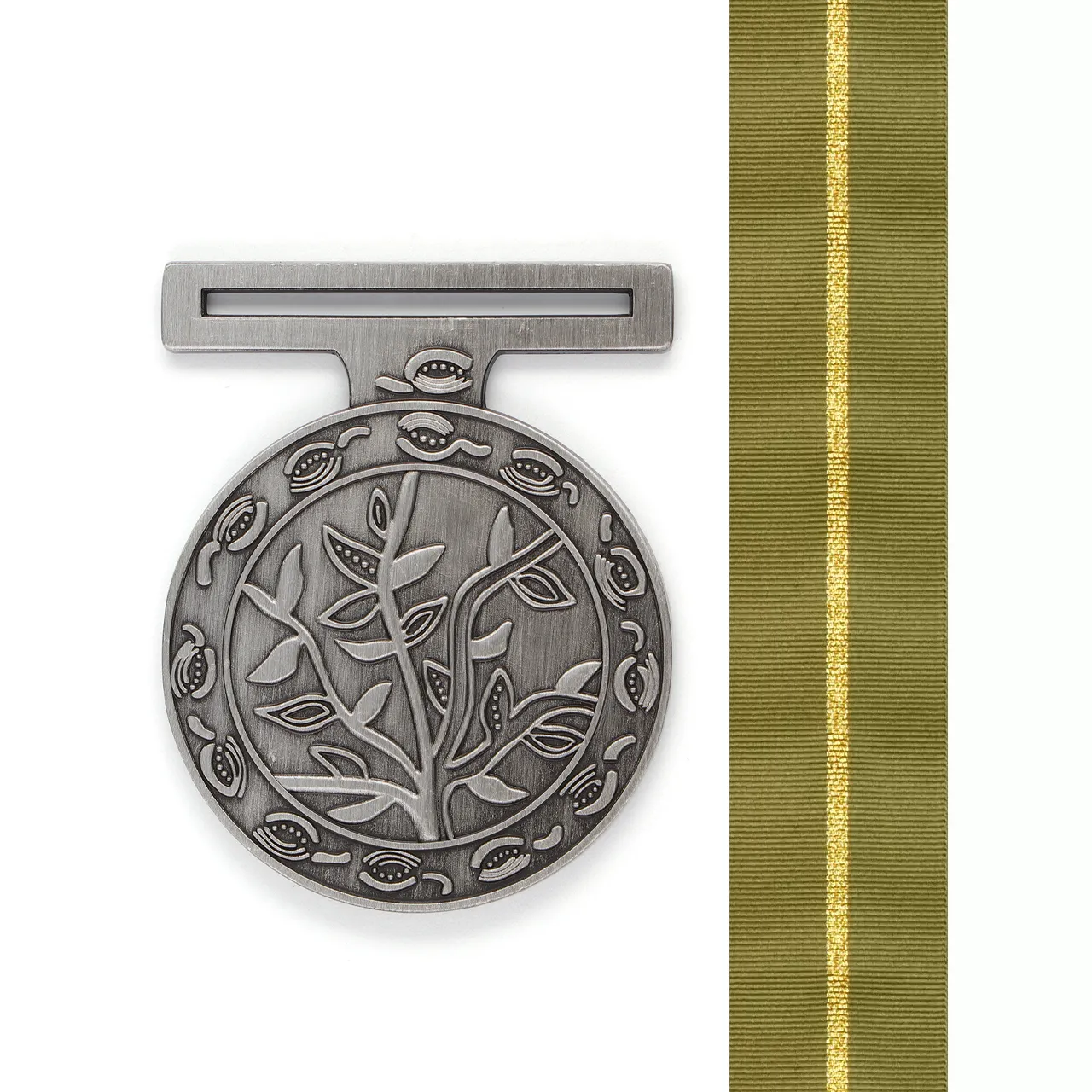
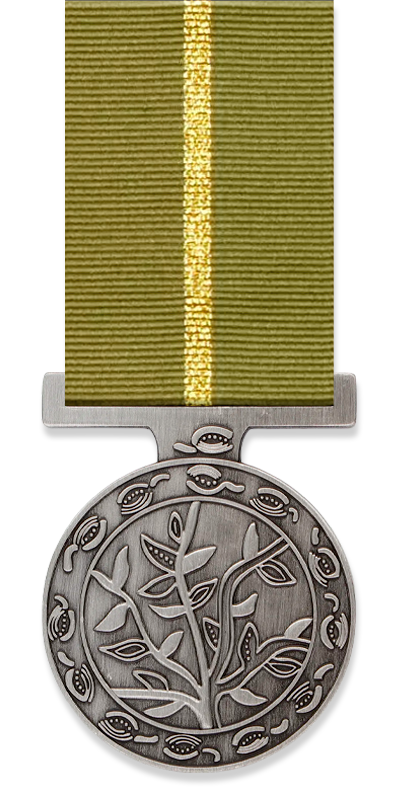
The central symbol of the medal is an Australian eucalyptus tree, its branches spreading from the Australian land at the base to the world, represented by a circle. A ring of gum nuts surrounds the circle, symbolising hope and life after disaster: like eucalyptus seeds regenerating after bushfire, humanitarian service assists the recovery and continuation of life. The reverse repeats the ring of gum nuts and details the award and the recipient. The medal draws its inspiration from Indigenous motifs and was designed by Balarinji of Sydney.
The ribbon

Eucalyptus green divided by gold, for the Australian sun, optimism and hope.
The ribbon is eucalyptus green, divided vertically by a stripe of gold. The gold symbolises the Australian sun, optimism and hope.
Clasps
A clasp named for the declared event is issued with the medal. Eligible service in a further operational area is recognised by an additional clasp, worn above those previously awarded. The clasps declared include the following.

2004 Indian Ocean Tsunami
For humanitarian service in response to the Boxing Day tsunami of 26 December 2004, declared under the natural disaster provisions, with reduced qualifying periods of seven or fourteen days recognising the intensity of the initial response.
Japan
For Australian assistance following the earthquake and tsunami in Japan of March 2011, declared in April 2012 and amended in 2018.

Pakistan II
For humanitarian service following the Pakistan floods of 2010, declared in April 2012 and amended in 2018.

South Vietnam
For Australian humanitarian service in South Vietnam, recognised retrospectively by an amendment declared in April 2019.

Ukraine
For humanitarian service in Ukraine, declared in June 2015, covering the Australian response to the downing of Malaysia Airlines flight MH17.

Vanuatu
For humanitarian service in Vanuatu following Tropical Cyclone Pam, declared in January 2019.

East Timor
For Australian humanitarian service in East Timor, declared in 2000 for eligible relief operations in the territory.

Iraq
For Australian humanitarian service in Iraq, declared in 2004 for eligible relief operations.
Eligibility
The medal is awarded by the Governor-General on the recommendation of the Secretary of the Department of the Prime Minister and Cabinet, to members of eligible organisations who give humanitarian service overseas in circumstances of risk and danger during a declared event.
- The eligible organisations, areas, dates and qualifying periods are set by the declaration for each event; the qualifying period is commonly thirty days, with reduced periods declared for the most intense disaster responses;
- Only one medal may be awarded to a person; eligible service in a further operational area is recognised by an additional clasp;
- Service that has been recognised, or is eligible for recognition, by another Australian award such as the Active Service Medal, the Service Medal or the Police Overseas Service Medal is not eligible, and the medal is not restricted to Australian citizens.
Order of wear
The medal is worn among the Australian service awards, after the Police Overseas Service Medal. The precise neighbours in the order of wear should be confirmed against the current Australian Order of Wear.
Frequently asked questions
What service does the medal recognise?
Frontline humanitarian service to civilians overseas, given in circumstances of risk and danger by members of recognised Australian organisations, to sustain the life or dignity of needy or distressed people. It is not an award for development aid or capacity building.
How much service is needed?
The qualifying period is set by the declaration for each event, commonly thirty days in the operational area. Reduced periods have been declared for the most intense responses, such as seven or fourteen days for the 2004 Indian Ocean tsunami.
Can I receive more than one medal?
No. Only one medal is awarded to a person, and eligible service in a further operational area is recognised by an additional clasp worn on the medal.
Can ADF members receive it?
Usually their service is recognised by the military awards instead, and service eligible for another Australian award cannot count for this medal. The Defence Force has been declared an eligible organisation where no military award applied, first for Operation Sumatra Assist after the 2004 tsunami and again for Operation Pakistan Assist in 2005.
Who awards it and how do I apply?
The Governor-General, on the recommendation of the Secretary of the Department of the Prime Minister and Cabinet. Applications are made for members of eligible organisations for declared events, endorsed by the deploying organisation.
Does it carry a post-nominal?
No.