
History
The French Croix de Guerre 1914-1918 was created in 1915, when the scale of the war made the older French honours too few to recognise the courage being shown, and a new award was needed that a commander could grant for each act of bravery. Every cross carries at least one citation, a mention in dispatches, for gallantry by a soldier of any rank of the French forces or of an allied army.
It was given widely to the allied soldiers who fought alongside France, and many Australians received it for their service on the Western Front. The cross itself is awarded once; further citations are marked by additional devices on the ribbon. As a foreign award it is worn in the Australian Order of Wearing after Australian and Commonwealth honours.
Design & ribbon
The medal
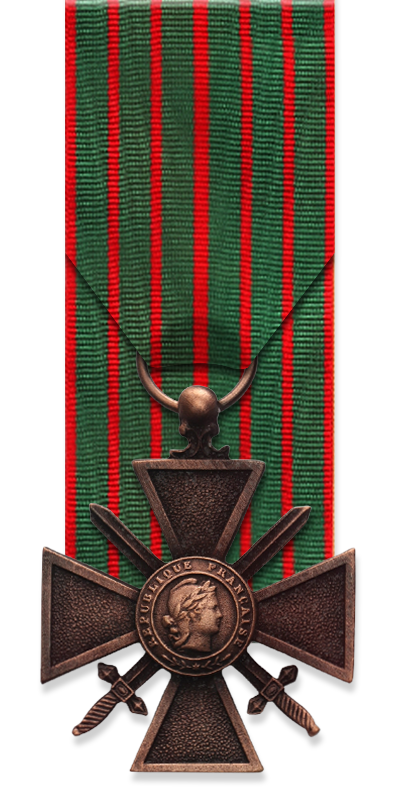
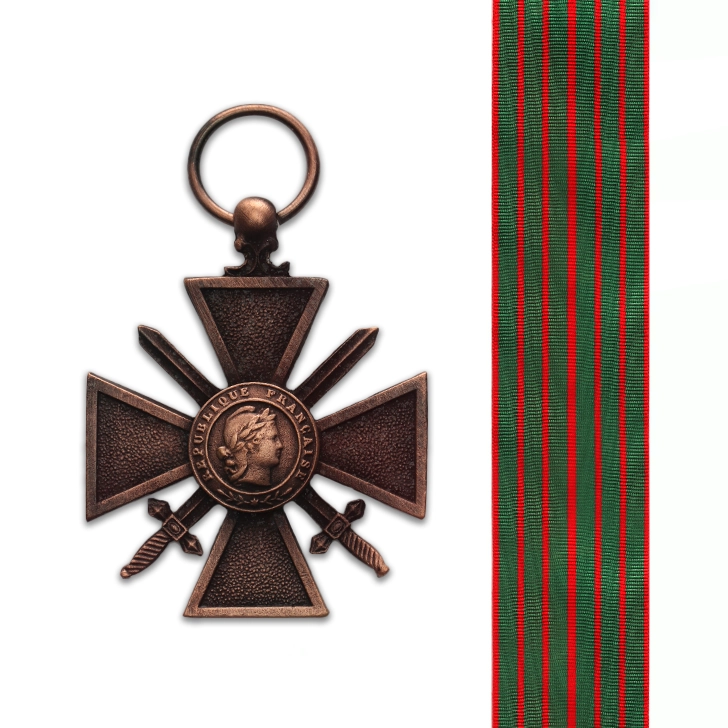
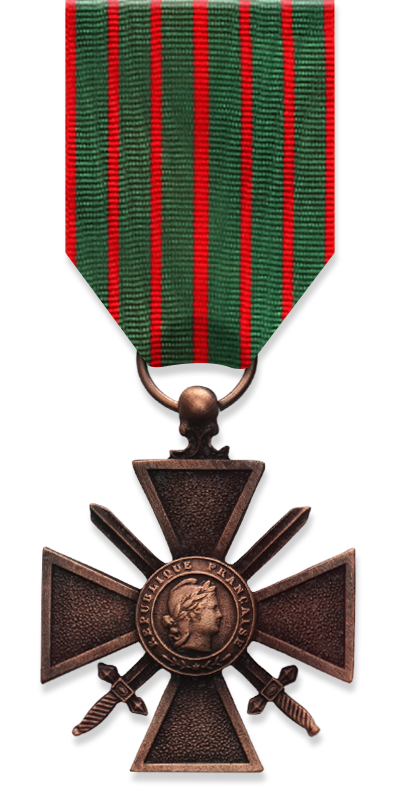
The medal is a bronze cross whose arms widen toward the ends, with two swords crossed between them. The centre of the obverse bears the head of Marianne, the figure of the French Republic, a young woman in a Phrygian cap, encircled by the words REPUBLIQUE FRANCAISE. The reverse centre bears the dates of the war, most often 1914-1918. The level of the citation is shown by a device on the ribbon.
The ribbon
Green with seven red stripes and red edges.
The ribbon is green with seven narrow red stripes evenly spaced and a red stripe at each edge. A device marks the level of the citation: a bronze star for a mention at regiment, battalion or brigade level, a silver star for division, a silver-gilt star for corps, and a bronze palm for a mention at the level of the army.
Eligibility
The cross was awarded for a citation for gallantry to members of the French forces and of allied armies.
- A mention in dispatches for an act of bravery in the First World War qualified; many Australians received it for service on the Western Front;
- The cross is awarded once, and further citations are marked by additional stars or palms on the ribbon rather than by a second cross;
- As a foreign award it is worn in the Australian Order of Wearing after Australian and Commonwealth honours.
Order of wear
In the Australian Order of Wearing, foreign awards are worn after Australian honours and Commonwealth awards, in the order set for foreign awards, generally by the date of the service for which they were given. A foreign award is worn only where its acceptance and wear have been approved.
Frequently asked questions
What is the French Croix de Guerre 1914-1918 awarded for?
A citation for gallantry, a mention in dispatches, for an act of bravery by a soldier of the French forces or of an allied army in the First World War.
Why did Australians receive it?
It was given widely to the allied soldiers who fought alongside France, and many Australians earned it for their service on the Western Front.
What do the ribbon devices mean?
They mark the level of the citation: a bronze star for regiment, battalion or brigade, a silver star for division, a silver-gilt star for corps, and a bronze palm for the army.
What does the obverse show?
The head of Marianne, the figure of the French Republic, a young woman in a Phrygian cap, encircled by the words REPUBLIQUE FRANCAISE.
Can it be awarded more than once?
The cross is awarded once; further citations are marked by additional stars or palms on the ribbon rather than by a second cross.
How is it worn in Australia?
As a foreign award, after Australian and Commonwealth honours in the Australian Order of Wearing.