
History
The Italy Star, instituted in May 1945, was awarded for operational service in the Italian campaign between 11 June 1943 and 8 May 1945: the Allied fight up the Italian peninsula from the invasion of Sicily through Salerno, Cassino, Anzio and the Gothic Line, together with related service in Sicily, Greece, Yugoslavia, the Aegean, Corsica, Sardinia and Elba. Qualification followed prior award of the 1939-1945 Star and entry into an operational area, with a gallantry award or a mention in despatches qualifying regardless of time served.
No clasps were awarded with the Italy Star. Australian service in the Italian campaign was primarily in the air and at sea rather than on the ground, the army divisions having returned to the Pacific, but Australians of the Royal Australian Air Force and attached to British and Commonwealth forces qualified. As an Imperial award it retains its place in the Australian Order of Wearing.
Design & ribbon
The medal
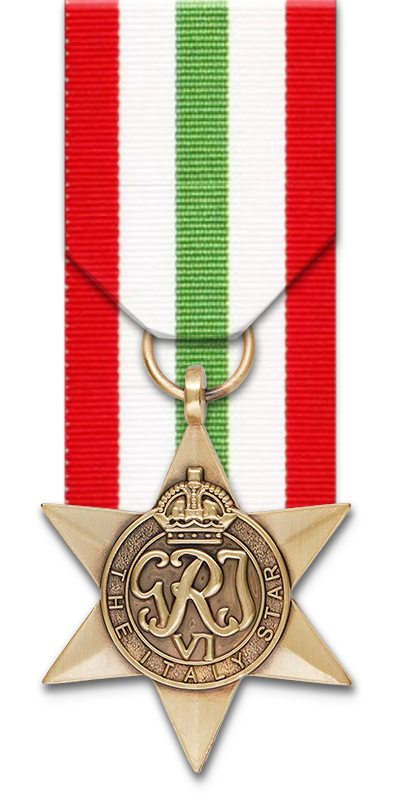
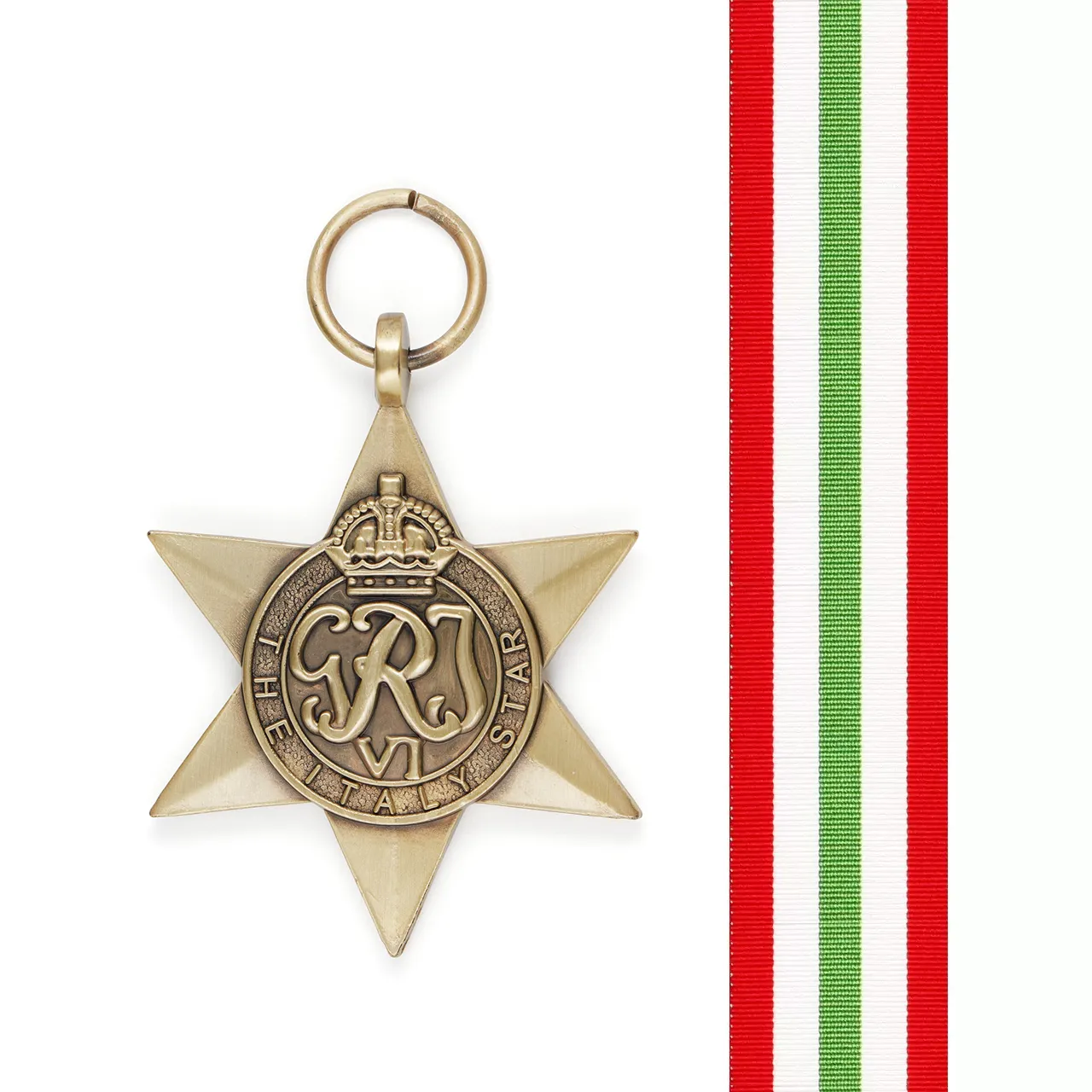
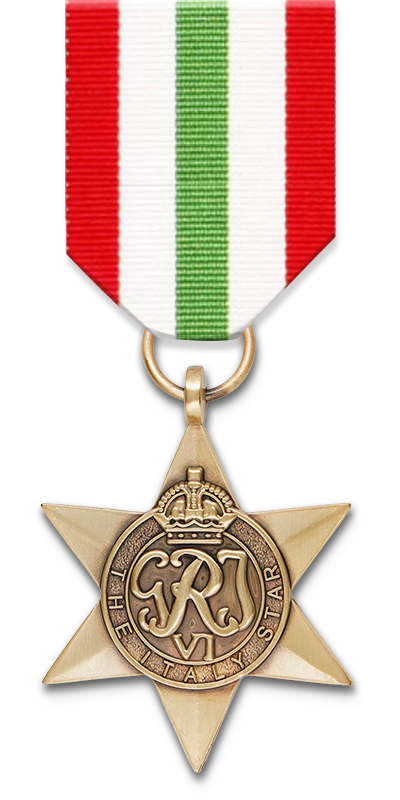
The Star is a six-pointed star of yellow copper-zinc alloy fitting within a 44 millimetre circle, ensigned with a crown carrying a ring for suspension, its obverse bearing the royal cypher GRI VI within a circlet inscribed THE ITALY STAR. The reverse is plain; Australian issues, unlike most Commonwealth stars, were impressed on the reverse with the recipient's number, initials and surname after a campaign by veterans' organisations.
The ribbon
Red, white, green, white and red, the Italian colours.
The ribbon has five equal stripes of red, white, green, white and red, the colours of the flag of Italy.
Eligibility
The Star was awarded for operational service in the Italian campaign between 11 June 1943 and 8 May 1945.
- Entry into an operational area qualified, after prior qualification for the 1939-1945 Star; a gallantry award or a mention in despatches in a qualifying area qualified regardless of duration;
- Related service in Sicily, Greece, Yugoslavia, the Aegean, Corsica, Sardinia and Elba, and naval service in the invasion of southern France, also counted; no clasps were awarded;
- As an Imperial award it retains its place in the Australian Order of Wearing.
Order of wear
No more than five of the Second World War campaign stars could be awarded to one person, six including the later Arctic Star; those who qualified for more wore a clasp on the ribbon of a star they held, naming a further star, with only one clasp worn on any star.
Frequently asked questions
What is the Italy Star awarded for?
Operational service in the Italian campaign between 11 June 1943 and 8 May 1945, after prior qualification for the 1939-1945 Star, together with related service in the Mediterranean theatre.
What did the campaign involve?
The Allied advance up the Italian peninsula from the invasion of Sicily through Salerno, Cassino, Anzio and the Gothic Line, some of the hardest fighting of the war.
Are there clasps?
No. The Italy Star is the only one of the Second World War theatre stars for which no clasp was instituted.
Did Australians receive it?
Yes, chiefly airmen of the Royal Australian Air Force and personnel attached to British and Commonwealth forces, the Australian army divisions having returned to the Pacific.
Is it named to the recipient?
Australian issues are impressed on the reverse with the recipient's details, unlike most Commonwealth stars.
Does it carry a post-nominal?
No; it is a campaign star and carries no post-nominal.