
History
The Africa Star, instituted on 8 July 1943 among the first two campaign stars, was awarded for a minimum of one day's service in an operational area of North Africa between 10 June 1940, when Italy entered the war, and 12 May 1943, when the last Axis forces in Africa surrendered at Tunis. The operational area stretched from the Suez Canal to Gibraltar and took in Malta, Ethiopia, Kenya, Sudan, the Somalilands and Eritrea. Members of the Australian Imperial Force also qualified for service in Syria between June and July 1941.
Three clasps mark the formations of the desert war: 8th Army, 1st Army, and North Africa 1942-43, of which only the first earned is worn on the ribbon. About 1.5 million ribbon bars had been issued by early 1944. For Australia the Africa Star belongs above all to the Rats of Tobruk and the divisions of the early desert campaigns before their recall to the Pacific. As an Imperial award it retains its place in the Australian Order of Wearing.
Design & ribbon
The medal
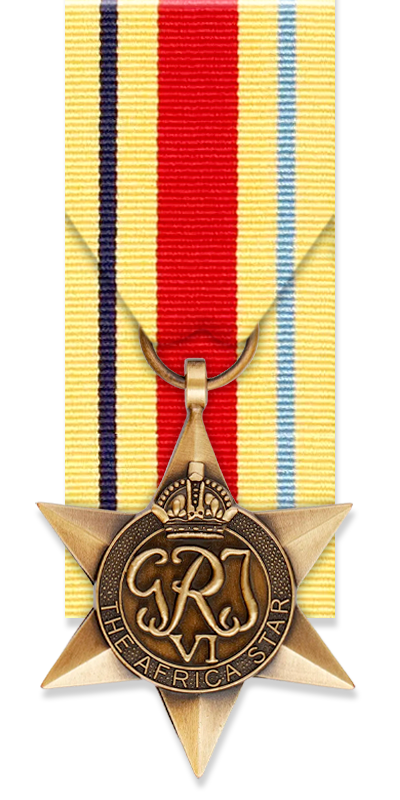
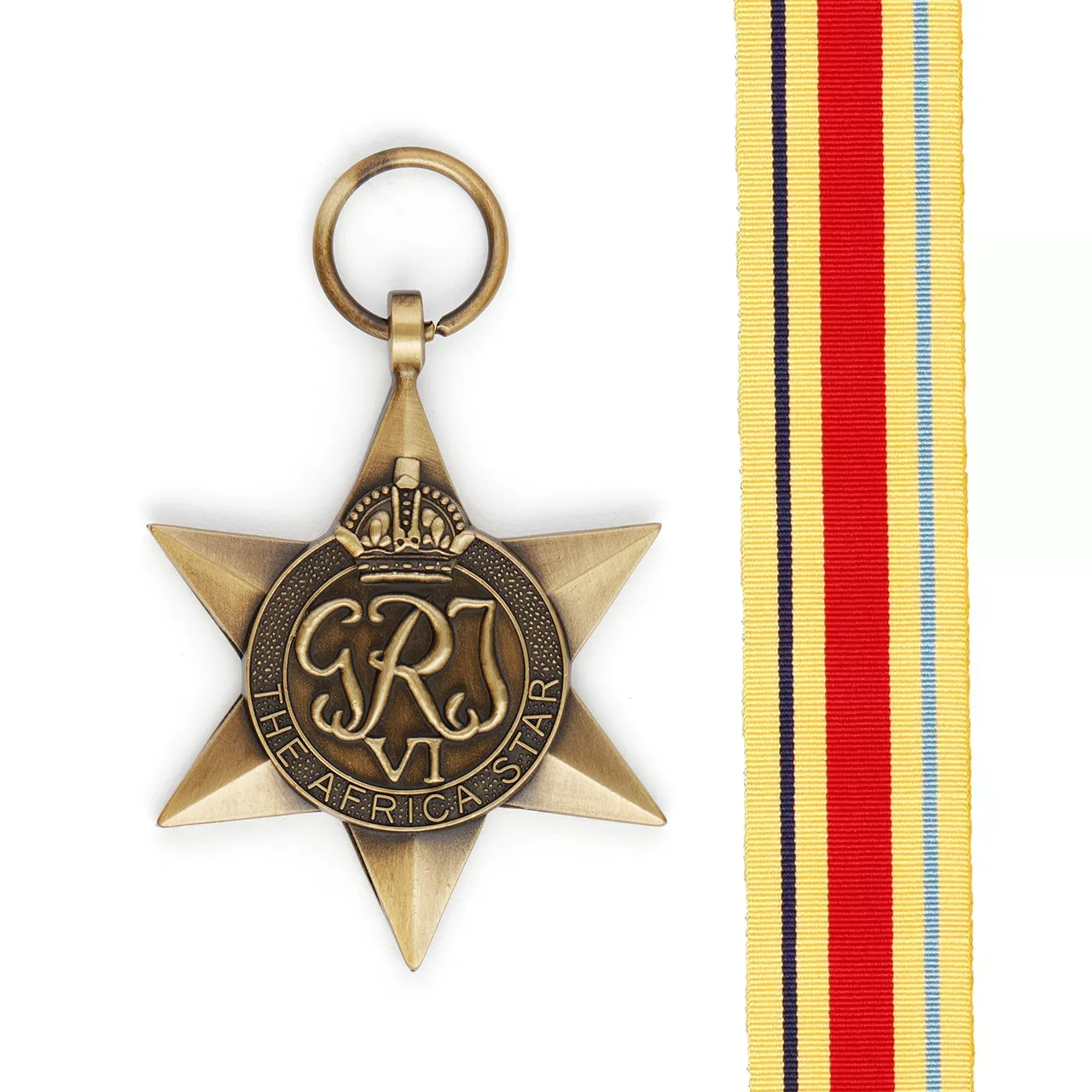
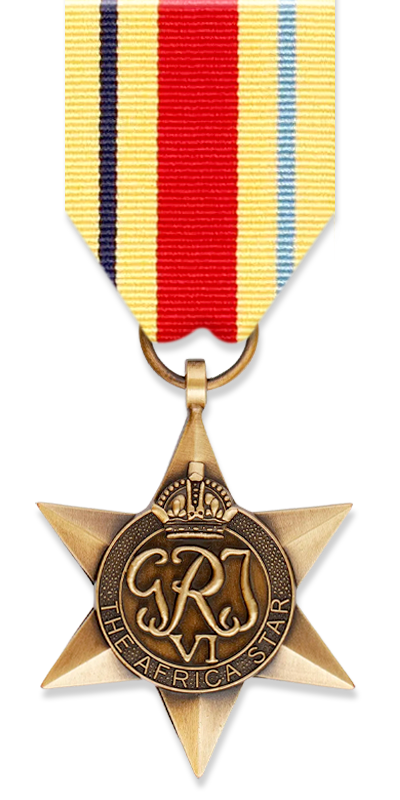
The Star is a six-pointed star of yellow copper-zinc alloy fitting within a 44 millimetre circle, ensigned with a crown carrying a ring for suspension, its obverse bearing the royal cypher GRI VI within a circlet inscribed THE AFRICA STAR. The reverse is plain; Australian issues, unlike most Commonwealth stars, were impressed on the reverse with the recipient's number, initials and surname after a campaign by veterans' organisations.
The ribbon
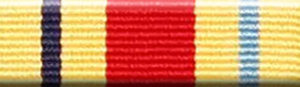
Desert buff with central red, dark blue and light blue stripes.
The ribbon is pale buff, the colour of desert sand, with a central red stripe and narrow stripes of dark blue and light blue, representing the Army in the desert and the three services.
Clasps
Three clasps were instituted for the Africa Star, of which only the first earned is worn on the ribbon.

8th Army
Marks service with the 8th Army.

1st Army
Marks service with the 1st Army.

North Africa 1942-43
Marks specified headquarters, naval, merchant and air service.
Eligibility
The Star was awarded for service in an operational area of North Africa between 10 June 1940 and 12 May 1943.
- A minimum of one day's service in the operational area qualified; the area ran from the Suez Canal to Gibraltar and included Malta and East Africa, with Australian service in Syria in 1941 also qualifying; service in West Africa did not;
- Three clasps were instituted, 8th Army, 1st Army and North Africa 1942-43, of which only the first earned is worn, represented on the ribbon bar by a rosette or a numeral 8 or 1;
- As an Imperial award it retains its place in the Australian Order of Wearing.
Order of wear
No more than five of the Second World War campaign stars could be awarded to one person, six including the later Arctic Star; those who qualified for more wore a clasp on the ribbon of a star they held, naming a further star, with only one clasp worn on any star.
Frequently asked questions
What is the Africa Star awarded for?
A minimum of one day's service in an operational area of North Africa between 10 June 1940 and 12 May 1943, the span of the desert campaign from Italy's entry to the Axis surrender at Tunis.
What area did it cover?
From the Suez Canal to Gibraltar, including Malta, Ethiopia, Kenya, Sudan, the Somalilands and Eritrea. Australian service in Syria in 1941 also qualified; West Africa did not.
What are the clasps?
8th Army, 1st Army and North Africa 1942-43. Only the first earned may be worn on the ribbon, though the two army clasps mark the desert's most famous formations.
What does it mean to Australians?
It is above all the star of the Rats of Tobruk and the divisions of the early desert war, before their return to the Pacific theatre.
Is it named to the recipient?
Australian issues are impressed on the reverse with the recipient's details, unlike most Commonwealth stars.
Does it carry a post-nominal?
No; it is a campaign star and carries no post-nominal.