
History
Instituted on 24 September 1940 by King George VI, the George Medal was created alongside the George Cross to meet the same wartime need: at the height of the Blitz, existing awards open to civilians could not adequately recognise the courage of ordinary people under enemy bombing. The King intended the Cross to rank next to the Victoria Cross and the Medal for wider distribution, and the George Medal has served ever since as the honour for gallantry that meets a very high standard without reaching the extreme threshold of the Cross.
Like the Cross it is primarily a civilian award, extended to military personnel for gallant conduct not in the face of the enemy. Its first recipients, gazetted on 30 September 1940, included firemen who returned to a burning ammunition ship in Dover Harbour during an air raid, and the first women decorated, ambulance crews from Aldeburgh. About 2,100 medals have been awarded, with 27 second-award bars. As an Imperial award it retains its place in the Australian Order of Wearing.
Design & ribbon
The medal
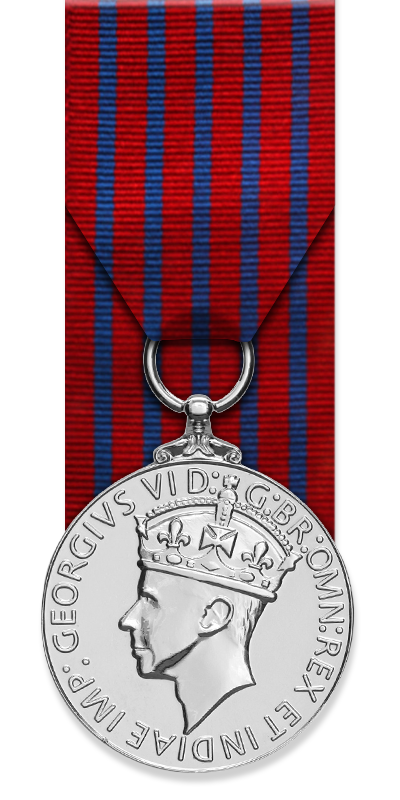
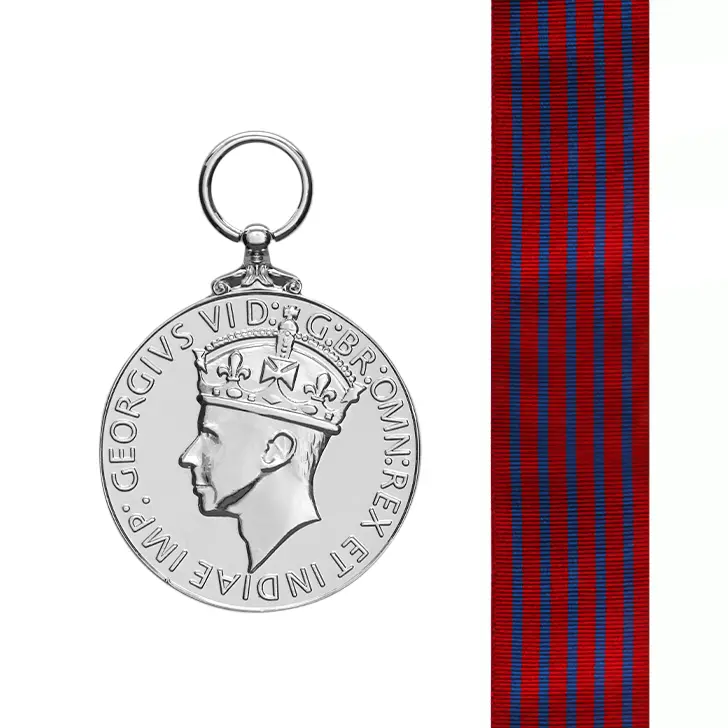
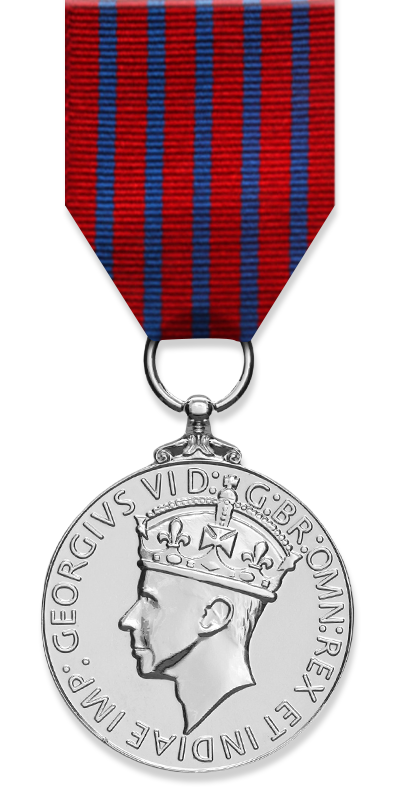
The medal is circular silver, 36 millimetres in diameter, with the ribbon suspended from a ring. The obverse bears the crowned effigy of the reigning sovereign; the reverse shows Saint George on horseback slaying the dragon on the coast of England, with the inscription THE GEORGE MEDAL. The recipient's name is engraved on the rim.
The ribbon
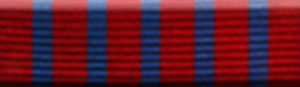
Crimson with five narrow blue stripes, the blue of the George Cross.
The ribbon is crimson with five narrow blue stripes, the blue taken from the ribbon of the George Cross.
Clasps
Further acts of gallantry meriting the medal are recognised by a bar rather than a second medal.
Eligibility
The medal is awarded for acts of gallantry, typically by civilians, or in circumstances where military honours are not appropriate.
- It recognises gallantry in circumstances of great danger, of a very high standard but below that required for the George Cross; military awards are confined to gallant conduct not in the face of the enemy;
- Recipients are entitled to the post-nominal letters GM; bars may be awarded for further acts, denoted by a silver rosette on the ribbon when worn alone;
- As an Imperial award it retains its place in the Australian Order of Wearing.
Order of wear
Imperial awards were the honours of Australia before the Australian honours system was established in 1975, and they retain their place in the Order of Wearing. They are worn after the Australian honours of their kind and among the Imperial awards in the order set by the Australian Order of Wearing, which follows the British order of precedence.
Frequently asked questions
What is the George Medal awarded for?
Acts of gallantry in circumstances of great danger, of a very high standard but below that required for the George Cross, typically by civilians or where military honours are not appropriate.
How does it relate to the George Cross?
The Cross and the Medal were instituted together in 1940; the Cross is for the greatest heroism in extreme danger, the Medal for gallantry of a very high standard more widely awarded.
Can military personnel receive it?
Yes, for gallant conduct not in the face of the enemy, where purely military honours are not appropriate.
How are further awards shown?
By a bar on the ribbon, represented by a silver rosette when the ribbon alone is worn. Twenty seven second-award bars have been granted.
Who were the first recipients?
Firemen who fought fires aboard an ammunition ship in Dover Harbour during an air raid in July 1940, gazetted that September, along with the first women decorated, ambulance crews from Aldeburgh.
Does it carry a post-nominal?
Yes, the letters GM.