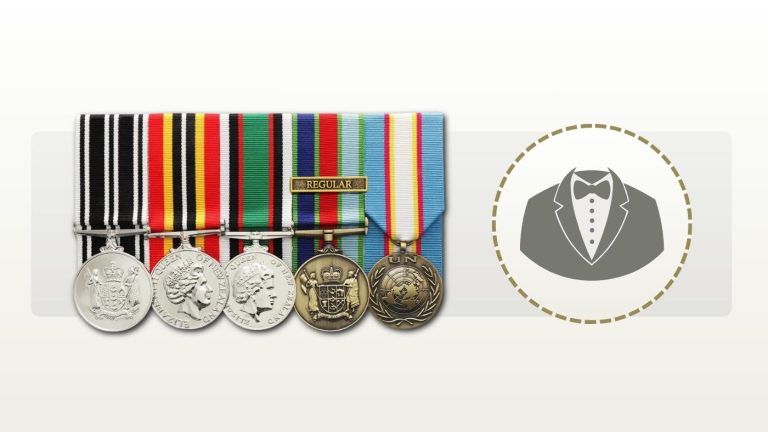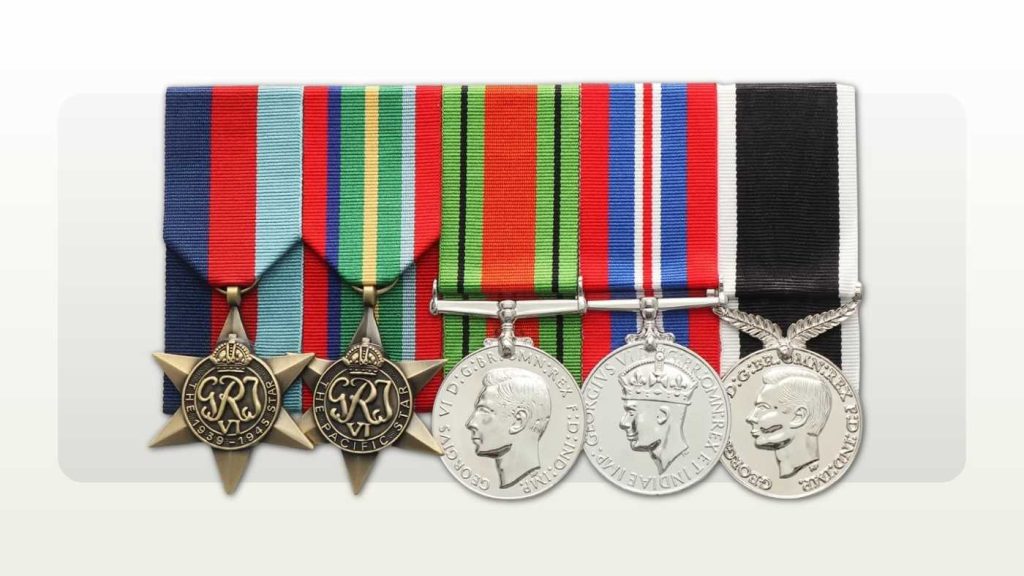
The award order comes first. Width and overlap are then used to make that correctly ordered group fit the relevant dress rules and the garment. A narrow jacket does not justify changing precedence.
A medal rack can look simple on screen and still raise a practical question when it reaches the jacket: how wide should the group be, when should the medals overlap, and what happens if the available space is limited?
There is no single universal width formula that applies to every Australian service, medal count, mounting style and garment. The correct approach is to separate three decisions: first confirm the awards and their order, then apply the relevant dress guidance, and finally review how the finished group will physically sit on the garment.[4][5]
Start with the Correct Award Order Before Thinking About Width
The Department of the Prime Minister and Cabinet states that when a person holds more than one award, the main insignia are mounted on a medal bar in the order set out in the Australian Order of Wearing. The Governor-General's current Order of Wearing provides the national precedence sequence.[4][5]
This means width is a presentation and fit problem, not a reason to rearrange the honours. If a group becomes too wide for the applicable dress standard or garment, the solution is usually an approved overlap or a mounting adjustment, not moving a lower-precedence medal ahead of a higher one.
Medal Count Affects Width, but Count Alone Does Not Set the Final Layout
Medal count matters, but it does not prescribe the finished width by itself. Service rules, full-size versus miniature format, mounting style and the physical group all matter.
Rack Builder lets users add awards in the applicable order, choose a format and review the finished arrangement before ordering. Its full-size product can be court or swing mounted, and Rack Builder states that both mounting methods follow the same published order of wear.[1][2]
Official Dress Manuals Show Why Overlap Rules Are Service-Specific
The clearest way to see why a universal formula is risky is to compare current service guidance. Army and Air Force both use overlap for larger groups, but their published instructions describe the thresholds and fit rules in service-specific terms.[6][7]
| Current public guidance | What it says about larger groups | Planning lesson |
|---|---|---|
| Australian Army | Five full-size medals are shown side by side. Six to nine, and groups of ten or more, are shown court mounted with ribbon overlap. The current manual also gives maximum widths of 165 mm (6), 170 mm (7), 180 mm (8) and 190 mm (9), and 240 mm for groups of ten or more. | For Army uniform wear, use the current Army Dress Manual rather than a generic medal-count formula. |
| Royal Australian Air Force | Five full-size medals or fewer are court mounted side by side. Six to nine use ribbon overlap, with published maximum widths of 165 mm (6), 170 mm (7), 180 mm (8) and 190 mm (9). Groups of 10 or more are not to exceed 200 mm. | Air Force shares Army's limits for six to nine medals but sets a lower 200 mm limit for ten or more, showing why a generic formula should not be applied across services. |
| Civilian or other organisational wear | National precedence still matters, but the garment may not have the same pocket, lapel or seam geometry as an ADF uniform. | Use the applicable organisation or event guidance and have the physical fit reviewed where necessary. |
Important: The Army and Air Force examples above demonstrate service-specific rules. They should not be copied automatically to Navy, police, emergency services or another organisation without checking that organisation's current dress instructions.
Overlap Is a Normal Layout Tool, Not Evidence That a Rack Is Wrong
Overlap is used when the medal group becomes wider than the dress rules or garment can comfortably accommodate. In an overlapped full-size group, the priority is to preserve the correct order and keep the higher-precedence side clearly presented.
The Air Force manual is explicit that when more than five full-size medals are overlapped, the highest award in the order of precedence is to show in full. Army likewise publishes illustrated overlapped layouts for larger full-size groups.[6][7]
So a buyer should not assume that every medal must remain fully visible side by side. For larger groups, a controlled overlap can be the correct result rather than a compromise.
Court Mounting and Swing Mounting Change How the Group Sits, Not Its Precedence
Rack Builder describes court mounting as fixing each medal to a firm backing so the row sits still, while swing mounting lets the medals hang and move freely from the mounting bar. Both are built in the published order of wear.[2]
Because court mounting fixes the row while swing mounting suspends the medals from the bar, the two styles should not automatically be assumed to need the same physical layout.
For Army and Air Force uniform wear, the current dress manuals require full-size medals to be court mounted, so check the relevant manual before choosing swing mounting for a uniform set.[6][7]
The Jacket Matters Because a Rack Is Worn on a Real Garment, Not an Empty Page
Uniform manuals position medals relative to garment features such as breast pockets, lapels and shoulder seams. That is why the same medal group can require different practical consideration on service dress, mess dress or a civilian jacket.[6][7]
When the wearer has a particularly narrow chest, a small jacket, unusual tailoring or a very large group, a professional mounter may need to review the physical garment or reliable measurements before final mounting. Rack Builder's support page specifically accepts questions about formats, sizes, mounting and fit.[3]
Use a Garment-Fit Review Without Turning It into a Universal Measurement Formula
A useful fit review records the garment and the problem rather than inventing a rule such as 'every medal needs a fixed number of millimetres'. For a complex rack, give the mounter enough information to understand where the group will be worn.
- Confirm the service, jurisdiction or organisation whose dress rules apply.
- Confirm whether the set is full-size or miniature, and whether it will be court or swing mounted.
- Identify the actual garment: service dress jacket, mess dress, blazer or another approved garment.
- If fit is already a concern, provide the jacket size and any measurements the mounter specifically requests.
- Mention nearby lapels, pocket edges, badges or other authorised insignia that could affect available space.
- If possible, have the garment available for a final fit check rather than relying only on a screen preview.
A Hypothetical Example Shows Why Medal Count and Jacket Fit Must Be Reviewed Together
Imagine a serving member has a correctly ordered group of eight full-size medals. The award sequence has already been confirmed. The next question is not whether two awards can be swapped to make the rack narrower. The question is how the applicable service manual expects an eight-medal group to be mounted and whether that approved layout sits correctly on the member's jacket.
If the wearer were Army, the current public manual already illustrates six-to-nine full-size medals with ribbon overlap. If the wearer were Air Force, the current manual states that groups with more than five full-size medals are to be overlapped. Those are service-specific answers to the same fit problem, which is exactly why the wearer's service needs to be confirmed before the layout is finalised.[6][7]
Rack Builder Can Organise the Rack, but Complex Physical Fit Still Deserves Review
Rack Builder's workflow lets the user choose the service or jurisdiction, add medals and clasps, choose the format, and review the arrangement before ordering. After checkout, the team reviews the saved rack against the selected jurisdiction and published order-of-wear guidance and contacts the customer if an award, clasp, layout or personal detail needs clarification.[1]
That makes the digital rack a strong planning tool, but a screen should not be treated as a substitute for garment-specific dress instructions or a physical fit review. If the concern is 'Will this large group actually sit correctly on my jacket?', send that question to the support team before production.[3]
Avoid These Common Medal-Rack Fit Mistakes
- Changing the order of precedence to make the row look more balanced.
- Assuming any overlap means the mounting is incorrect.
- Applying an Army or Air Force overlap rule to another service or organisation without checking its own guidance.
- Using a fixed width-per-medal formula for every award group.
- Choosing a mounting style without considering how the finished rack will sit on the garment.
- Waiting until the rack is in production before raising a known jacket-fit concern.
A Final Pre-Order Checklist for Width, Overlap and Fit
| Check | Question to answer |
|---|---|
| Awards | Is the entitlement and order of wear confirmed? |
| Service / jurisdiction | Which current dress rules apply to the wearer? |
| Format | Full-size, miniature or ribbon bar? |
| Mounting | Court mounted or swing mounted? |
| Overlap | Does the applicable dress guidance require or allow overlap for this group? |
| Garment | Which jacket or uniform will the rack actually be worn on? |
| Fit concern | Is the wearer narrow-chested, using unusual tailoring or wearing a particularly large group? |
| Support | Does the mounter need garment measurements or a fit question before production? |
The Best-Fitting Rack Still Starts with the Correct Rack
Solve width, overlap and jacket fit in the right order: confirm the awards and precedence, apply the wearer's current dress guidance, then check the physical mounting against the actual garment.
For a large rack or narrow jacket, raise the fit question before production so the final set can be both correct and wearable.
If your group combines ADF, police or emergency service awards, our guide to combining mixed-service awards correctly explains how to confirm the order before thinking about fit.
Ready to review the arrangement? Build and save your rack in Rack Builder.
Sources
Source pages reviewed 13 October 2026. Numbered citations in the article open the sources below.
- Rack Builder: How to Build and Order a Medal Rack Service or jurisdiction selection, medals and clasps, format choice, arrangement review and the post-checkout team review.
- Rack Builder: Full-size Replica Medals and Medal Mounting Court and swing mounting described; both built in the published order of wear.
- Rack Builder: Support Product questions about formats, sizes, mounting, engraving and fit.
- Department of the Prime Minister and Cabinet: Wearing awards Multiple awards are mounted on a medal bar in the order set out in the Australian Order of Wearing.
- Governor-General: Australian Order of Wearing Honours and Awards Current national precedence sequence (Schedule of 15 October 2025).
- Australian Army: Army Dress Manual (PDF) Annex 6E, paragraphs 10 to 16: court mounting, overlap from six medals, width limits of 165 to 190 mm for six to nine and 240 mm for ten or more.
- Royal Australian Air Force: Air Force Dress Manual (PDF) Chapter 5, paragraphs 5.10 to 5.17: overlap above five medals with the highest award in full, width limits of 165 to 190 mm for six to nine and 200 mm for ten or more.