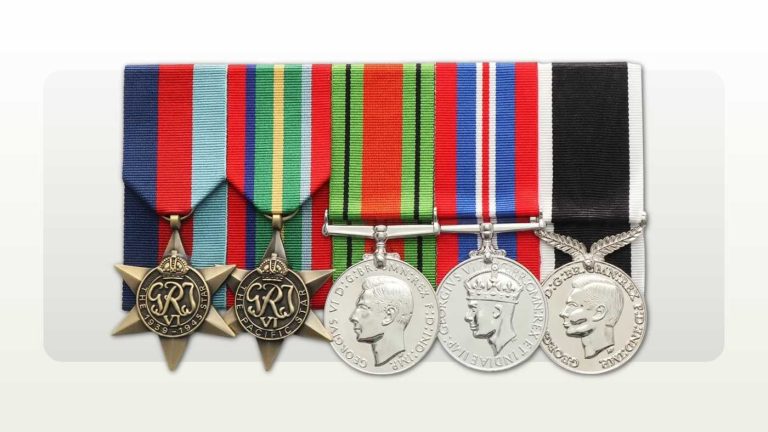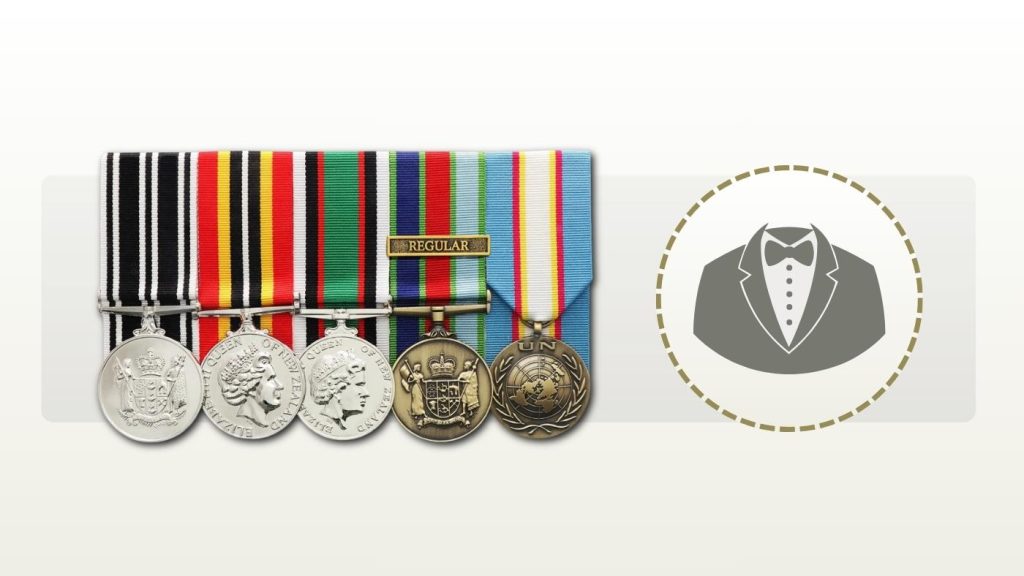
Do not solve a narrow-jacket problem by changing the medal order. Confirm precedence first, apply the relevant dress rules, then give the mounter enough garment information to review the physical fit.
A large medal group can be correctly ordered yet still be difficult to fit on a narrow jacket, especially where lapels, pockets or other garment features reduce usable space.
There is no universal chest measurement or overlap formula. The mounter needs the applicable dress rules, the expected rack size and the usable garment space.
Confirm the Award Order Before Taking Any Fit Measurements
The Department of the Prime Minister and Cabinet states that when a person holds more than one award, the main insignia are mounted on a medal bar in the order set out in the Australian Order of Wearing. The Governor-General publishes that national precedence sequence.[5][6]
Settle the order before discussing fit. If the rack is too wide, use the applicable service rules rather than rearranging precedence.
Measure the Finished Rack as Well as the Jacket
For an existing rack, the most useful starting point is its actual physical size. Rack Builder's current case-fitting guidance tells customers measuring an existing rack to record the full width across the mounting bar, the height from the top of the bar to the lowest medal or clasp, and the depth needed for raised clasps or deep medals.[4]
Those measurements are for case fitting, not jacket wear, but they illustrate the key point: actual rack dimensions matter more than medal count alone.
For a New Rack, Ask for the Expected Mounted Width Instead of Guessing It
For a new rack, do not multiply medal count by one standard width. Service rules, authorised overlap, mounting style and medal design can all change the finished size.
Rack Builder lets users choose the service or jurisdiction, add medals and clasps, select the format and review the arrangement before ordering. The team reviews saved racks against the selected jurisdiction and published order-of-wear guidance before production and contacts the customer if a layout needs clarification.[1]
The Most Useful Garment Measurement Is the Usable Chest Area
Chest circumference does not show the mounter how much usable space exists on the left front of the jacket.
A fit review may instead need the horizontal space between relevant garment boundaries, such as the lapel, breast pocket and outer chest. These are practical fitting measurements, not a universal Defence formula.
| Measurement or detail | Why a mounter may need it | What to provide |
|---|---|---|
| Finished or expected rack width | Shows the horizontal space the mounted group needs. | Existing rack: measure across the full mounting bar. New rack: ask the mounter for the expected width. |
| Rack height | Shows how far the lowest medal will extend. | Measure from the top of the bar to the lowest medal or projecting clasp. |
| Usable jacket width | Shows whether the group fits between relevant garment boundaries. | Measure only the area the mounter requests on the actual garment. |
| Pocket position | Some dress rules use the breast pocket as the placement reference. | Record the pocket top where the applicable rules require it. |
| Lapel / outer boundary | A wide group may conflict with the lapel or outer chest. | Provide the boundary measurement or a clear photo if requested. |
| Nearby insignia | Other authorised items may occupy the same area. | Tell the mounter what else must remain on the jacket. |
| Attachment method | Pin and magnetic backings interact differently with garment layers. | State the preferred method, subject to applicable dress rules. |
Air Force Rules Show Why the Pocket, Lapel and Shoulder Boundaries Matter
The current Air Force Dress Manual provides a useful example of garment-specific fitting rules. It states that full-size medals are worn on a single medal brooch on the left breast, with the top of the brooch positioned immediately above the left breast pocket of the shirt or tunic.[7]
For more than five full-size medals, Air Force requires overlap, with the highest award in the order of precedence showing in full. It also publishes maximum widths for larger full-size groups: 165 mm for six, 170 mm for seven, 180 mm for eight, 190 mm for nine and 200 mm for groups of ten or more.[7]
For miniature groups, the same manual says the brooch must not project beyond the inside edge of the lapel or the shoulder seam, with overlap used if necessary. That is a clear example of why jacket geometry matters. The medal count alone does not tell the whole story.[7]
Service-specific caution: The Air Force example should not be copied automatically to Army, Navy, police, emergency-service or other uniforms. Check the current dress instructions for the wearer's service or organisation.
Measure the Garment as It Will Actually Be Worn
Measure the actual jacket as it will be worn. An open jacket can present a different usable chest area from the same garment when fastened normally.
- Use the exact jacket intended for the event or service dress, not another jacket of the same nominal size.
- Fasten the jacket in its normal wearing position before taking fit measurements.
- Do not pull the fabric flat or stretch it to create extra apparent width.
- Take a clear front-on photograph if the mounter asks for visual context, ideally with the garment sitting naturally.
Court, Swing and Backing Choices Can Change the Physical Fit
Rack Builder offers both court and swing mounting. Court mounting fixes the medals to a firm backing so the group sits as a structured row, while swing mounting lets the medals hang and move from the mounting bar. Both follow the same order of wear, but they do not behave identically on the garment.[2]
Rack Builder also offers pin-back and MagnaRack magnetic backing options on its full-size product. A magnetic backing avoids pinning through the garment, but serving members should still check the applicable dress rules before assuming a particular attachment method is permitted with their uniform.[2]
A Large Rack Should Trigger a Fit Review Before Production, Not After
A fit review is especially useful for an unusually large group, a narrow jacket, a close-set lapel or nearby authorised insignia.
Rack Builder's support page specifically accepts questions about formats, sizes, mounting and fit. If you already know the jacket may be difficult, send the saved Rack Builder reference or order number and raise the issue before the order enters production.[3]
Use a Measurement Handover Instead of Sending Random Numbers
A good handover labels what each measurement represents. Unlabelled numbers are not enough.
| Handover field | Record |
|---|---|
| Service or jurisdiction | ____________________________ |
| Exact garment / order of dress | ____________________________ |
| Full-size or miniature rack | ____________________________ |
| Court or swing mounting | ____________________________ |
| Medal count | ____________________________ |
| Existing rack width, if applicable | ________ mm |
| Existing rack height, if applicable | ________ mm |
| Usable garment width requested by mounter | ________ mm |
| Pocket / lapel reference requested by mounter | ____________________________ |
| Other authorised insignia nearby | ____________________________ |
| Preferred backing, subject to dress rules | Pin / magnetic / confirm with mounter |
| Front-on garment photo supplied | Yes / No |
A Hypothetical Eight-Medal Air Force Group Shows the Process
Suppose an Air Force member has eight confirmed full-size medals and a narrow ceremonial jacket. The first step is not to compress the group by eye. The current Air Force manual already sets an eight-medal maximum width of 180 mm and requires overlap for groups of more than five.[7]
The mounter then checks whether that correctly mounted group can sit in the required left-breast position without conflicting with the pocket, lapel or other authorised items. If not obvious, review the garment before production.
Avoid These Common Measurement Mistakes
- Sending only chest circumference and assuming it equals usable rack width.
- Measuring the body instead of the actual jacket front.
- Taking measurements with the jacket open when it will be worn closed.
- Ignoring the pocket and lapel even when the dress manual uses them as placement references.
- Changing the order of medals to create more space.
- Assuming a screen preview proves the rack will physically fit every jacket.
- Applying one service's width or overlap rule to another service or organisation.
The Best Measurement Is the One the Mounter Can Use
A narrow-jacket fit problem needs a sequence, not a made-up formula: confirm the awards, check the dress rules, establish the rack dimensions and provide the garment information the mounter requests.
That approach keeps the rack correct first and wearable second, without sacrificing one for the other.
If the award list itself still needs checking, start with our guide to building a medal rack from a service record.
Already have a saved rack and a fit question? Contact Rack Builder support before production.[3]
Sources
Source pages reviewed 13 October 2026. Numbered citations in the article open the sources below.
- Rack Builder: How to build and order a medal rack Choose the service or jurisdiction, add medals and clasps, choose the format and review; team review before production.
- Rack Builder: Full-size replica medals and medal mounting Court and swing mounting; pin-back and MagnaRack magnetic backing options.
- Rack Builder: Support Product questions on formats, sizes, mounting and fit; include the saved rack reference or order number.
- Rack Builder: Premium cases, measuring an existing rack Case-fitting guidance: width across the full mounting bar, height to the lowest medal or clasp, extra depth for raised clasps.
- Department of the Prime Minister and Cabinet: Wearing awards More than one award: main insignia mounted on a medal bar in the order set out in the Australian Order of Wearing.
- Governor-General of the Commonwealth of Australia: Australian Order of Wearing Honours and Awards National order of wearing; links to the current Schedule on the Federal Register of Legislation.
- Royal Australian Air Force: Air Force Dress Manual (PDF) AL1 to Edition 2, 2024, Chapter 5, paras 5.10 to 5.19: brooch position, overlap, maximum group widths and miniature limits.