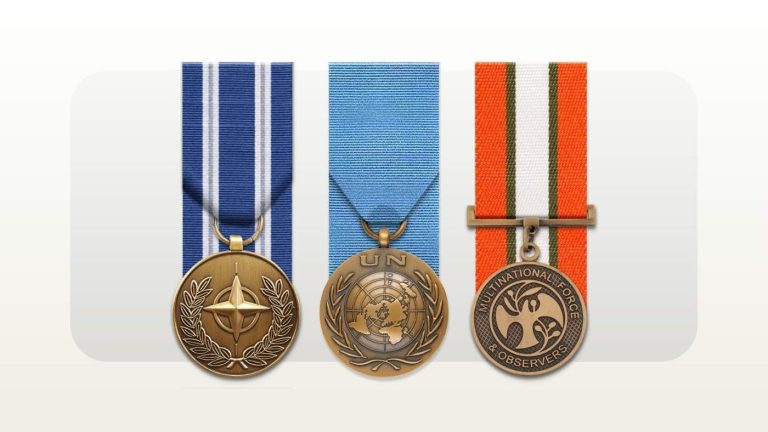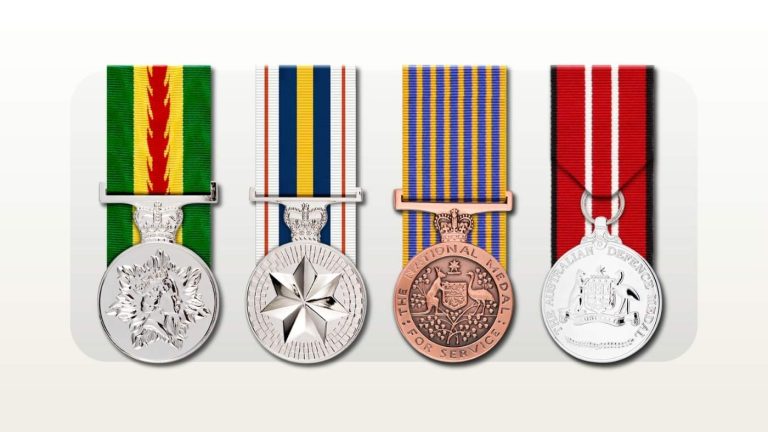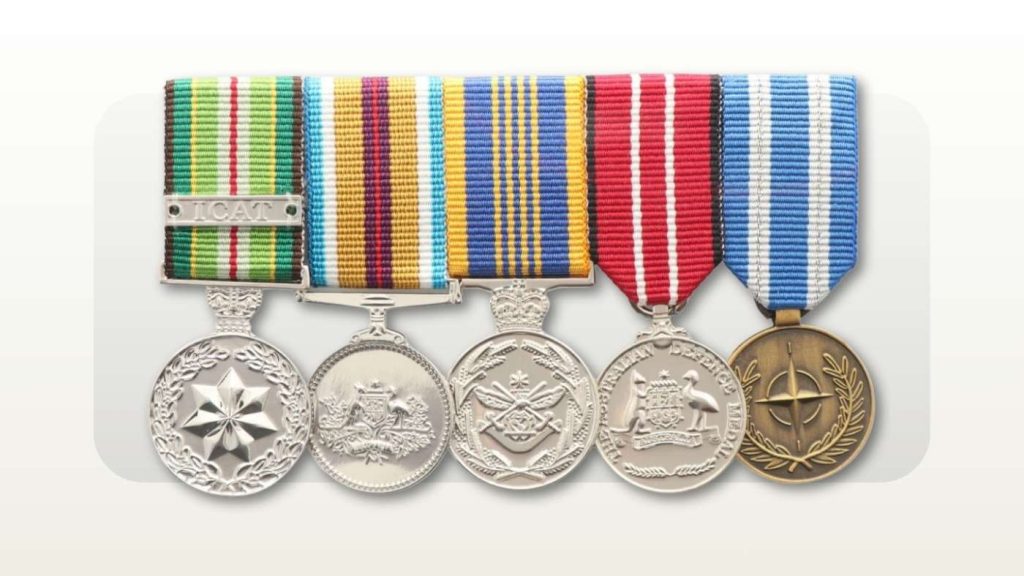
You have Australian medals and an award from another country. Can they go on the same rack? In many cases, yes. Officially approved foreign awards may be worn on the left breast under the Australian Order of Wearing, subject to any applicable service requirements.[1]
The important part is knowing where each award belongs. Start with your confirmed awards, check the instructions for your situation, and then plan the mounting. This guide focuses on arranging one recipient's medals, not deciding eligibility or combining several relatives' awards.
Start with a confirmed award list and a specific wearing occasion
Before choosing a layout, write down who received the awards and where the finished rack will be worn. An Australian Defence Force (ADF) uniform, civilian commemorative outfit and permanent display should not be treated as the same request.
For official uniforms or official duty, the February 2026 foreign award guidelines require you to follow the relevant service or agency's dress rules. Finding an award on the national approved schedule does not remove that requirement.[1]
Still unsure which awards belong to the recipient? Defence offers a full-assessment pathway for members, former members and families seeking a list of entitled awards. Resolve that question before finalising the mounting.[2]
Check the exact foreign award on the approved schedule
Use the Governor-General's Schedule of Approved Countries and Awards. Match the award name and issuing country or organisation, not simply the ribbon colours or the word "service". A country's inclusion does not mean every award from that country is approved.[3]
For example, the schedule lists the Timor-Leste Solidarity Medal under Timor-Leste. It also explains that variants of listed awards, such as levels or classes, are included. Check those details against the recipient's documents rather than relying on a product photograph.[3]
The Department of Foreign Affairs and Trade (DFAT) says Australians generally do not need separate government approval for scheduled awards, but identifies additional requirements for ADF personnel and DFAT officers. Check the pathway that applies to you instead of assuming everybody follows the same process.[4]
Arrange your Australian awards before adding the foreign section
Begin with the Australian Order of Wearing, available through the Governor-General's website. Precedence means which award comes before another. Follow each award's position in that schedule rather than arranging the Australian medals by the date you received them.[5]
Most Australian awards are worn above the left breast, and multiple medals are mounted in the prescribed order. Not every honour belongs on a bar: a neck badge, for example, is worn around the neck.[6]
On the medal bar, the highest-ranking award sits closest to the centre of the chest. Approved foreign medals normally follow the Australian awards, with specific exceptions to check below.[7][8]
Check which date applies when sorting several foreign awards
The published national and Defence instructions use different wording. Note 8 of the 2025 national schedule orders foreign awards by the date they were awarded, while expressly allowing exceptions for ADF personnel.[7]
Defence's wearing guidance instead describes an order based on the date of approval to wear. It also permits awarding-country precedence when all foreign awards were approved on the same date, and same-nation grouping for an ADF member with multiple awards from that nation.[8]
An award date and an approval date may differ. Keep both in your notes. For an ADF set, ask the relevant service which instruction and exception apply before finalising a disputed sequence. Do not assume the two dates are interchangeable or use a purchase receipt as a substitute.
For a civilian set, start with the national schedule and seek clarification if your paperwork leaves the order uncertain. Where the instructions suggest different sequences, get official confirmation before mounting.
Check older Imperial awards and the special Korea placement
Do not move every British award to the foreign section. Defence treats Imperial British honours and awards issued before 5 October 1992 as Australian awards for wearing purposes. Check the recipient's award and its prescribed position.[8]
There is also a specific exception for the United Nations Service Medal for Korea: it is worn immediately after the Korea Medal. Do not move it to the end just because it is a foreign award.[7]
These examples show why the exact medal matters more than a broad "Australian or overseas" label.
This example places a foreign campaign medal after the Australian awards
Imagine a recipient whose confirmed awards include the four medals below. Assume all relevant wearing requirements have been met. This is a hypothetical subset, not a standard entitlement list or a complete Vietnam service group.
Their relative order is:[7][9]
| Position | Award |
|---|---|
| 1. | Vietnam Medal |
| 2. | Defence Long Service Medal |
| 3. | Australian Defence Medal |
| 4. | Republic of Vietnam Campaign Medal |
The Republic of Vietnam Campaign Medal was issued by the former Republic of Vietnam government. It is not the Australian Vietnam Medal. Sharing a conflict does not make the two awards interchangeable or place them side by side automatically.[9]
Add any other confirmed medals at their own positions. Do not copy this four-medal example as a complete rack for another person.
Check the device required for the medal format you order
The correct sequence is only part of the brief. For the Republic of Vietnam Campaign Medal, Defence specifies a "1960–" device on the medal ribbon and a smaller "60–" device on the ribbon bar. Those are different formats of the authorised device, not two extra awards.[9]
Record the exact medal, clasp or device, and the format required. When ordering a ribbon bar as well as full-size medals, check both configurations rather than assuming every detail carries across unchanged.
Leave unlisted foreign awards off your official left-breast rack
The 2026 guidelines treat foreign awards not on the approved schedule as unofficial. They describe right-breast wear in appropriate private settings and advise that such medals should ideally not be worn at public ceremonial or commemorative events. Pending approval does not make an award officially approved.[1]
Keep an unresolved award separate from the final mounting instructions. An overseas presentation, attractive ribbon or available replica is not a reason to add it to the official left-breast group.
Give your mounter the sequence and the evidence behind it
Bring the decisions together in one short brief. Include:
- The recipient, intended uniform or occasion, and required medal format.
- The confirmed award sequence, identifying the foreign medals and any exception.
- The exact clasps or devices, with references to the supporting documents.
- Any official advice resolving a date, approval or placement question.
To wear a foreign award on ADF uniform, Defence asks for documentary evidence, service dates and locations, and English translations of award certificates and associated documents. Keep those administrative checks with Defence or the relevant agency rather than expecting a commercial mounter to decide them.[2]
Use Rack Builder to review your confirmed arrangement before ordering
With the award list confirmed, use Rack Builder to choose your service or jurisdiction, add medals and clasps, compare formats and review the arrangement before ordering.[10]
For an unusual foreign combination, contact Rack Builder support about the builder, format and mounting. Include your saved rack reference when available. If a medal is missing from the library, raise the issue rather than selecting a similar-looking substitute.[11]
A preview helps you check presentation; it does not grant entitlement or official permission to wear an award. Take unresolved approval or service-rule questions to the responsible authority.[1][2]
If your group also combines ADF, police or emergency service awards, our guide to mixed-service medal racks covers how those awards fit together.
Explore how Rack Builder works to plan your confirmed set, or contact Rack Builder support before placing a complex order. A clear award list and a checked sequence give you a better starting point than guesswork.[10][11]
Sources
Source pages reviewed 13 October 2026. Numbered citations in the article open the sources below.
- Governor-General: Foreign Award Guidelines, February 2026 (PDF) Gazette C2026G00100, paragraphs 8, 9 and 13: wearing status and official-duty requirements.
- Department of Defence: Application process Full assessment and foreign award applications; documentary evidence and translations.
- Governor-General: Accepting and wearing of foreign awards by Australians Approved countries and awards; schedule displayed as at 1 May 2026.
- Department of Foreign Affairs and Trade: Honours and awards Separate approval requirements for ADF personnel and DFAT officers.
- Governor-General: Australian Order of Wearing Honours and Awards Current national schedule landing page; schedule dated 15 October 2025.
- Department of the Prime Minister and Cabinet: Wearing awards Medal bars, left-breast wear and separate treatment of neck badges.
- Federal Register of Legislation: Australian Order of Wearing 2025 (PDF) Gazette C2025G00607: note 8, example sequence and Annex 1, note 7.
- Department of Defence: Wearing honours and awards Approval-date sequencing, same-country exceptions and older Imperial awards.
- Department of Defence: Republic of Vietnam Campaign Medal Foreign award identity and different devices for the medal ribbon and ribbon bar.
- Rack Builder: How it works Published service selection, medal and clasp entry, format comparison and order review.
- Rack Builder: Support Builder, mounting, format and missing-medal enquiries.