
History
The Order of Australia was instituted on 14 February 1975 by Queen Elizabeth II as an Australian society of honour for according recognition to Australian citizens and other persons for achievement or meritorious service, ending the nation's reliance on the Imperial honours. The King is Sovereign Head of the Order and the Governor-General its Chancellor. Changes of 24 May 1976 added the Medal of the Order below Member and a Knight and Dame level above Companion, and renamed the Civil Division the General Division; the knighthoods were abolished in 1986, briefly restored in 2014 and closed again in 2015.
The Medal of the Order was one of the 1976 additions, created below the Member level and awarded for service worthy of particular recognition. It is the Order's broadest reach and its most familiar face: no quota applies, and each list carries hundreds of names drawn from surf clubs and school canteens, fire sheds and hospital auxiliaries, the long volunteering that holds Australian communities together. Nominations come from the community and are considered by the Council for the Order of Australia, with announcements generally each January and June.
Design & ribbon
The medal
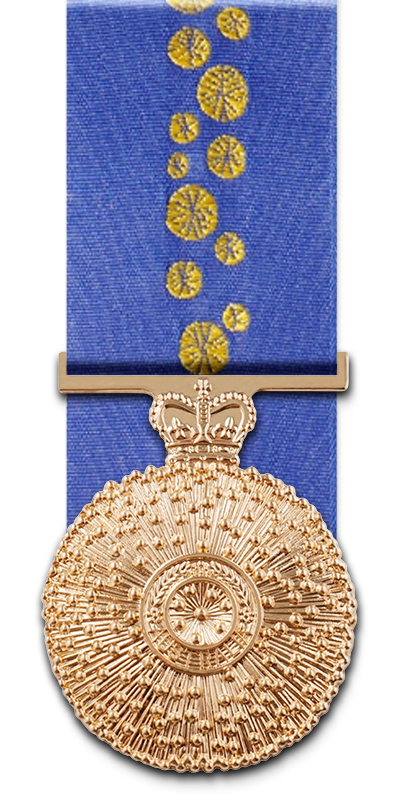
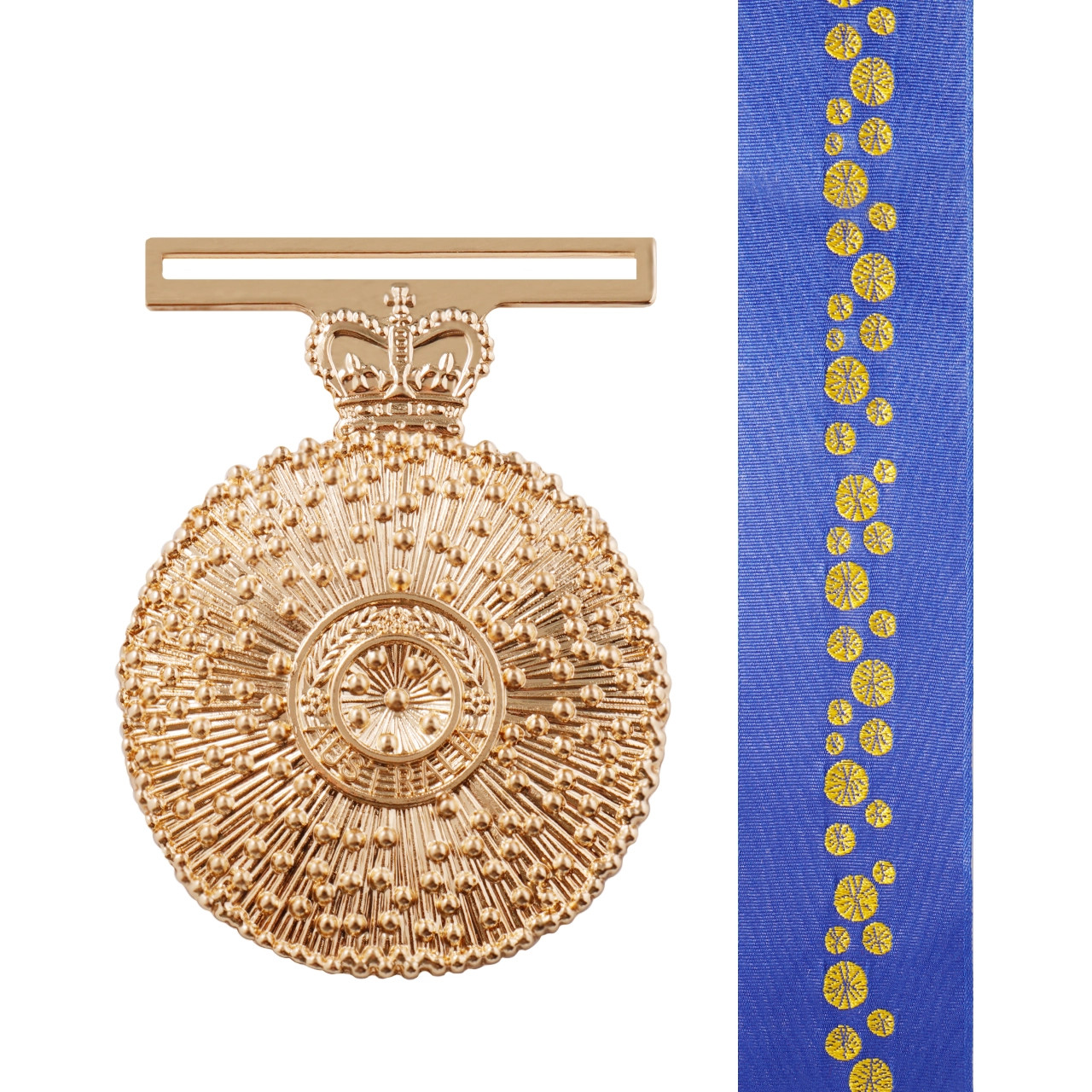
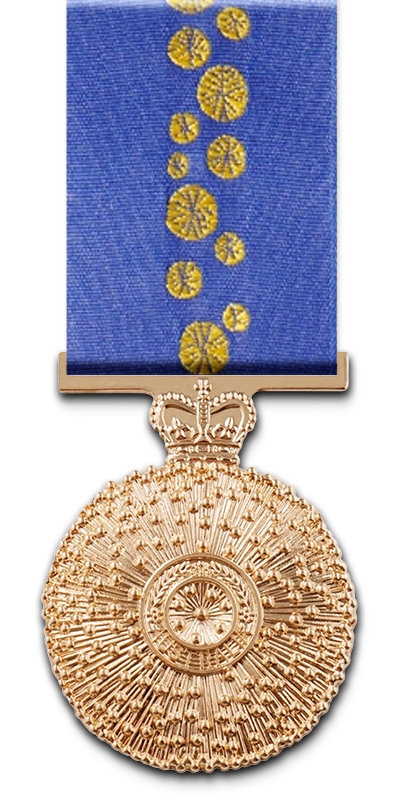
The Medal of the Order is a badge carrying the gold plated silver insignia of the Order at its centre, the Stuart Devlin mimosa design inscribed AUSTRALIA in gold capital letters. It is worn on the ribbon at the chest by men and on a bow at the shoulder by women, with a plain gold lapel pin for daily wear. The insignia is identical in both divisions.
The ribbon
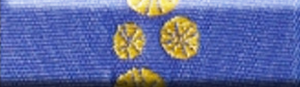
Royal blue scattered with gold mimosa, the colours of the Order.
The ribbon is royal blue with a central band of scattered gold mimosa blossoms, the national colours of Australia at the time the Order was established.
Eligibility
Awards are made by the Governor-General on the recommendation of the Council for the Order of Australia, for service worthy of particular recognition.
- Anyone may nominate an Australian citizen; nominations are confidential, independently researched, supported by referees, and considered by the nineteen member Council;
- No quota applies to the Medal, and honorary awards may be made to non-citizens;
- Recipients are entitled to the post-nominal OAM, and may also hold an award in the Military Division.
Order of wear
The Order's grades are worn among the orders of chivalry and decorations, interleaved with the Imperial awards of equivalent standing. A General Division appointment takes precedence over the equivalent appointment in the Military Division. The precise neighbours should be confirmed against the current Australian Order of Wear.
Frequently asked questions
What is the Medal of the Order of Australia awarded for?
Service worthy of particular recognition. It is the fourth level of the Order, added in 1976, and the only level without an annual quota.
Who typically receives it?
Community volunteers and long serving contributors across every field: sport, emergency services, health, education, the arts and local institutions. It is by far the most awarded level of the Order.
How is someone nominated?
Anyone may nominate an Australian citizen through the Governor-General's website. Nominations are confidential, independently researched and considered by the Council for the Order of Australia.
When are awards announced?
Generally twice a year, in the Australia Day and King's Birthday honours lists each January and June.
Is the OAM a lesser Order of Australia?
It is the fourth of four levels, but it is a full award of the same Order, carrying its own post-nominal and worn on the Order's blue and gold ribbon.
Does it carry a post-nominal?
Yes: OAM.