
History
Announced by the Prime Minister on 31 December 1998 and formally established on 23 December 1999 by Letters Patent, the Australian Sports Medal was struck for the year Sydney hosted the Olympic and Paralympic Games. Through 2000 it was awarded to more than 18,000 Australians who had contributed to the nation's sporting success: competitors and coaches, sports scientists, office holders, and the people who maintain the grounds and facilities where Australian sport actually happens. Peak sporting bodies nominated through quotas set by the Australian Sports Commission, and every Australian parliamentarian could put names forward.
The medal was discontinued in 2001, then brought back. On 4 December 2020 the regulations were amended to reactivate the award, which now commemorates participation as an official member of an Australian national team at declared international multi-sport events, commencing with the Invictus Games held in Sydney in 2018 and including the Special Olympics World Games among the declared events. A person may receive the Australian Sports Medal only once, and recipients from 2000 are not eligible for a second.
Design & ribbon
The medal
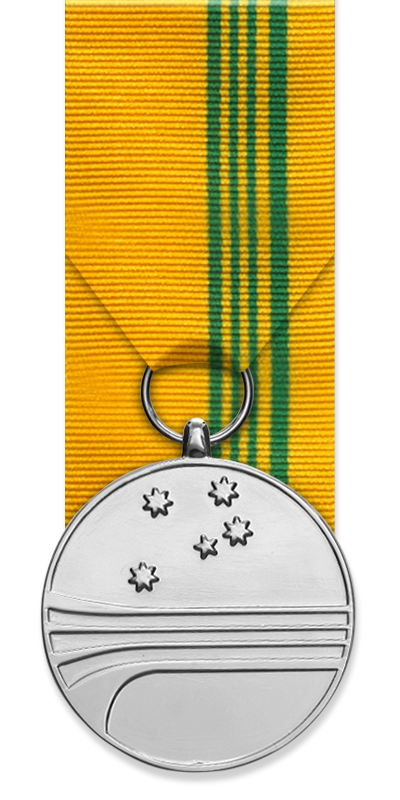
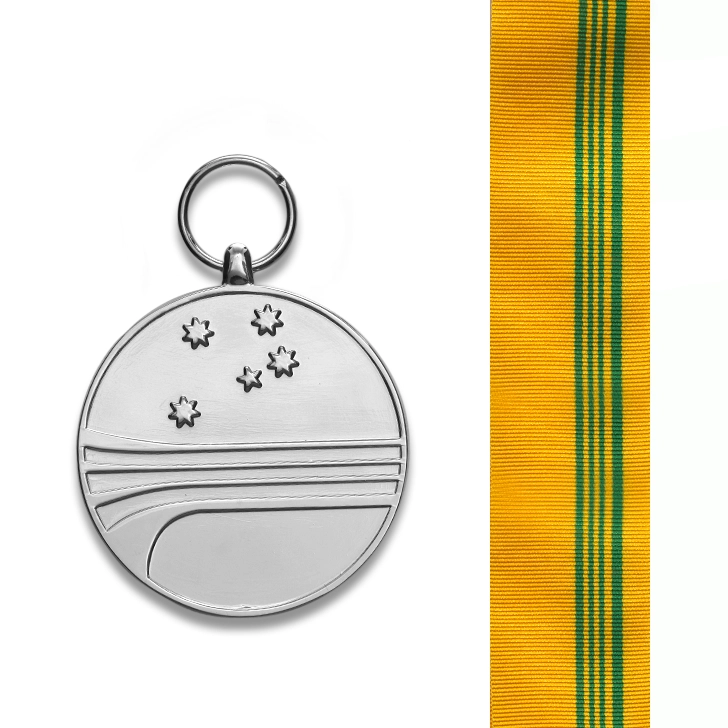
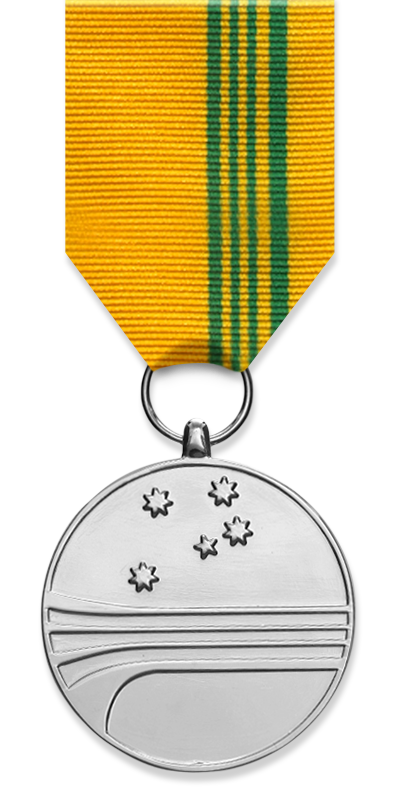
The medal is circular, in nickel-silver with a highly polished finish. The obverse symbolises Australian sport with the stars of the Southern Cross and lines depicting the athletics track at the Australian Sports Stadium in Sydney, with the words AUSTRALIAN SPORTS MEDAL in an arch inside the raised rim. The reverse repeats the track lines with the words to commemorate Australian sporting achievement in the rim, and is marked with the year 2000. The medal hangs from its ribbon by a connector piece and ring.
The ribbon
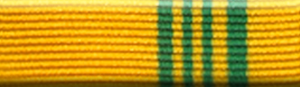
Green and gold, the national sporting colours.
The 32 millimetre ribbon is in green and gold, Australia's national sporting colours.
Eligibility
The medal is awarded by the Governor-General. In its original year it recognised contribution to Australian sport in all its forms; since reactivation it commemorates participation in Australian national teams.
- Under the current arrangements, official members of Australian teams at declared international multi-sport events are eligible, commencing with the Invictus Games in Sydney in 2018;
- Nominations are made by the Chef de Mission of the organising body for each team, who also administers the medal for that team;
- The medal may only be awarded once; recipients of the medal in 2000 are not eligible for a second.
Order of wear
The medal is worn among the Coronation, Jubilee, Remembrance and Commemorative medals, after the service awards and before the Australian long service awards. The precise neighbours in the order of wear should be confirmed against the current Australian Order of Wear.
Frequently asked questions
Who received the Australian Sports Medal in 2000?
More than 18,000 Australians who contributed to the nation's sporting success: competitors, coaches, sports scientists, office holders, and people who maintained sporting facilities and services. Nominations came through peak sporting bodies with quotas set by the Australian Sports Commission, and every parliamentarian could nominate.
Is the medal still awarded?
Yes. After being discontinued in 2001, the regulations were amended on 4 December 2020 to reactivate it. It now commemorates participation as an official member of an Australian national team at declared international multi-sport events.
Which events count under the reactivated medal?
Declared international multi-sport events, commencing with the Invictus Games held in Sydney in 2018, and including events such as the Special Olympics World Games. The full list is set out in the guidelines on the Governor-General's website.
Can I receive the medal twice?
No. The medal may only be awarded once, and recipients of the medal in 2000 are not eligible for a second.
How do I apply?
You do not apply directly. Nominations are made by the Chef de Mission of the organising body for each Australian team, who administers the medal for that team.
Does it carry a post-nominal?
No.