
History
The Australian Operational Service Medal was established on 22 May 2012 by Letters Patent and the Australian Operational Service Medal Regulations 2012, replacing the Australian Active Service Medal and the Australian Service Medal for future operations. For Defence civilians, and other classes of civilian employed on ADF operations under the provisions of the Defence Force Discipline Act 1982, the medal takes a different form: the same medal on a single civilian service ribbon, with a clasp naming each declared operation.
The first civilian clasp, East Timor, was declared on 12 December 2012. Clasps for the International Coalition Against Terrorism and the Greater Middle East Operation followed by instruments made in 2014 and 2015, and a clasp Indo-Pacific was declared by an instrument registered on 12 January 2025, keeping the civilian medal in step with the ribbons awarded to ADF members.
Design & ribbon
The medal
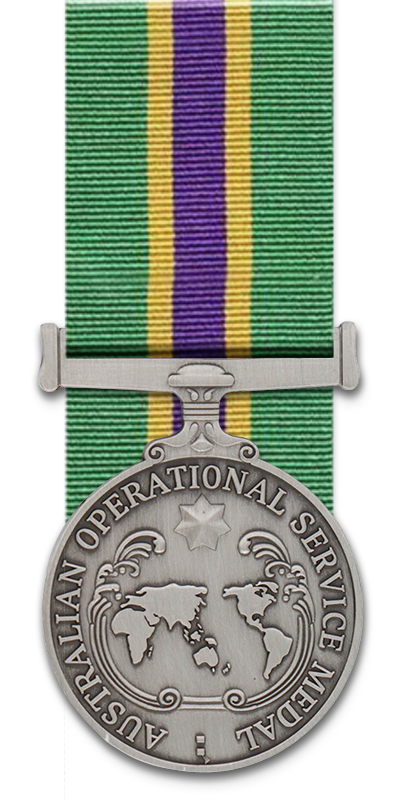
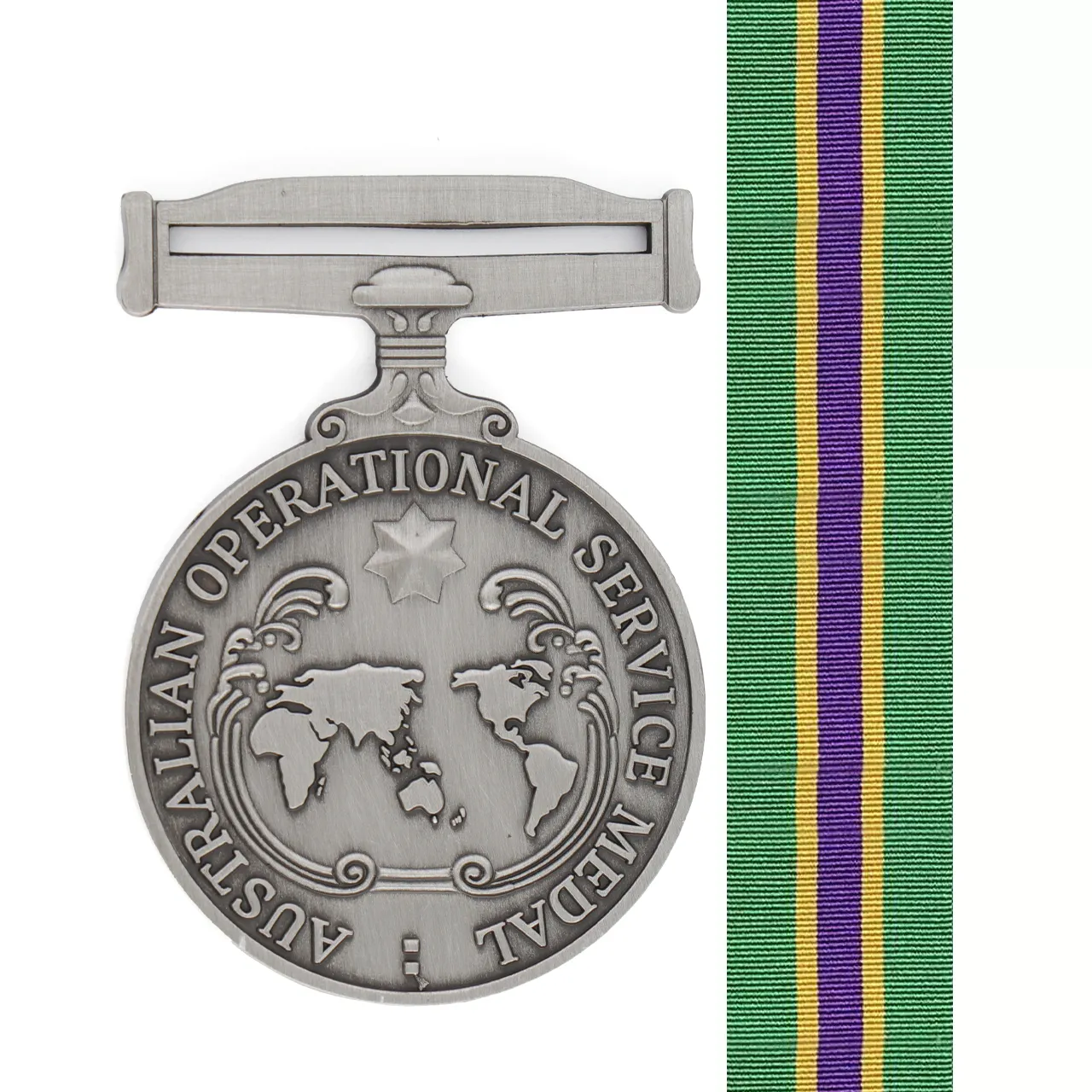
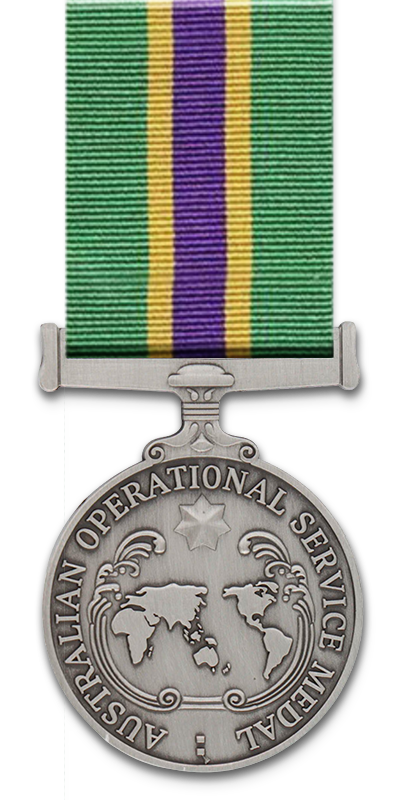
The Australian Operational Service Medal is a cupro-nickel medal finished in antique silver. The obverse bears an old-world stylised world globe signifying global operations, interlinked with a Federation Star, the globe surrounded by the words AUSTRALIAN OPERATIONAL SERVICE MEDAL. The reverse bears a central horizontal stylised scroll with the words Defending Australia and its national interests, overlaying a wreath of mimosa, above which sits an hourglass motif signifying the ongoing vigilance and timely response of Defence.
The ribbon

Green with central stripes of gold and purple, the purple for Defence, the green and gold for Australia.
The ribbon is green with central stripes of gold and purple. The purple represents Defence, and the green and gold are Australia's national colours.
Clasps
A clasp with the name of the declared operation is presented with the medal. A further award in another declared operation is recognised by an additional clasp, worn above previously awarded clasps in order of date of receipt. The following clasps have been declared.

East Timor
The first civilian clasp, declared on 12 December 2012, for civilians employed for duty on the declared East Timor operations, with a qualifying period of an aggregate of thirty days.

ICAT
Declared by instruments made in September 2014 and April 2015, for civilians employed on the declared operations of the International Coalition Against Terrorism, the Afghanistan era campaign recognised for ADF members by the Active Service Medal with clasp ICAT.

Greater Middle East Operation
Declared by instruments made in September 2014 and April 2015, for civilians employed on the declared Greater Middle East operations, the civilian counterpart of the Operational Service Medal, Greater Middle East Operation.

Iraq 2003
For eligible civilian service in Iraq, covering Operation Falconer in 2003 and Operation Catalyst from 2003 to 2009.
Solomon Islands II
For eligible civilian service with the Australian contribution in the Solomon Islands, determined in 2012.

Timor-Leste
For eligible civilian service in Timor-Leste, determined in 2012 for operations following the 2006 deployment.
Eligibility
The medal is awarded by the Governor-General on the recommendation of the Chief of the Defence Force or a delegate, to Defence civilians and other classes of civilian who are employed on ADF operations under the provisions of the Defence Force Discipline Act 1982.
- Each clasp is declared by its own instrument, which sets the operation, the area, the dates and the qualifying period, commonly an aggregate of thirty days employed for duty on the operation;
- A clasp naming the declared operation is presented with the medal, and a further award in another declared operation is recognised by an additional clasp;
- Additional clasps are worn above previously awarded clasps, in order of date of receipt.
Order of wear
The civilian medal is worn among the Australian campaign and operational awards, after the Operational Service Medals awarded to ADF members. The precise neighbours should be confirmed against the current Australian Order of Wear.
Frequently asked questions
Who can receive the civilian medal?
Defence civilians and other classes of civilian who are employed on ADF operations under the provisions of the Defence Force Discipline Act 1982.
Why does the civilian version use clasps?
ADF members receive the medal with a unique ribbon for each operation. Civilians receive one standard civilian ribbon, so a clasp naming the declared operation does the identifying instead.
Which clasps have been declared?
East Timor, declared in December 2012, ICAT and Greater Middle East Operation, declared by instruments made in 2014 and 2015, and Indo-Pacific, declared by an instrument registered in January 2025.
How much service is needed to qualify?
The qualifying period is set by the instrument for each declared operation, commonly an aggregate of thirty days employed for duty on the operation.
How is further service recognised?
A further award in another declared operation is recognised by an additional clasp, worn above previously awarded clasps in order of date of receipt.
Does it carry a post-nominal?
No.