
History
The Australian Operational Service Medal was established on 22 May 2012 by Letters Patent and the Australian Operational Service Medal Regulations 2012, replacing the Australian Active Service Medal and the Australian Service Medal for future operations. For Defence members it is awarded as a standard medal with a unique ribbon for each declared operation, and an accumulated service device denotes those who complete multiple tours on a particular operation.
The Border Protection version recognises the range of border protection operations conducted since 1997. Its coverage reaches back to Operations Cranberry, Dirk, Stanhope and Mistral in the late 1990s and runs through to Operation Resolute, the enduring Defence contribution to the security of Australian maritime areas, which commenced on 17 July 2006 and continues today.
Design & ribbon
The medal
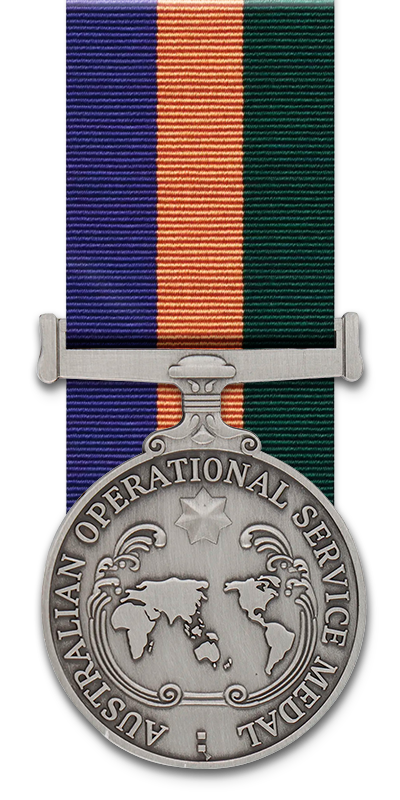
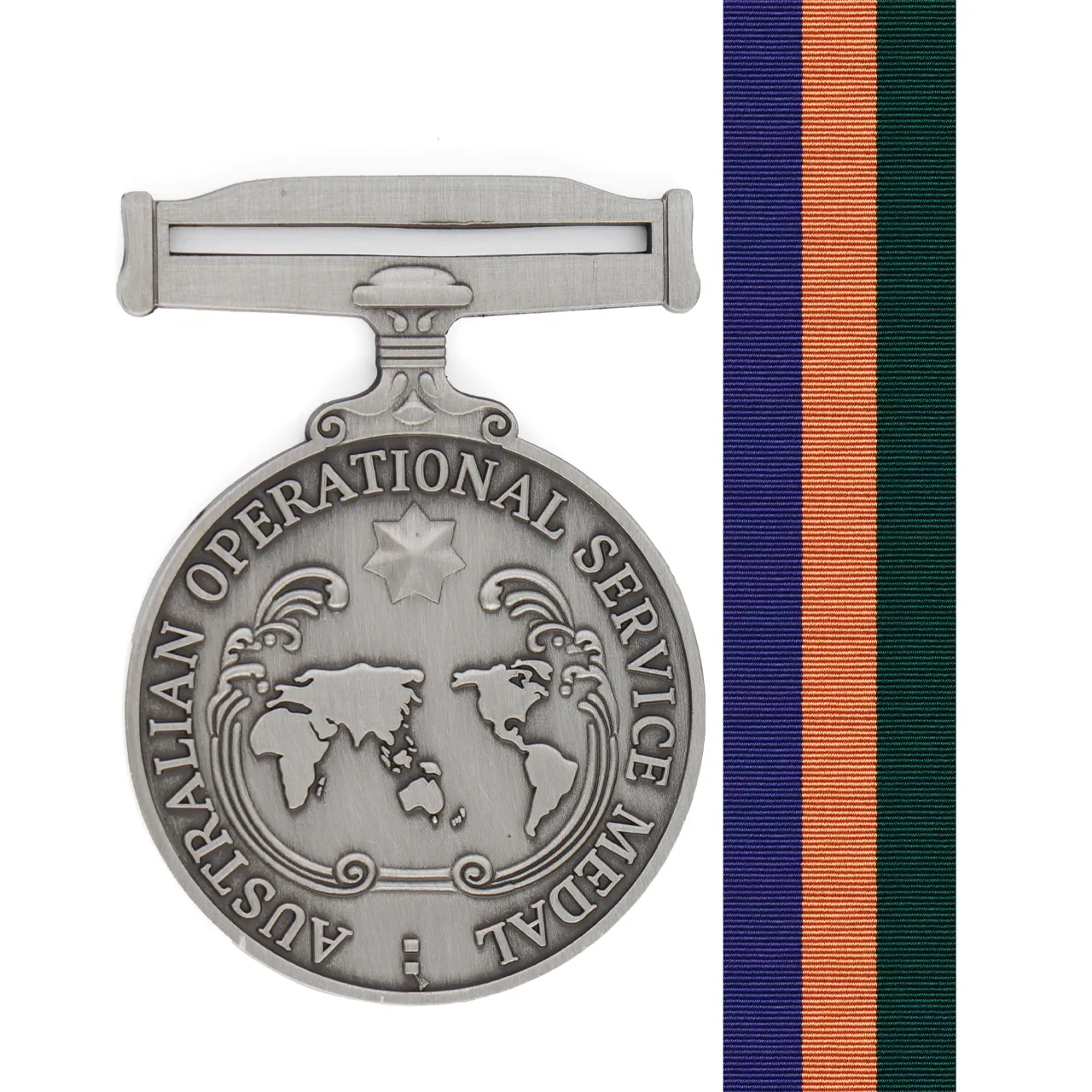
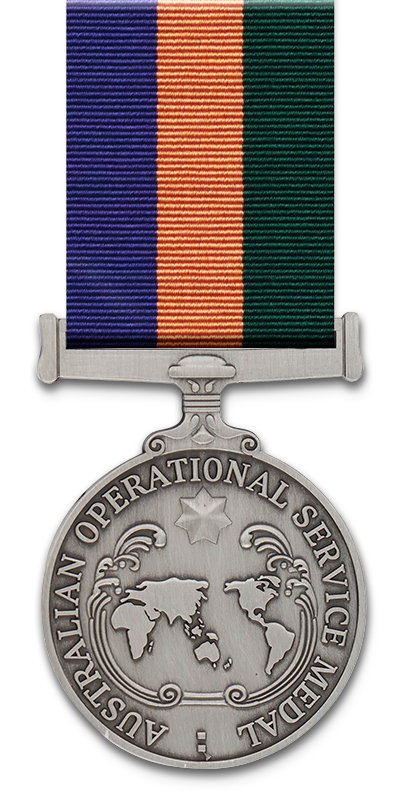
The Australian Operational Service Medal is a cupro-nickel medal finished in antique silver. The obverse bears an old-world stylised world globe signifying global operations, interlinked with a Federation Star, the globe surrounded by the words AUSTRALIAN OPERATIONAL SERVICE MEDAL. The reverse bears a central horizontal stylised scroll with the words Defending Australia and its national interests, overlaying a wreath of mimosa, above which sits an hourglass motif signifying the ongoing vigilance and timely response of Defence.
The ribbon

Dark blue, ochre and dark green for the seas and sky, the deserts, and the forests and grasslands.
The ribbon has three equal stripes of dark blue, ochre and dark green, which denote the seas and sky, the deserts, and the forests and grasslands of Australia.
Eligibility
The medal is awarded by the Governor-General on the recommendation of the Chief of the Defence Force or a delegate. Defence members must have been deployed or force assigned for duty as a member of a declared operation for a period of not less than an aggregate of thirty days, or have completed thirty sorties from a unit assigned to a declared operation, provided the sorties were flown over a period of not less than an aggregate of thirty days at a rate of one sortie per day.
- Declared operations include Cranberry, Dirk, Stanhope and Mistral from the late 1990s, and Operation Resolute from 17 July 2006 to the present;
- The declared area is defined by Australian seas and land areas and their superjacent airspace, together with Nauru and Manus Island;
- A second or subsequent qualifying period on the operation is recognised by an accumulated service device.
Order of wear
The Operational Service Medals are worn among the Australian campaign and operational awards, after the Australian Service Medal. Where a person holds more than one Operational Service Medal, they are worn in order of date of qualifying service. The precise neighbours should be confirmed against the current Australian Order of Wear.
Frequently asked questions
What is the Australian Operational Service Medal?
A campaign medal established on 22 May 2012 that replaced the Australian Active Service Medal and the Australian Service Medal for operations declared after that date. The medal design is the same for every operation, and a unique ribbon identifies each one.
Which operations count for the Border Protection medal?
The declared operations include Cranberry, Dirk, Stanhope and Mistral from the late 1990s, and Operation Resolute, the enduring border protection operation that commenced on 17 July 2006 and continues today.
How much service is needed to qualify?
An aggregate of thirty days deployed or force assigned to a declared operation, or thirty sorties from an assigned unit flown over an aggregate of at least thirty days, with no more than one sortie counted per day.
What happens if I deploy on the operation more than once?
A second or subsequent qualifying period on the same operation is recognised by an accumulated service device worn on the medal, rather than by a further medal.
Why does the medal have no clasps?
For Defence members the operation is identified by the unique ribbon, so no clasp is needed. Only the civilian version of the Operational Service Medal uses clasps, worn on its standard civilian ribbon.
Why does a 2012 medal cover service from 1997?
The medal was established in 2012, but the Border Protection declaration reached back to recognise the border protection operations conducted since 1 August 1997 that had not previously been covered by a campaign award.