
History
The Australian Service Medal was approved in 1988, with its Letters Patent gazetted in November 1988 alongside those of the Australian Active Service Medal. It may be awarded for service in, or in connection with, a prescribed non-warlike operation on or after 14 February 1975, covering peacekeeping, monitoring, humanitarian and similar duties.
Around thirty clasps have been issued across more than three decades, spanning the United Nations observer missions of the 1970s and 1980s, the peacekeeping surge of the 1990s in Cambodia, Mozambique and Western Sahara, regional stabilisation in Bougainville, the Solomon Islands and Timor-Leste, and standing counter terrorism duty at home. Since the Australian Operational Service Medal was established in 2012, new operations have gone to that medal, and from late 2023 the long running Middle East, Sinai and South Sudan clasps transitioned to Operational Service Medal variants.
Design & ribbon
The medal
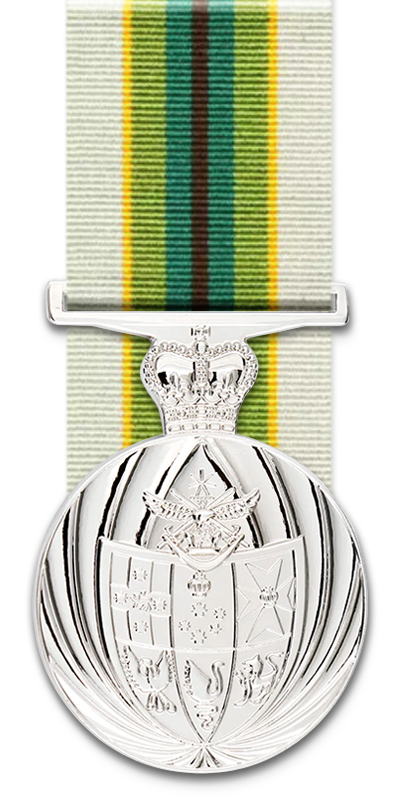
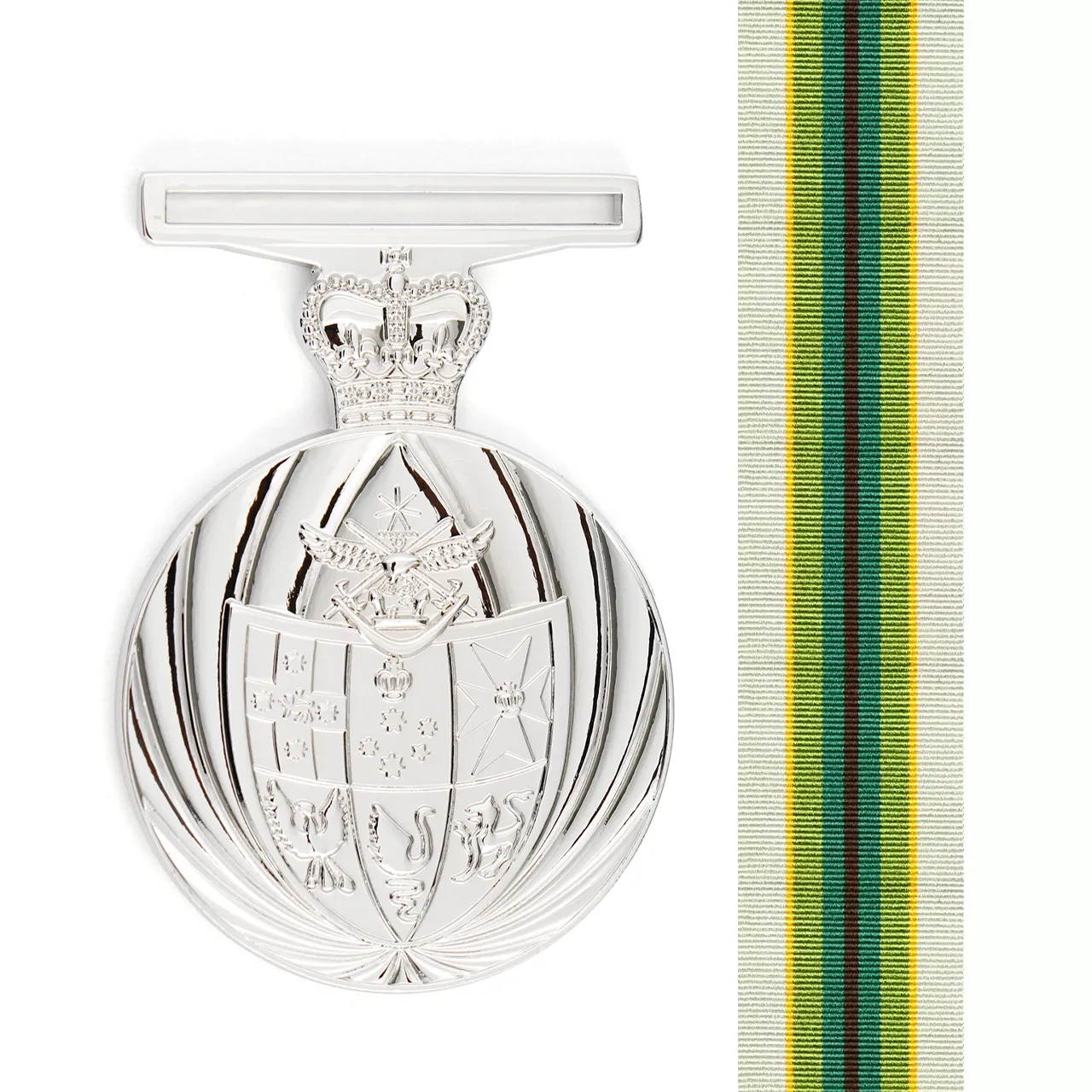
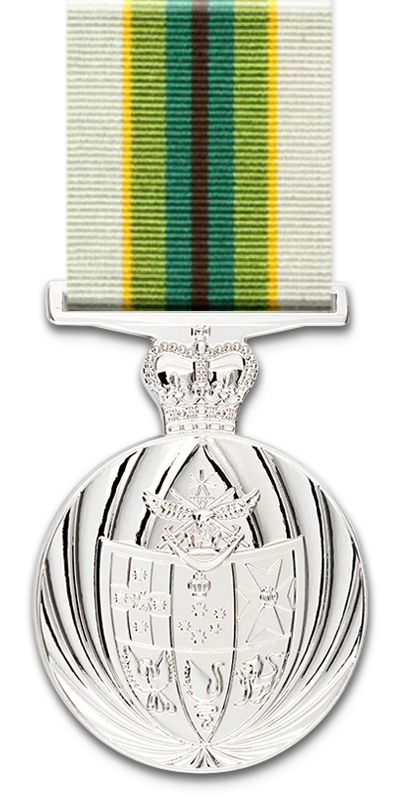
The medal is nickel-silver. The obverse bears a modified shield of the Australian Coat of Arms surmounted by the Defence Force Joint Service Emblem, superimposed on a background of the meridians of longitude. The reverse has clusters of mimosa blossoms surrounding a Federation Star bearing the inscription FOR SERVICE. A nickel-silver clasp with the name of the theatre or action is presented with the medal.
The ribbon
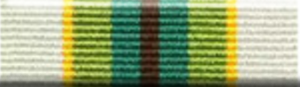
Green and gold in the tones of the Australian bush, with a central brown stripe for the earth of Australia.
The ribbon colours are variations of the Australian green and gold in the tones of the Australian bush. The central brown stripe symbolises the earth of Australia.
Clasps
A clasp naming the theatre or action for which the award is made is presented with the medal. Further awards in other areas are recognised by additional clasps, worn above those previously awarded in order of date of receipt. The clasps issued include the following.

Balkans
For Operation Osier with the NATO Stabilisation Force in the former Yugoslavia, 25 January 1997 to 16 April 2012. Earlier Balkans service is recognised by the Active Service Medal.

Bougainville
For service with the Truce Monitoring Group and Peace Monitoring Group in Bougainville, 20 November 1997 to 26 August 2003.

Cambodia
For the United Nations Military Liaison Team and the Cambodian Mine Action Centre, 8 October 1993 to 4 October 1999. The earlier UNTAC period was upgraded to the Active Service Medal.

CT/SR
The Counter Terrorism and Special Recovery clasp, for service in a Tactical Assault Group or Recovery Force from 31 August 1979 to 31 October 2020, with a qualifying period of sixty days continuous service. It is not awarded where the clasp Special Ops covers the same period.

East Timor
For humanitarian work on Operation Faber in 1975, the United Nations Assistance Mission in East Timor in 1999, Defence Cooperation Program activities, and Operations Citadel, Spire and Chiron to 11 May 2006. Later service is recognised by the clasp Timor-Leste.
Ethiopia/Eritrea
For Operation Pomelo, the ADF contribution to the United Nations Mission in Ethiopia and Eritrea, 15 January 2001 to 31 May 2005.

Gulf
For Royal Australian Navy activity in the Persian Gulf and Gulf of Oman between 17 November 1986 and 28 February 1989.

Iran/Iraq
For service with the United Nations Iran-Iraq Military Observer Group on the border between the two countries, 12 August 1988 to 1 January 1991.

Iraq
For Operations Habitat, Blazer and Pollard, authorised third country deployments, and the non-warlike component of the coalition no-fly zone patrols, between 1991 and January 2003. The warlike component is recognised by the Active Service Medal with clasp Iraq.

Irian Jaya
For the Operation Cenderawasih series of survey operations conducted between 1976 and 1981.

Kashmir
For service with the United Nations Military Observer Group in India and Pakistan, 14 February 1975 to 31 December 1985. It is not awarded where the Australian Service Medal 1945-1975 with clasp Kashmir has been received.

Korea
For duty with United Nations Command Military Armistice Commission activities on the Korean Peninsula, 14 February 1975 to 1 December 2024.

Kuwait
For the multinational deployment in the Persian Gulf from 2 August 1990 to 16 January 1991, and for Operation Damask from 1 March 1991 to 15 July 2003.

Middle East
For observer service with the United Nations Truce Supervision Organisation, the Disengagement Observer Force, the second Emergency Force and the Interim Force in Lebanon, and Royal Australian Navy deployments in the North West Indian Ocean, from 14 February 1975. The clasp closed on 31 October 2023 when Operation Paladin service transitioned to the Operational Service Medal, Greater Middle East Operation.
Peshawar
For service with the United Nations Mine Clearance Training Team in Pakistan, 16 July 1989 to 31 December 1993.

Sinai
For the Multinational Force and Observers in the Sinai from 1982 to 1986 and on Operation Mazurka from 1993. The clasp closed on 31 October 2023 when the service transitioned to the Operational Service Medal, Greater Middle East Operation.

Solomon Islands
For Operation Trek, the International Peace Monitoring Team in the Solomon Islands, 4 November 2000 to 15 March 2002.

Solomon Islands II
For Operation Anode, the Defence contribution supporting the Australian Government's strengthened assistance to the Solomon Islands Government, 24 July 2003 to 30 September 2013.

Somalia
Revoked. The declaration was withdrawn in 2023 and eligibility for this clasp was cancelled. Service in Somalia from 17 October 1992 to 30 April 1993 is now recognised by the Active Service Medal with clasp Somalia, and the Service Medal clasp is kept as a memento rather than worn.

South East Asia
For land service in Malaysia and Singapore, Royal Australian Navy ships with the ANZUK force, and Operation Gading 5 on Sumatra, from 14 February 1975.

South Pacific 2006
For Operation Quickstep, the ADF contribution to the safety of Australians and approved foreign nationals in Fiji, 31 October to 22 December 2006.

South Sudan
For Operation Aslan, the ADF contribution to the United Nations Mission in the Republic of South Sudan, 23 September 2011 to 31 October 2023, after which the service transitioned to the Operational Service Medal, Africa.

Special Ops
For service on special operations, for activities and dates as specified by the Chief of the Defence Force, 14 February 1975 to 31 October 2019.

Sudan
For Operation Azure with the United Nations Mission in Sudan from 2005 to 2011, and Operation Hedgerow with the United Nations and African Union Mission in Darfur from 2008 to 2011.

Timor-Leste
For Operation Astute from 12 May 2006, Defence Cooperation Program activities, Operations Citadel, Spire and Chiron after May 2006, and Operation Tower with the United Nations mission to 12 December 2012.
Uganda
For service with the Commonwealth Military Training Team in Uganda, 18 March 1982 to 24 March 1984.

West Sahara
For ADF activities in Western Sahara, 5 September 1991 to 15 December 2012.
Eligibility
The medal is awarded by the Governor-General on the recommendation of the Chief of the Defence Force or a delegate, for service in or in connection with a prescribed non-warlike operation. Each operation is declared by its own instrument, which sets the area, the dates and the qualifying period.
- The qualifying period is commonly thirty days, though it ranges from seven days for some operations to ninety days for the early observer missions, and sixty days continuous service for counter terrorism duty;
- Service already recognised at the warlike level by the Active Service Medal for the same period is not counted again;
- There is no post-nominal for the medal.
Order of wear
The medal is worn among the Australian campaign and operational awards. The precise neighbours in the order of wear should be confirmed against the current Australian Order of Wear.
Frequently asked questions
What service does the Australian Service Medal recognise?
Non-warlike service in or in connection with prescribed operations on or after 14 February 1975, including peacekeeping, monitoring, humanitarian and counter terrorism duties. Warlike service in the same era is recognised by the Australian Active Service Medal.
How many clasps have been issued?
Around thirty, from Kashmir and the Middle East in the 1970s through Bougainville, the Solomon Islands and Timor-Leste. The full list and the exact criteria for each are set out in the Declarations and Determinations.
What happened to the clasp Somalia?
It was revoked in 2023. Service in Somalia from October 1992 to April 1993 is now recognised by the Active Service Medal with clasp Somalia, and the old Service Medal clasp is kept as a memento rather than worn.
Is the Australian Service Medal still awarded?
Applications are still processed for service within declared operations and dates, and the Korea clasp ran to 1 December 2024. Operations declared after 22 May 2012 are recognised by the Australian Operational Service Medal, and several clasps transitioned to that medal from late 2023.
How much service is needed to qualify?
Commonly thirty days within the declared operation, though the period varies from seven days to ninety days depending on the declaration, and counter terrorism duty required sixty days of continuous service.
Does it carry a post-nominal?
No.