
History
The Australian Active Service Medal was established on 13 September 1988 by Letters Patent, gazetted that November, to recognise the service of Australian Defence Force members and certain other persons in prescribed warlike operations on or after 14 February 1975. It was created as the warlike counterpart to the Australian Service Medal, as the young Australian honours system took over campaign recognition from the Imperial system.
Because the medal is always awarded with a clasp naming the prescribed operation, its clasps trace three decades of deployments: the Gulf War of 1991, Somalia and Rwanda, the Balkans, the East Timor intervention, and the International Coalition Against Terrorism clasp for the Afghanistan era. Since the Australian Operational Service Medal was established on 22 May 2012, new operations have been recognised by that medal, while operations already declared for the Active Service Medal continued under it, with Operation Slipper service running to 31 December 2014 and Operation Palate II to March 2017.
Design & ribbon
The medal
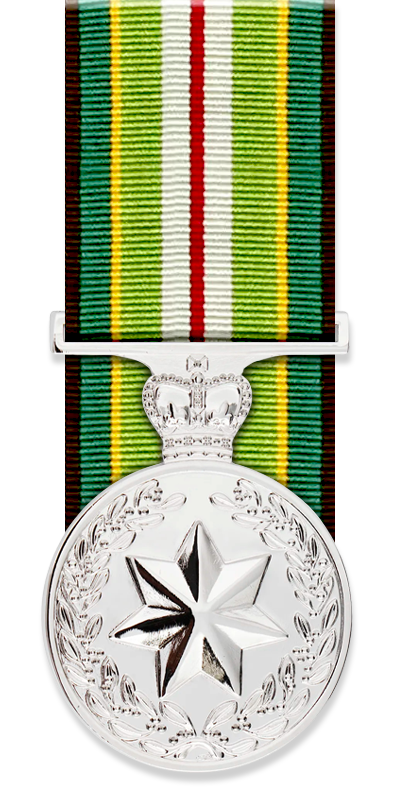
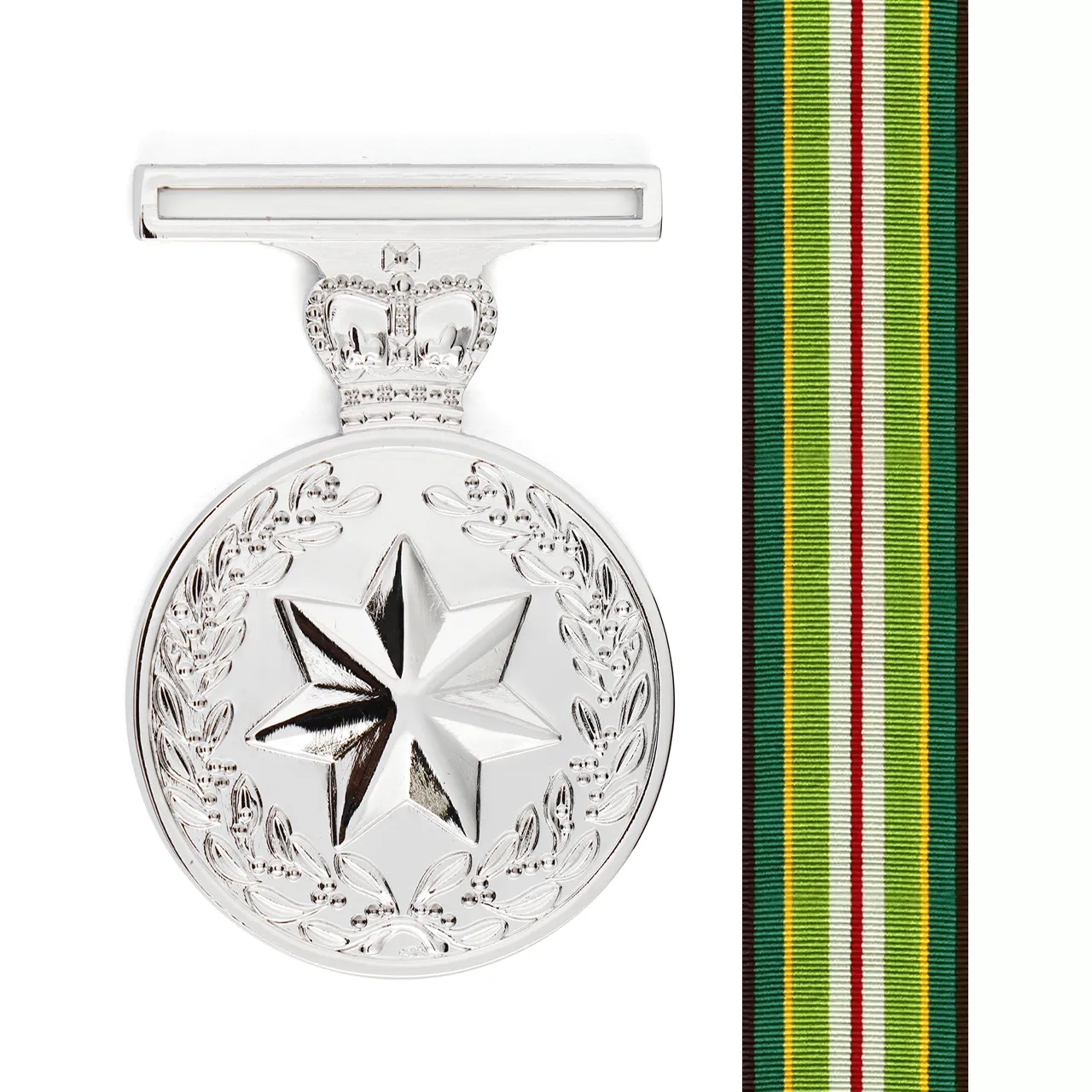
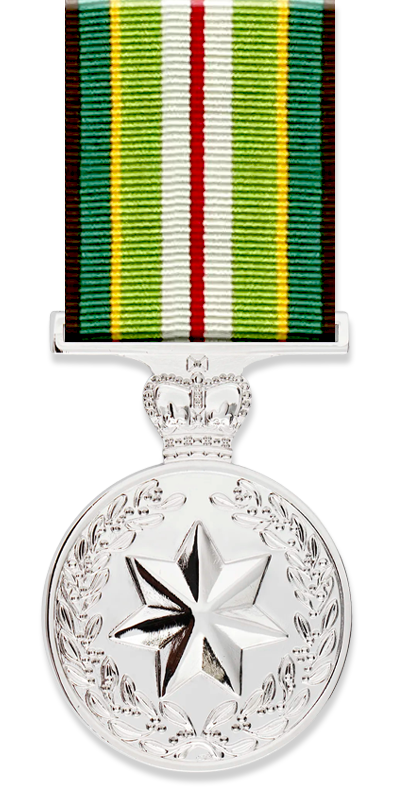
The Australian Active Service Medal is a nickel-silver medal ensigned with the Crown of St Edward. The obverse shows a Federation Star flanked by a wreath of mimosa. The reverse bears a stylised laurel wreath surrounding the inscription FOR ACTIVE SERVICE. A nickel-silver clasp carrying the name of the prescribed operation is presented with the medal.
The ribbon
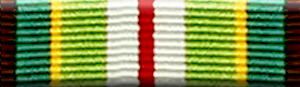
A central red stripe for the danger of warlike operations, set within bands of Australian green and gold.
The ribbon has a central red stripe symbolising the danger of warlike operations. It is flanked by stripes of silver-green, which are in turn flanked by stripes of light green, gold, dark green and brown, the colours being variations of the Australian green and gold.
Clasps
The medal is always awarded with a clasp naming the theatre or action for which the award is made. A further award of the medal in another area is recognised by an additional clasp, worn above previously awarded clasps in order of date of receipt. The following clasps have been issued.

Balkans
For United Nations peacekeeping activities in the former Yugoslavia from 12 January 1992 to 24 January 1997. The period was upgraded from the Australian Service Medal, and service on or after 25 January 1997 is recognised by the Service Medal with clasp Balkans.

Cambodia
For service with the United Nations Transitional Authority in Cambodia from 20 October 1991 to 7 October 1993, upgraded from the Australian Service Medal.

East Timor
For Operations Faber, Warden, Tanager and Citadel, covering the United Nations mission, the International Force East Timor and the transitional administrations, from September 1999 to August 2003.

ICAT
The International Coalition Against Terrorism clasp, for Operation Slipper in the Middle East forward area from 11 October 2001 to 31 December 2014, service at Diego Garcia, and Operations Palate and Palate II supporting the United Nations in Afghanistan to March 2017.

Iraq
For the no-fly zone era: Operations Jural, Provide Comfort, Bolton, Southern Watch and Northern Watch, patrolling the Iraq no-fly zones with United Kingdom and United States coalition elements between 1991 and January 2003.

Iraq 2003
For Operation Falconer, the ADF contribution to the coalition operations in Iraq from 18 March 2003, Operation Catalyst to July 2009, and Operations Riverbank and Kruger providing security in Iraq to December 2013.

Kuwait
For service with the multinational deployment in the Persian Gulf during the Gulf War, 17 January to 28 February 1991, and for service on HMAS Canberra on Operation Damask VI in January 1993.

Middle East
For ADF members engaged with the United Nations Truce Supervision Organisation in southern Lebanon from 12 July to 14 August 2006, upgraded from the Australian Service Medal for that period.

Namibia
For service with the United Nations Transition Assistance Group in Namibia from 18 February 1989 to 10 April 1990, upgraded from the Australian Service Medal.

Rwanda
For Operation Tamar, the ADF contribution to the United Nations Assistance Mission for Rwanda, from 25 July 1994 to 8 March 1996, upgraded from the Australian Service Medal.

Sierra Leone
For service with the International Military Advisory and Training Team in Sierra Leone from 15 January 2001 to 28 February 2003.

Somalia
For Operations Iguana and Solace and the second United Nations operation in Somalia between October 1992 and March 1995. A 2023 declaration consolidated recognition of the earliest period under this clasp, replacing the former Service Medal clasp.

Vietnam 1975
For RAAF activities supporting UNICEF from Butterworth in the final weeks of the Vietnam War, 29 March to 28 April 1975.
Eligibility
The medal is awarded by the Governor-General on the recommendation of the Chief of the Defence Force or a delegate, for service in a prescribed warlike operation on or after 14 February 1975. Each operation is declared by its own instrument, which sets the area, the dates and the qualifying period.
- For members allotted or assigned to an operation, the qualifying period is commonly one day of service or one sortie, while visitors and members on temporary duty commonly require thirty days;
- Several clasps, including Balkans, Cambodia, Namibia and Rwanda, were upgraded from the Australian Service Medal after the service was reclassified as warlike;
- There is no post-nominal for the medal.
Order of wear
The medal is worn among the Australian campaign and operational awards. The precise neighbours in the order of wear should be confirmed against the current Australian Order of Wear.
Frequently asked questions
What is the difference between the Active Service Medal and the Service Medal?
The Active Service Medal recognises warlike service, while the Australian Service Medal recognises non-warlike and peacekeeping service. Some operations were upgraded from one to the other when the nature of the service was reassessed.
Why is the medal always worn with a clasp?
The clasp names the prescribed operation for which the award is made. Further service in another prescribed operation is recognised by an additional clasp, worn above earlier clasps in order of date of receipt.
Is the Australian Active Service Medal still awarded?
Applications are still processed for service within operations declared before 2012. Operations declared after 22 May 2012 are recognised by the Australian Operational Service Medal instead.
Which clasp covers Afghanistan service?
The clasp ICAT covers Operation Slipper service to 31 December 2014 and Operations Palate and Palate II to 2017. The same deployments are also recognised by the Afghanistan Medal, and service from 2015 falls under the Operational Service Medal, Greater Middle East Operation.
How much service is needed to qualify?
The qualifying period is set by the declaration for each operation. It is commonly one day of service or one sortie for members allotted or assigned to the operation, and thirty days for visitors or members on temporary duty.
Does it carry a post-nominal?
No.