
History
The United Nations Mission in Haiti, UNMIH, was established in September 1993 to help implement the Governors Island Agreement, modernise the Haitian armed forces and build a new national police force, after the coup that had overthrown the elected government. The mission was delayed by the non-cooperation of the Haitian military, deploying in strength only in 1994, and ran until June 1996. A series of further missions followed, all sharing this medal and ribbon, distinguished by a bar.
Australia contributed a contingent to the Haiti mission in 1994 and 1995, part of the international effort to restore order and rebuild the country's institutions. The medal was awarded for ninety days' service. As a foreign award it takes its place in the Australian Order of Wearing among the United Nations medals.
Design & ribbon
The medal
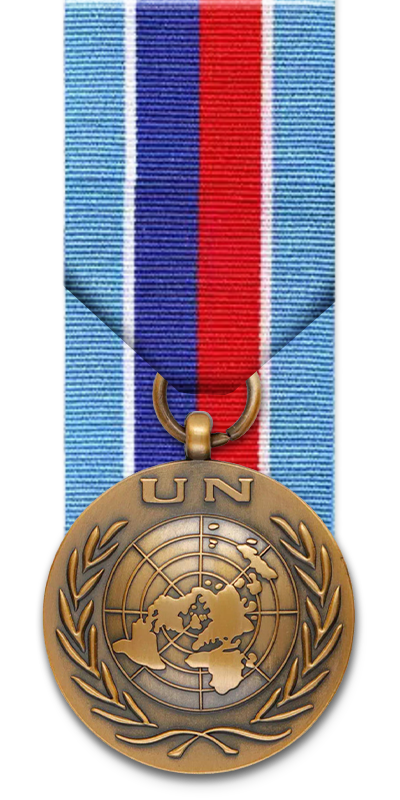
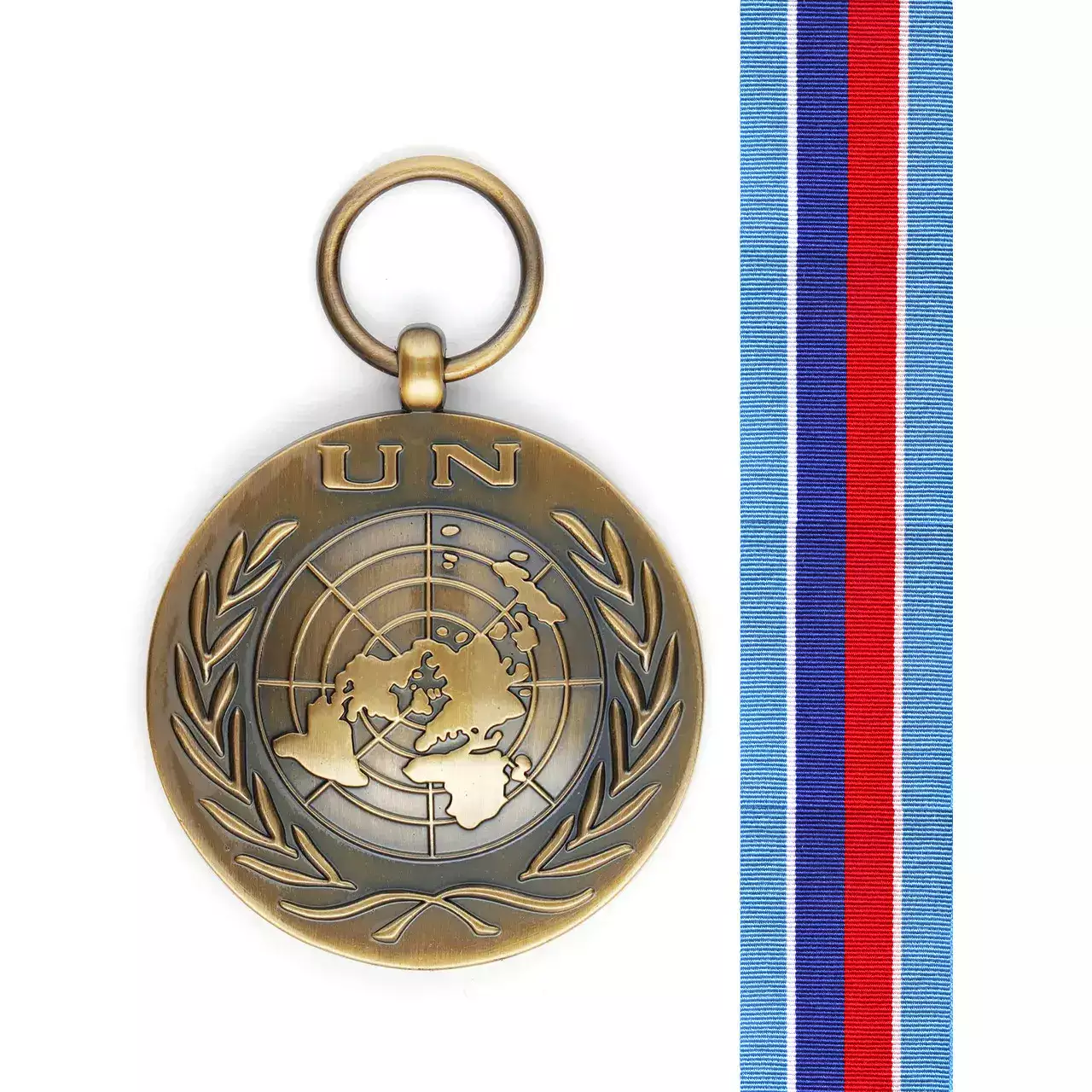
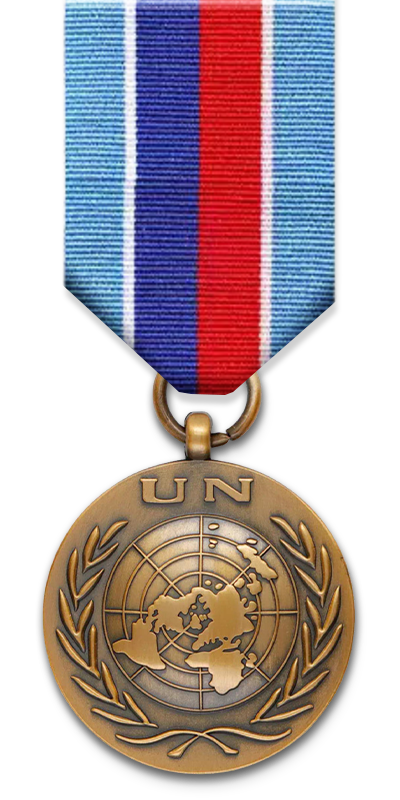
The medal follows the standard United Nations design: a circular bronze medallion 35 millimetres in diameter, the obverse bearing the emblem of the United Nations, a world map seen from the north pole within a wreath of olive branches, surmounted by the letters UN. The reverse carries the words IN THE SERVICE OF PEACE in relief. United Nations medals are issued unnamed, and the mission is identified by the colours of the ribbon.
The ribbon
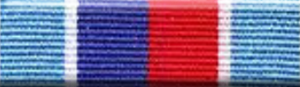
Haitian blue and red bordered in UN blue and white.
The ribbon carries the royal blue and red of the Republic of Haiti in the centre, bordered by United Nations blue with two white lines denoting the friendship between the nation and the United Nations.
Clasps
A bronze bar may be worn naming the specific Haitian mission served.
United Nations Number 1
A silver numeral worn on the ribbon of the medal. United Nations numerals record the number of qualifying periods of service completed with the mission.
United Nations Number 2
A silver numeral recording a second qualifying period of service with the mission.
United Nations Number 3
A silver numeral recording a third qualifying period of service with the mission.
United Nations Number 4
A silver numeral recording a fourth qualifying period of service with the mission.
Eligibility
The medal is awarded for service with the United Nations Mission in Haiti and its successor missions.
- Ninety days' service with the mission qualifies; Australia contributed a contingent in 1994 and 1995;
- A bronze bar may be worn naming the specific mission, for those who served the successor missions that share this ribbon;
- As a foreign award it takes its place in the Australian Order of Wearing among the United Nations medals.
Order of wear
United Nations medals are awarded by the United Nations and accepted and worn by Australians who served the mission. In the Australian Order of Wearing they are worn after Australian honours and campaign awards, among the foreign awards, in the sequence set for United Nations service, which generally follows the dates of the missions.
Frequently asked questions
What is the UN Haiti Medal awarded for?
Service with the United Nations Mission in Haiti, UNMIH, established in 1993 to rebuild the country's armed forces and police after a coup, and with the successor missions that shared its medal and ribbon.
What do the ribbon colours mean?
The royal blue and red of the Republic of Haiti in the centre, bordered by United Nations blue with two white lines for the friendship between the nation and the United Nations.
What was Australia's role?
Australia contributed a contingent to the mission in 1994 and 1995, part of the international effort to restore order.
What do the bars mean?
A bronze bar names the specific Haitian mission served, for those who qualified for one of the successor missions on the same ribbon.
What is the qualifying period?
Ninety days' service with the mission.
Is it named to the recipient?
No; United Nations medals are issued unnamed.