
History
The Netherlands War Cross, the War Commemorative Cross, was established in 1944 by royal decree of Queen Wilhelmina, at a time when the Dutch government in exile sought to recognise those who continued to fight for the kingdom from beyond the occupied homeland. It was awarded for service in the armed forces, the merchant navy, the fishing fleet or civil aviation outside occupied territory, from May 1940, for six months or more of faithful service.
Its clasps name the many theatres and kinds of service in which the free Dutch fought on against Germany, Japan and their allies, from the defence of the Netherlands in 1940 to the war in East Asia and the South Pacific. Australians who served in connection with the Netherlands forces, particularly in the Netherlands East Indies and the South West Pacific, could be recognised by it. As a foreign award it is worn in the Australian Order of Wearing after Australian and Commonwealth honours.
Design & ribbon
The medal
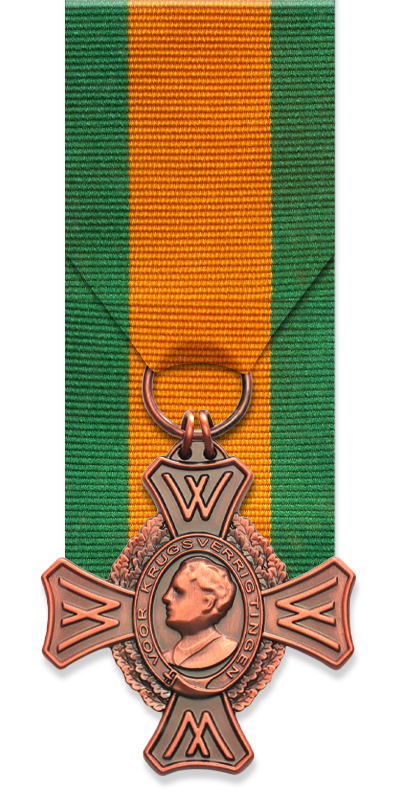
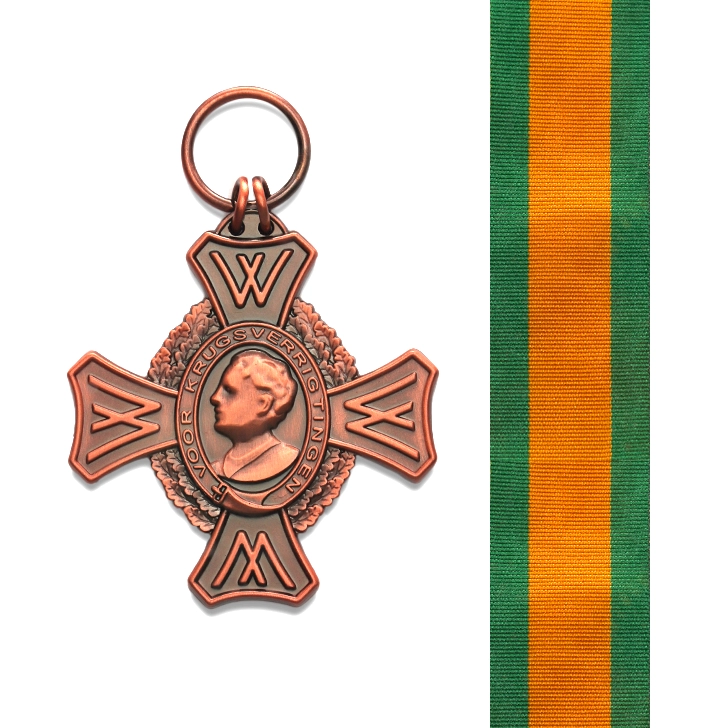
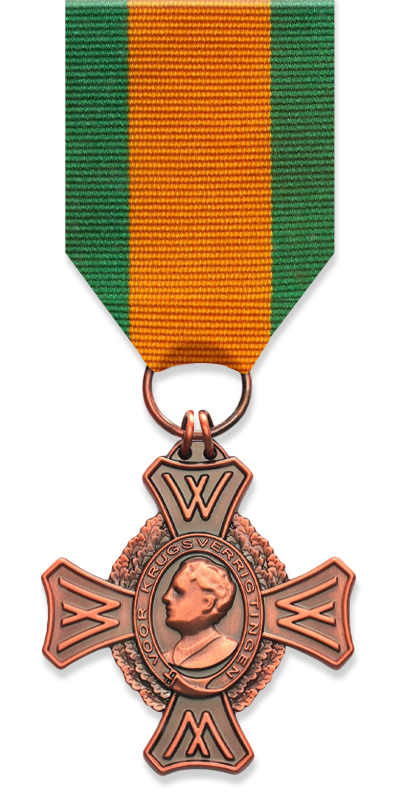
The medal is a bronze cross of four arms with concave ends, forty millimetres across. The obverse bears a central oval portrait of Queen Wilhelmina within a garter inscribed VOOR KRIJGSVERRICHTINGEN, meaning For Military Operations, each arm bearing her monogram W, with an oak wreath between the arms. The reverse is plain.
The ribbon
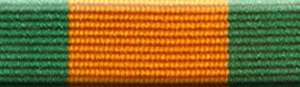
Orange with a green band at each edge.
The ribbon is orange with a green band at each edge. The cross is awarded with one or more clasps naming the theatre or the kind of service.
Clasps
The cross is awarded with one or more clasps naming where or how its wearer served.
Eligibility
The cross was awarded for service to the Netherlands outside occupied territory during the Second World War.
- Service in the armed forces, merchant navy, fishing fleet or civil aviation outside occupied territory, from May 1940, for six months or more, was required;
- Australians who served in connection with the Netherlands forces, particularly in the Netherlands East Indies and the South West Pacific, could be recognised by it;
- As a foreign award it is worn in the Australian Order of Wearing after Australian and Commonwealth honours.
Order of wear
In the Australian Order of Wearing, foreign awards are worn after Australian honours and Commonwealth awards, in the order set for foreign awards, generally by the date of the service for which they were given. A foreign award is worn only where its acceptance and wear have been approved.
Frequently asked questions
What is the Netherlands War Cross awarded for?
Service to the Netherlands outside occupied territory during the Second World War, in the armed forces, merchant navy, fishing fleet or civil aviation, for six months or more from May 1940.
What is the Australian connection?
Australians who served in connection with the Netherlands forces, particularly in the Netherlands East Indies and the South West Pacific, could be recognised by the cross.
What do the clasps mean?
They name the theatre or the kind of service, such as the defence of the Netherlands in May 1940, or the war in East Asia and the South Pacific, along with service at sea, in the air and in the merchant and fishing fleets.
What does the obverse show?
A central oval portrait of Queen Wilhelmina within a garter inscribed VOOR KRIJGSVERRICHTINGEN, For Military Operations, with her monogram W on each arm and an oak wreath between the arms.
What do the ribbon colours mean?
Orange, the national colour of the Netherlands, with a green band at each edge.
How is it worn in Australia?
As a foreign award, after Australian and Commonwealth honours in the Australian Order of Wearing.