
History
The Meritorious Service Medal began in 1845 as a British Army award for warrant officers and sergeants of long and meritorious service, carrying a small annuity that kept its numbers deliberately low. From 1895 it was extended to the local permanent forces of the Empire, and the Australian colonies of New South Wales, Victoria, Queensland, South Australia and Tasmania each awarded their own version with the colony's name on the reverse and a distinct ribbon. After Federation these were replaced from 1903 by a single Commonwealth issue, its reverse inscribed COMMONWEALTH OF AUSTRALIA.
The George V issue spans 1910 to 1936, the era in which the medal's Australian recipients were the backbone of the small permanent forces: the regimental sergeant majors and senior instructors who had trained the AIF's generation and then held the army together through the lean interwar years. During the same reign the Imperial medal was also used, from 1916 to 1928, as an immediate award for non-operational gallantry and valuable war service, and more than 1,200 Australians of the First World War received it in that form on the United Kingdom ribbon.
Design & ribbon
The medal
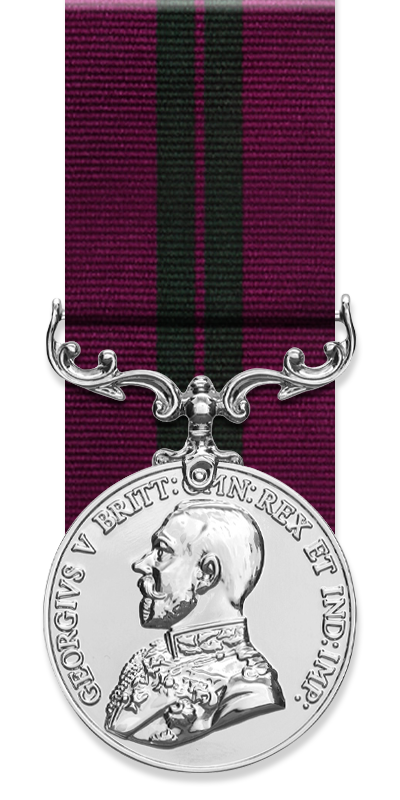
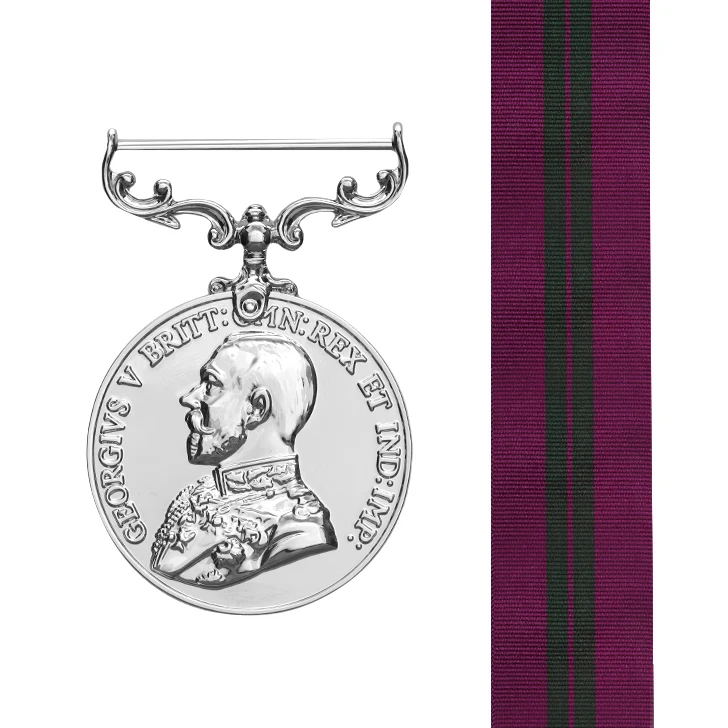
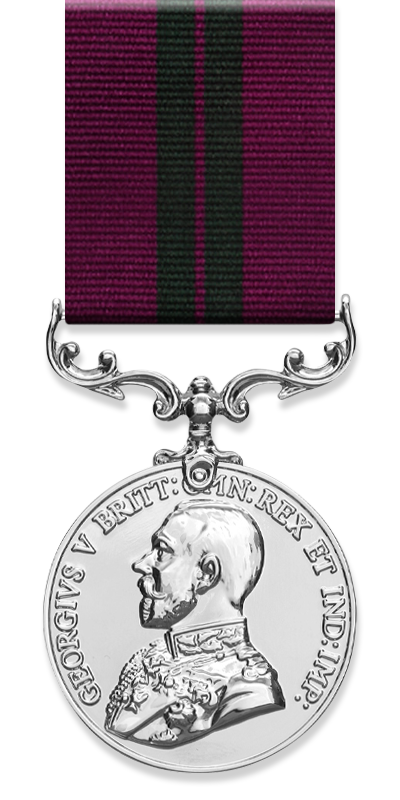
The medal is circular and silver, suspended from an ornate scroll bar. The obverse bears the crowned effigy of the reigning Sovereign; the reverse carries a small crown above a wreath surrounding the words FOR MERITORIOUS SERVICE, with COMMONWEALTH OF AUSTRALIA above the crown on the Australian issue.
On this issue the obverse bears the crowned effigy of King George V.
The ribbon
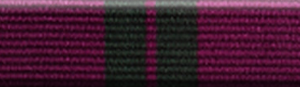
Crimson with twin dark green central stripes, the Australian issue's colours.
The ribbon of the Australian issue is crimson with two central stripes of dark green, distinguishing it from the United Kingdom medal's crimson with white stripes at the edges and centre.
Eligibility
The Australian medal was awarded to warrant officers and senior non-commissioned officers of the Australian Military Forces for long and meritorious service.
- Recipients were generally required to hold the Long Service and Good Conduct Medal first, with published qualifying periods varying across eras and references between 21 and 24 years of service;
- Recommendations were made through commanding officers, and the number of awards remained small: only a few thousand were made across the life of the series;
- The Department of the Prime Minister and Cabinet records the medal as awarded until 1975, when the Imperial long service awards were replaced by the National Medal, while the Australian War Memorial catalogues the series as late as 1985. The recipient's record is the reliable guide for an individual award.
Order of wear
The Imperial long service awards are worn together in the long service group, after the Australian long service medals and the Champion Shots Medal, in order of the date of the award, with the Service Medal of the Order of St John worn after all of them. The precise arrangement should be confirmed against the current Australian Order of Wear.
Frequently asked questions
What is the Australian Meritorious Service Medal?
The Imperial award for long and meritorious service by warrant officers and senior non-commissioned officers of the Australian Military Forces, issued in a Commonwealth of Australia version from 1903.
What years does the George V issue cover?
Awards made between 1910 and 1936, the reign of King George V.
How long did it take to earn?
Published requirements vary between references, from 21 to 24 years, with the Long Service and Good Conduct Medal generally required first. The recipient's record is the reliable guide.
Is this the MSM with the post-nominal?
No. The post-nominal MSM attaches to the separate wartime use of the Imperial medal for gallantry and valuable service between 1916 and 1928, awarded on the white striped United Kingdom ribbon. The Australian long service medal carries no post-nominal.
How do I tell an Australian award from a British one?
By the reverse, which reads COMMONWEALTH OF AUSTRALIA on the Australian issue, and by the ribbon, crimson with two central dark green stripes rather than the United Kingdom's white stripes.
What replaced it?
The Department of the Prime Minister and Cabinet records the Imperial long service awards as replaced by the National Medal from 1975, though examples of the series are catalogued into the 1980s.