
History
The Efficiency Medal was instituted by Royal Warrant on 17 October 1930 as a single, unified long service award for the part-time and auxiliary military forces across the British Empire, Australia among them. It swept away the tangle of separate awards that had gone before, superseding the Volunteer Long Service Medal, the Militia Long Service Medal, the Special Reserve Long Service and Good Conduct Medal, the Colonial Auxiliary Forces Long Service Medal and the Territorial Efficiency Medal. Australian awards carry a scroll bar on the suspender reading AUSTRALIA.
The Elizabeth II issue, awarded from 1953, closed the series in Australia. Its recipients were the soldiers of the post-war Citizen Military Forces: the instructors who trained the national service intakes of the 1950s, the depot staff and weekend soldiers who carried the part-time tradition through to the creation of the Australian honours system. When Australian long service recognition moved to the modern awards, the Efficiency Medal's role passed on, with sources citing the National Medal from 1975 and the Reserve Force Medal from 1982 as its successors.
Design & ribbon
The medal
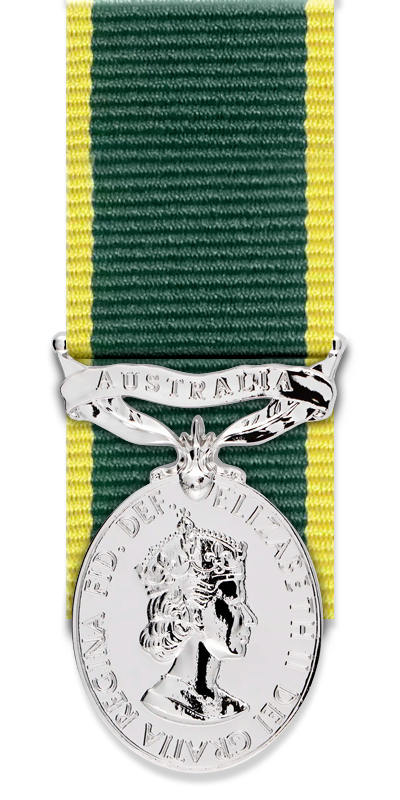
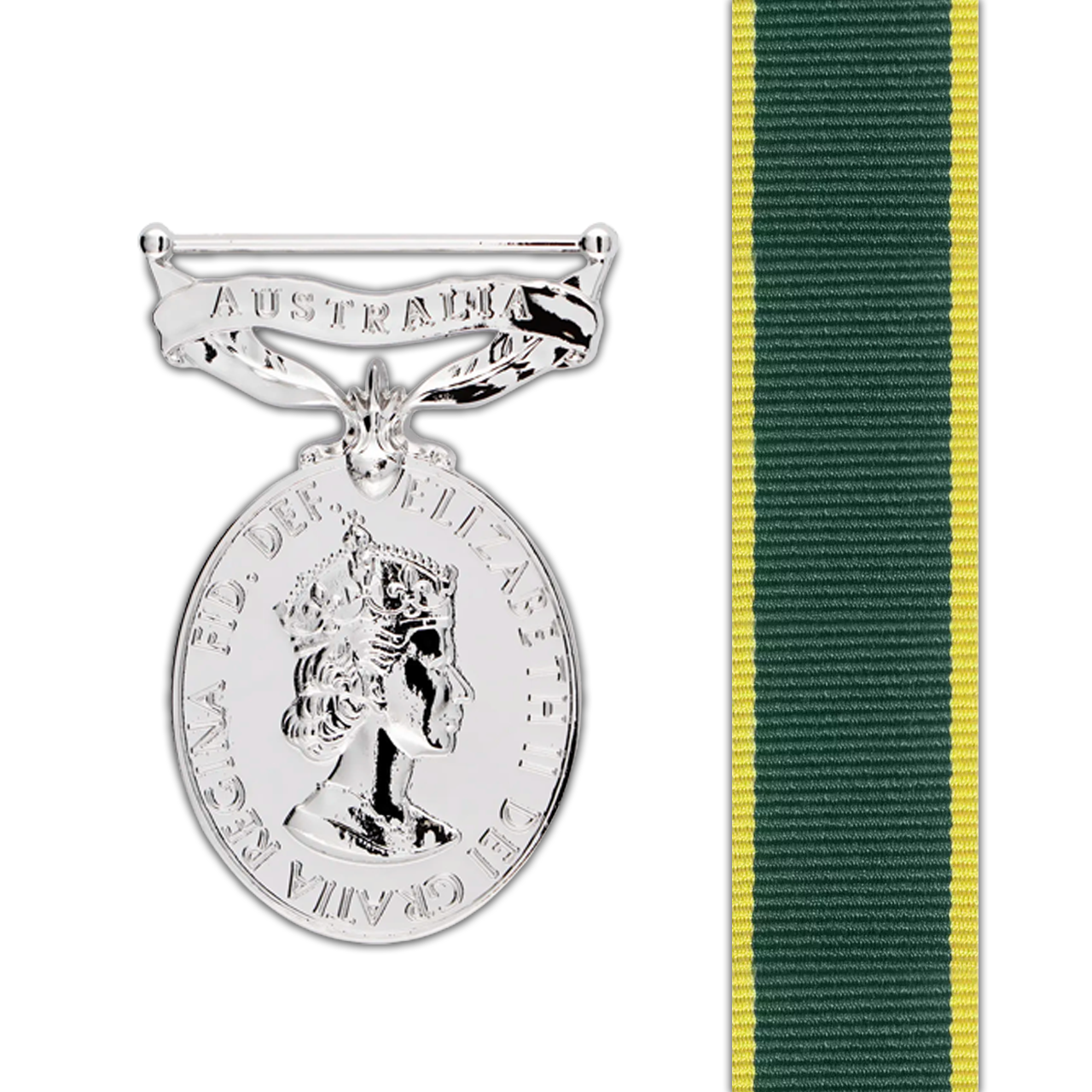
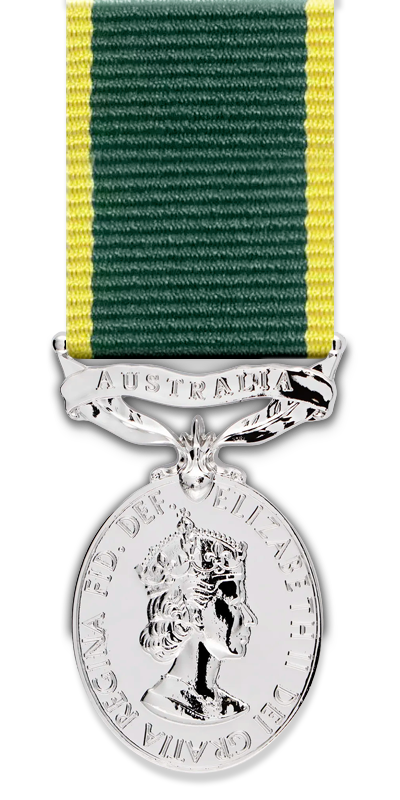
The Efficiency Medal is an oval medal, struck in cupro-nickel, suspended from an ornate scroll bar. The obverse bears the crowned effigy of the reigning monarch with the corresponding Latin inscription; the reverse carries the words FOR EFFICIENT SERVICE. Australian awards carry the AUSTRALIA scroll bar on the suspender, the device that distinguishes them from United Kingdom and other Dominion issues.
On this issue the obverse bears the crowned effigy of Queen Elizabeth II.
The ribbon
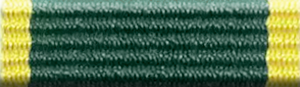
Dark green edged in yellow, inherited from the Territorial Efficiency Medal.
The ribbon is dark green with a narrow yellow stripe at each edge, the same ribbon used for the superseded Territorial Efficiency Medal, carrying the visual tradition of the part-time forces forward into the new award.
Clasps
A clasp was instituted alongside the medal, awarded on completion of each further period of six years of efficient service.
Six Year Clasp
A clasp was awarded for each further six years of efficient service beyond the original qualifying period, worn on the ribbon of the medal. The clasp carries the crown of the reigning Sovereign, so its design follows the same reigns as the medal. When the ribbon alone is worn, a clasp is denoted by a rosette.
Eligibility
The Efficiency Medal was awarded to warrant officers, non-commissioned officers and other ranks of the part-time and auxiliary military forces; the equivalent award for officers was the Efficiency Decoration.
- The standard qualifying period was twelve years of efficient service on the active list of the part-time forces, with efficiency meaning the member met the training and attendance obligations of the citizen forces;
- Wartime service could count at an accelerated rate, recognising active service as a more demanding form of duty than peacetime training;
- Sources differ on when Australia ceased awarding the medal: the Department of the Prime Minister and Cabinet records the Imperial long service awards as replaced by the National Medal from 1975, while medal references commonly cite the Reserve Force Medal of 1982 as the Australian successor. The recipient's service record is the most reliable guide for an individual award.
Order of wear
The Imperial long service awards are worn together in the long service group, after the Australian long service medals and the Champion Shots Medal, in order of the date of the award, with the Service Medal of the Order of St John worn after all of them. The precise arrangement should be confirmed against the current Australian Order of Wear.
Frequently asked questions
What years does the Elizabeth II Efficiency Medal cover?
Awards made from 1953 until Australia ceased awarding the medal, which sources place variously with the arrival of the National Medal in 1975 and the Reserve Force Medal in 1982.
Who was eligible?
Warrant officers, non-commissioned officers and other ranks of the post-war Citizen Military Forces, for twelve years of efficient service. Officers received the Efficiency Decoration instead.
Can it be worn with the Australian long service awards?
Yes. Veterans whose service spanned the transition wear the Efficiency Medal in the long service group beside awards such as the Reserve Force Medal, in order of the date of award.
How were further years recognised?
By a clasp for each additional six years of efficient service, carrying the Crown of Saint Edward for this reign, with a rosette on the ribbon bar when ribbons alone are worn.
What does the AUSTRALIA scroll bar mean?
It identifies an Australian award, distinguishing it from United Kingdom and other Commonwealth issues of the same medal.
What replaced the Efficiency Medal in Australia?
Sources record the transition differently, citing the National Medal from 1975 and the Reserve Force Medal from 1982. For a specific award, the recipient's documentation is the reliable guide.