
History
The award was created on 28 June 1901 by King Edward VII as the Conspicuous Service Cross, for warrant and subordinate officers, including midshipmen, who were ineligible for the Distinguished Service Order. In October 1914 it was renamed the Distinguished Service Cross and its eligibility extended to all naval officers, commissioned and warrant, below the rank of lieutenant commander, for gallantry at sea in the presence of the enemy. From March 1915 honorary awards could be made to allied foreign officers, and in August 1916 bars were introduced for further acts of gallantry.
Its reach widened over the decades: to the Merchant Navy in 1931, to senior naval ranks in 1939, and to Army and RAF personnel serving aboard ship in the Second World War. Since the 1993 reform, which discontinued the Distinguished Service Medal for ratings, the DSC has served as the third level award for gallantry at sea for all ranks. It was awarded to 182 Australians before Australia introduced its own Medal for Gallantry in 1991, and as an Imperial award it retains its place in the Australian Order of Wearing.
Design & ribbon
The medal
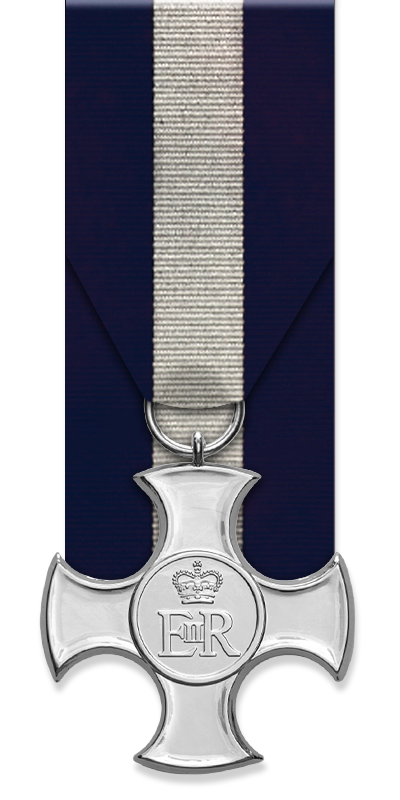
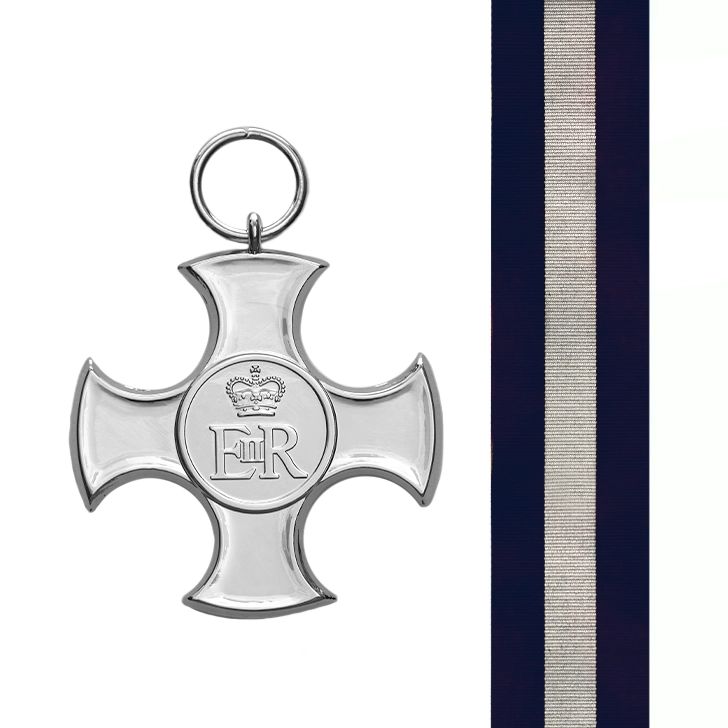
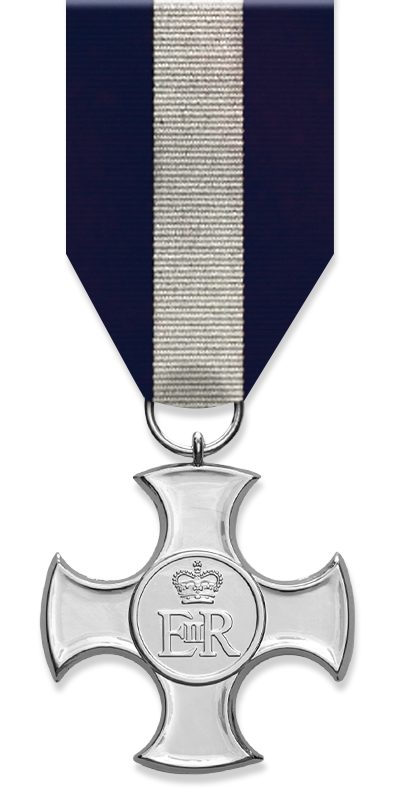
The Cross is plain silver with rounded ends, 43 millimetres wide, its obverse bearing a circular centre containing the royal cypher of the reigning monarch surmounted by a crown. The reverse is plain apart from the hallmark. From 1940 the year of issue was engraved on the lower limb, and since 1984 the Cross has been named to the recipient.
The ribbon

Dark blue, white and dark blue in equal stripes.
The ribbon has three equal stripes of dark blue, white and dark blue.
Clasps
Further acts of gallantry meriting the Cross are recognised by a bar rather than a second cross.
Bar (further award)
A bar is awarded for a further act of gallantry meriting the Cross, worn on the ribbon; when the ribbon alone is worn, a silver rosette denotes each bar. Bars have been awarded since August 1916.
Eligibility
The Cross is awarded in recognition of an act or acts of exemplary gallantry during active operations against the enemy at sea.
- Originally for naval officers below the rank of lieutenant commander, its eligibility widened over time; since 1993 it has been open to all ranks of the naval service, the Royal Fleet Auxiliary and the Merchant Navy;
- Bars have been awarded since 1916 for further acts of gallantry, with a silver rosette worn on the ribbon when the ribbon alone is worn; posthumous awards have been possible since 1979;
- Recipients are entitled to the post-nominal letters DSC. As an Imperial award it retains its place in the Australian Order of Wearing.
Order of wear
Imperial awards were the honours of Australia before the Australian honours system was established in 1975, and they retain their place in the Order of Wearing. They are worn after the Australian honours of their kind and among the Imperial awards in the order set by the Australian Order of Wearing, which follows the British order of precedence.
Frequently asked questions
What is the Distinguished Service Cross awarded for?
An act or acts of exemplary gallantry during active operations against the enemy at sea. It was the Royal Navy's equivalent of the Army's Military Cross.
Why does it carry the date 1914?
The award began in 1901 as the Conspicuous Service Cross and was renamed the Distinguished Service Cross in October 1914, when it took its lasting form; the master list distinguishes it by that date.
Who could receive it?
Originally naval officers below lieutenant commander; eligibility later widened to the Merchant Navy, senior ranks, and other services serving at sea, and since 1993 to all ranks.
How are further awards shown?
By a bar on the ribbon, with a silver rosette when the ribbon alone is worn. Bars have been awarded since 1916.
How many Australians received it?
182, with 13 first bars and three second bars, last awarded to an Australian in 1972; Australia replaced it with the Medal for Gallantry in 1991.
Does it carry a post-nominal?
Yes, the letters DSC.