
History
The Distinguished Flying Cross was established on 3 June 1918, weeks after the Royal Air Force itself, to reward acts of valour, courage or devotion to duty while flying in active operations against the enemy. It was originally awarded to RAF commissioned and warrant officers, including those of Commonwealth and allied forces, with eligibility extended to Fleet Air Arm officers in March 1941 and to Army officers attached to the RAF in November 1942. Posthumous awards were permitted from 1979.
Since the 1993 review of the honours system, which removed distinctions of rank in bravery awards, all ranks of all services have been eligible, and the Distinguished Flying Medal, previously the other ranks' award, was discontinued. Around 22,000 Crosses were awarded between 1918 and 2017, a great many to the airmen of the Second World War's bomber and fighter squadrons, Australians prominent among them. As an Imperial award it retains its place in the Australian Order of Wearing.
Design & ribbon
The medal
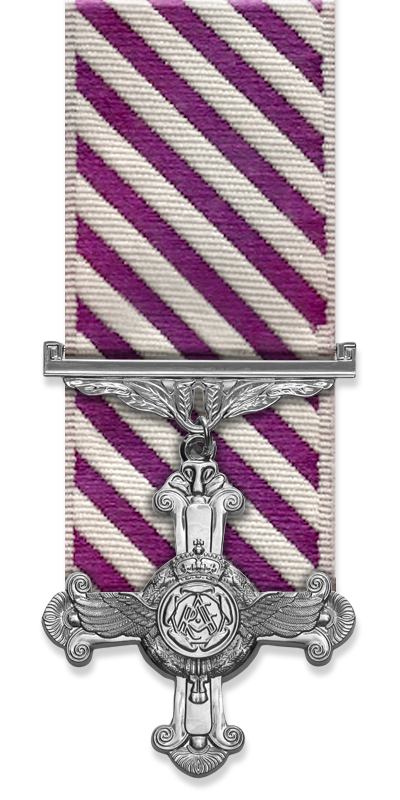
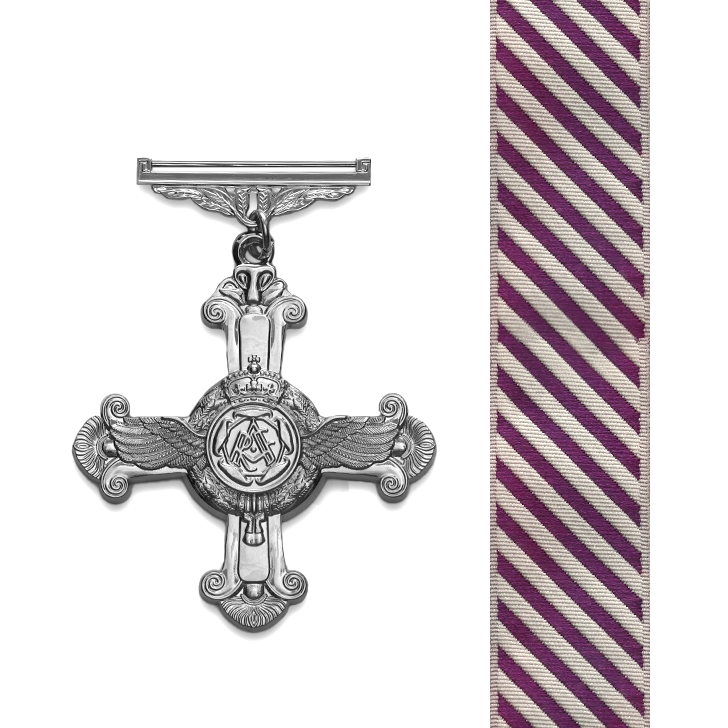
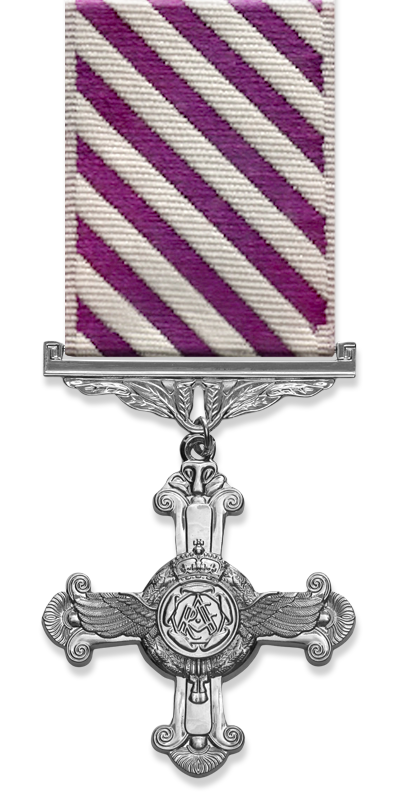
The Cross is silver, formed of the propeller blades of four crosses conjoined, the horizontal and vertical arms terminating in wings, the whole surmounted by another aircraft propeller. The centre bears a roundel within a laurel wreath charged with the letters RAF ensigned by an imperial crown. The reverse carries the royal cypher above the date 1918, and the suspender is straight and decorated with laurel.
The ribbon
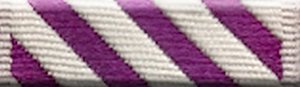
White with broad diagonal purple stripes.
The ribbon is white with broad diagonal purple stripes, the diagonal pattern adopted in 1919 in place of the original horizontal stripes.
Clasps
Further acts of gallantry meriting the Cross are recognised by a bar rather than a second cross.
Eligibility
The Cross is awarded for an act or acts of valour, courage or devotion to duty while flying in active operations against the enemy.
- Originally for RAF officers and warrant officers, including Commonwealth and allied officers, its eligibility widened to the Fleet Air Arm and Army aviation, and since 1993 to all ranks of all services;
- A bar denotes a further award, marked by a silver rosette with the RAF eagle when the ribbon alone is worn; posthumous awards have been possible since 1979;
- Recipients are entitled to the post-nominal letters DFC. As an Imperial award it retains its place in the Australian Order of Wearing.
Order of wear
Imperial awards were the honours of Australia before the Australian honours system was established in 1975, and they retain their place in the Order of Wearing. They are worn after the Australian honours of their kind and among the Imperial awards in the order set by the Australian Order of Wearing, which follows the British order of precedence.
Frequently asked questions
What is the Distinguished Flying Cross awarded for?
An act or acts of valour, courage or devotion to duty while flying in active operations against the enemy. It could not be awarded for non-operational achievement.
When was it created?
On 3 June 1918, shortly after the formation of the Royal Air Force, as the airman's operational gallantry cross.
How does it relate to the Military Cross and DSC?
It was the air counterpart of the Army's Military Cross and the Navy's Distinguished Service Cross: the officers' third-level gallantry award for its service.
What was its other-ranks companion?
The Distinguished Flying Medal, awarded to non-commissioned airmen until 1993, when the DFC opened to all ranks and the Medal was discontinued.
How are further awards shown?
By a bar on the ribbon, with a silver rosette bearing the RAF eagle worn when the ribbon alone is displayed.
Does it carry a post-nominal?
Yes, the letters DFC.