
History
The Australian General Service Medal for Korea was established by Letters Patent on 24 November 2009, with a determination approved by the Governor-General on 12 March 2010, and announced in February 2010. It followed the recommendations of the 2005 Post-Armistice Korean Service Review.
It recognises former Defence Force personnel who served in South Korea during the post-armistice period, service that had not previously been marked by a specific Australian medal.
Design & ribbon
The medal
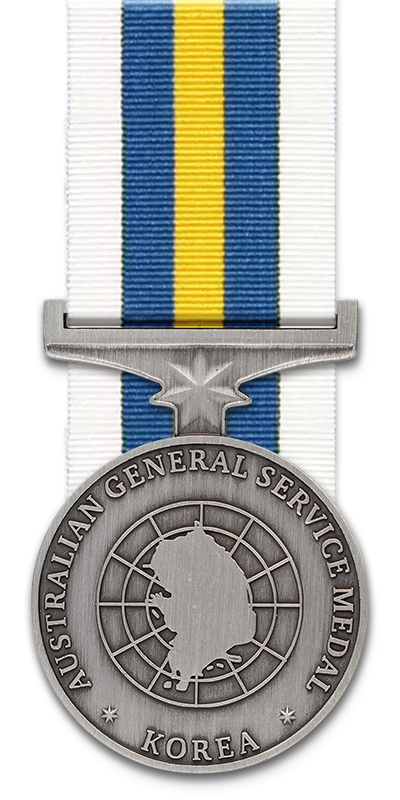
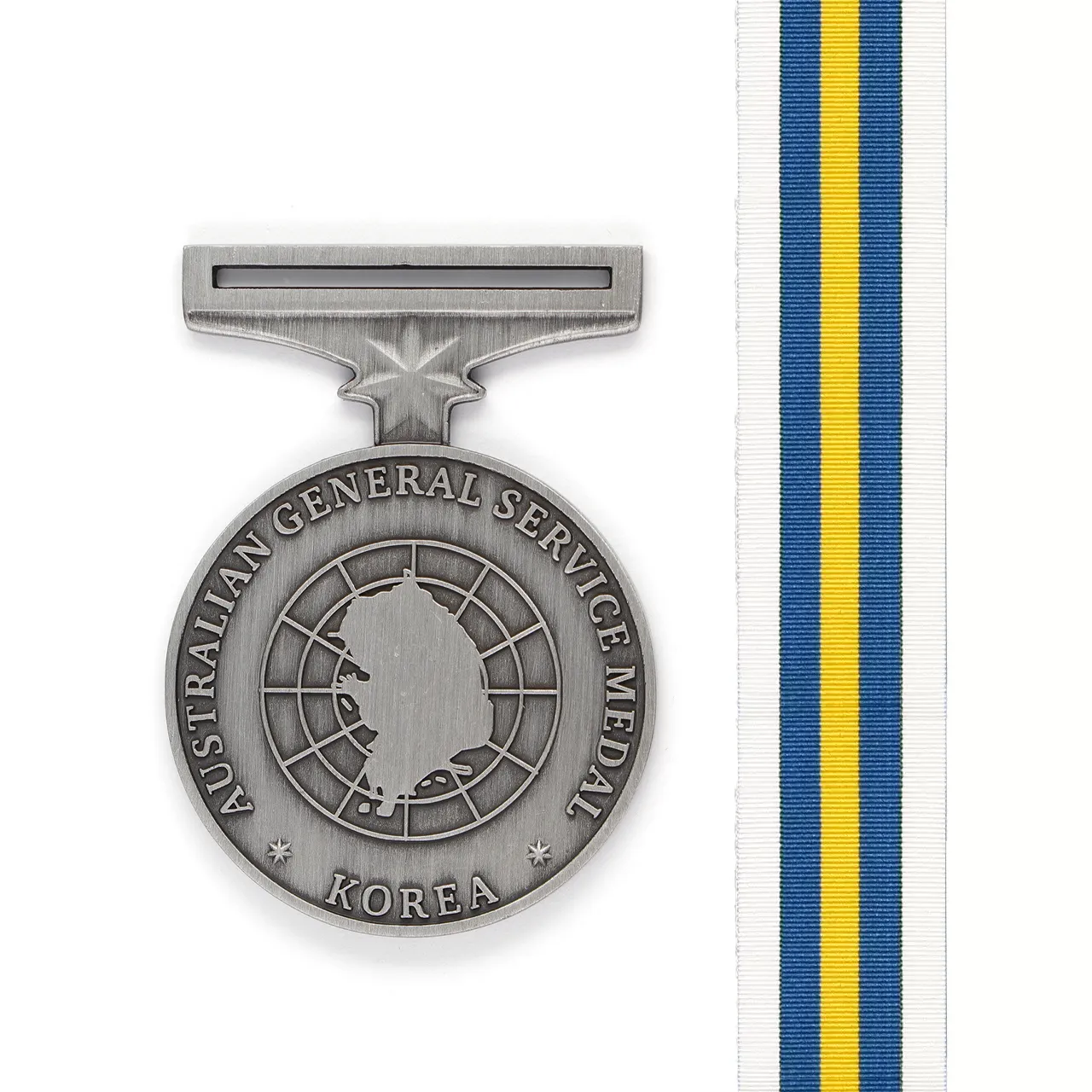
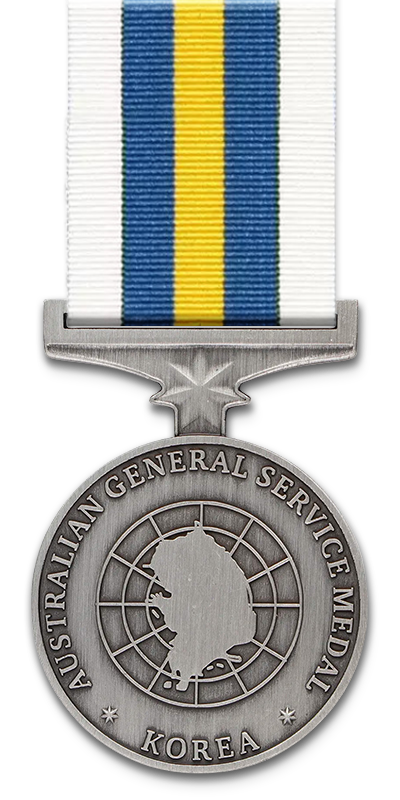
The medal is a circular nickel-silver medal, thirty-eight millimetres in diameter, with an antique silver finish and a raised polished outer edge, its suspender featuring a raised Federation Star. The obverse has a raised relief map of South Korea superimposed over polar projection lines representing the United Nations, with the words AUSTRALIAN GENERAL SERVICE MEDAL KOREA around the rim and two Federation Stars in the lower quadrants. The reverse carries the words POST ARMISTICE SERVICE 1953-1956 surrounded by a wreath of gum leaves and blossoms.
The ribbon
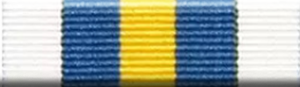
A central yellow flanked by blue and outer white, drawn from the Korea Medal and the United Nations Korea Medal.
The thirty-two millimetre ribbon has a central yellow stripe flanked by stripes of blue and then outer stripes of white. The colours are drawn from the Korea Medal and the United Nations Service Medal for Korea.
Eligibility
The medal is awarded for thirty days of service in operations in South Korea during the post-armistice period from 28 July 1953 to 19 April 1956.
- The qualifying area includes South Korea and any location up to 161 kilometres, about 100 miles, seaward from the coast;
- The qualifying period is 28 July 1953 to 19 April 1956;
- The exact criteria are set out in the Letters Patent and Regulations.
Order of wear
The medal is worn in the order of wear at the position for its period. The precise neighbours should be confirmed against the current Australian Order of Wear.
Frequently asked questions
What does the Australian General Service Medal for Korea recognise?
Service by former Defence Force personnel in operations in South Korea during the post-armistice period, 28 July 1953 to 19 April 1956.
When was it established?
By Letters Patent on 24 November 2009, with the determination approved in March 2010, following the 2005 Post-Armistice Korean Service Review.
How much service is required?
Thirty days of service in South Korea, including any location up to 161 kilometres seaward from the coast.
Why was it created so long after the period it covers?
To recognise post-armistice Korean service that had not previously been marked by a specific Australian medal.
What do the ribbon colours represent?
They are drawn from the Korea Medal and the United Nations Service Medal for Korea.
Does it have clasps?
No.