
History
The United Nations Preventive Deployment Force, UNPREDEP, was established in March 1995, when the United Nations work in the former Yugoslav Republic of Macedonia was separated from the wider Balkans force and given its own name. Its mandate was preventive: to watch the border areas and report anything that might undermine the country's stability or threaten its territory, and it is remembered as a rare success in heading off conflict before it began. The mission ended in February 1999.
The medal is awarded for ninety days' service, with a numeral marking additional service. As a foreign award it takes its place among the United Nations medals in the Australian Order of Wearing, where its acceptance and wear have been approved.
Design & ribbon
The medal
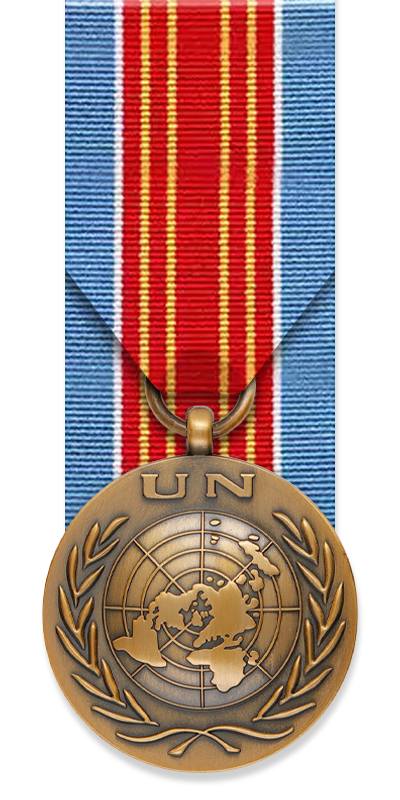
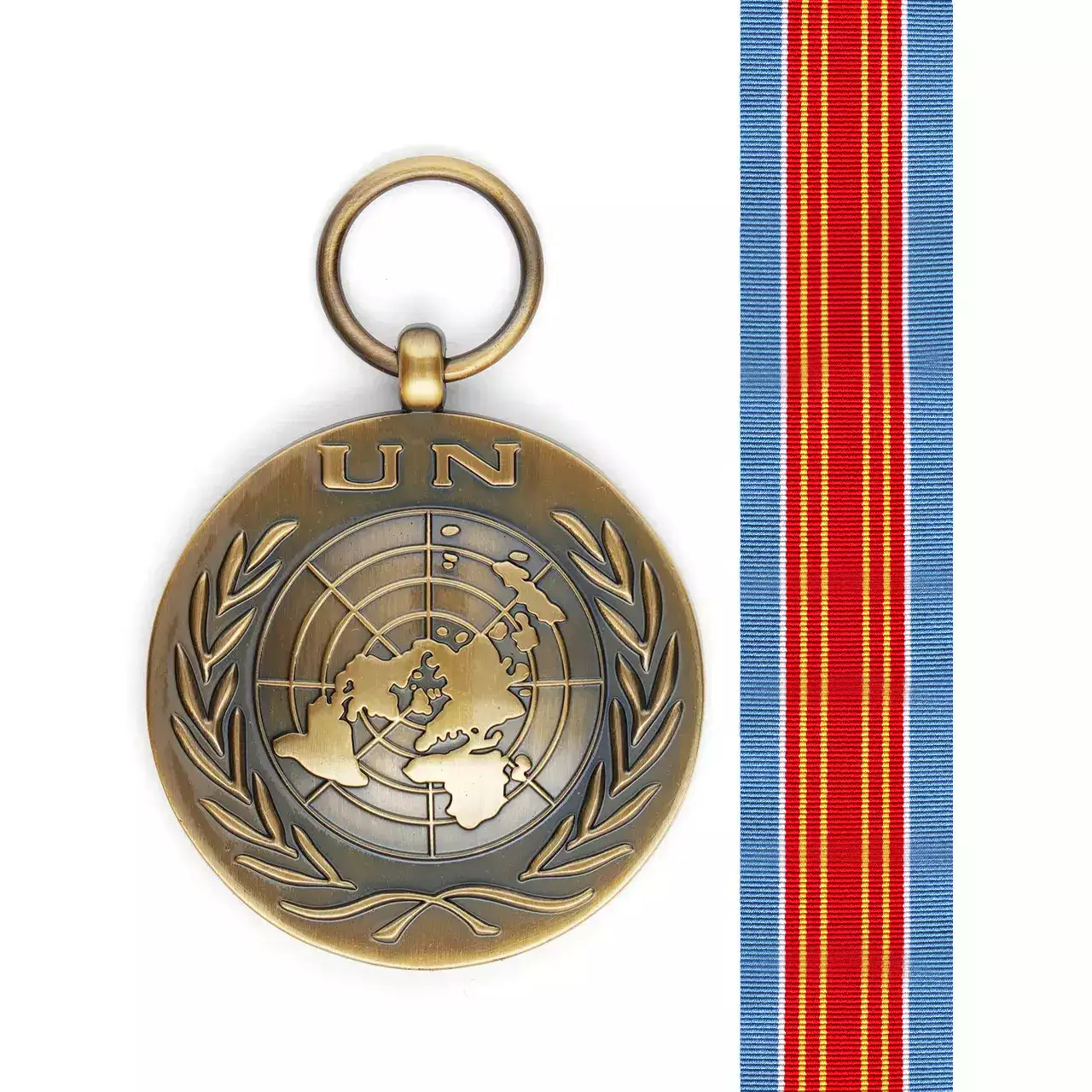
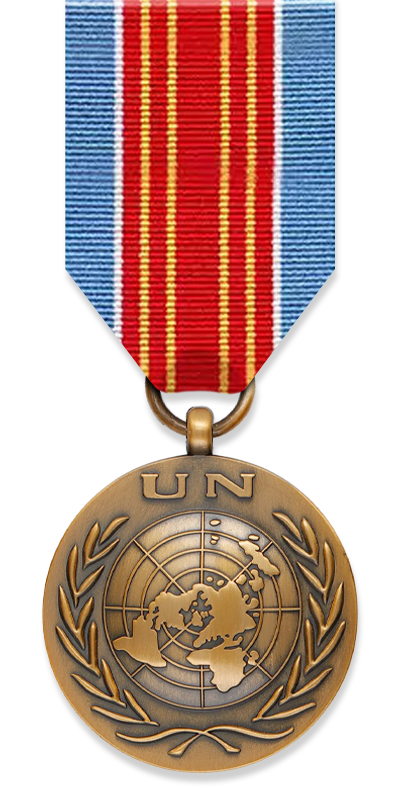
The medal follows the standard United Nations design: a circular bronze medallion 35 millimetres in diameter, the obverse bearing the emblem of the United Nations within a wreath of olive branches, surmounted by the letters UN. The reverse carries the words IN THE SERVICE OF PEACE. United Nations medals are issued unnamed, and the mission is identified by the ribbon.
The ribbon
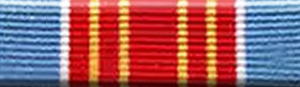
UN blue with a red and yellow centre, for Macedonia.
The ribbon is United Nations blue, with a broad central red field bearing yellow bands and bordered by thin white bands, for the flag and arms of Macedonia, a gold lion on red.
Clasps
The United Nations marks additional qualifying service with a numeral worn on the ribbon rather than a lettered bar.
United Nations Number 1 Medal Clasp
A numeral 1 worn on the ribbon to mark the completion of one additional qualifying period of service beyond the first award.
United Nations Number 2 Medal Clasp
A numeral 2 worn on the ribbon to mark the completion of two additional qualifying periods of service.
United Nations Number 3 Medal Clasp
A numeral 3 worn on the ribbon to mark the completion of three additional qualifying periods of service.
United Nations Number 4 Medal Clasp
A numeral 4 worn on the ribbon to mark the completion of four additional qualifying periods of service.
Eligibility
The medal is awarded for service with the United Nations Preventive Deployment Force.
- Ninety days' consecutive service between 31 March 1995 and 28 February 1999 qualifies;
- The qualifying period is not required where service ended in death on assignment, and the medal may then be awarded posthumously;
- Additional qualifying service is marked by a numeral on the ribbon;
- As a foreign award it takes its place among the United Nations medals in the Australian Order of Wearing.
Order of wear
United Nations medals are awarded by the United Nations and accepted and worn by Australians who served the mission. In the Australian Order of Wearing they are worn after Australian honours and campaign awards, among the foreign awards, in the sequence set for United Nations service, which generally follows the dates of the missions.
Frequently asked questions
What is the UNPREDEP Medal awarded for?
Service with the United Nations Preventive Deployment Force in Macedonia between 1995 and 1999, a mission to prevent conflict spreading into the country.
Why was the mission unusual?
It was a rare preventive deployment, sent to keep a war from starting by watching the borders, rather than to end a war already under way.
What is the qualifying period?
Ninety days' consecutive service; the period is waived where service ended in death on assignment, and the medal may then be awarded posthumously.
What are the ribbon colours?
United Nations blue with a red and yellow centre bordered by white, for the flag and arms of Macedonia.
How is additional service shown?
By a numeral worn on the ribbon.
Is it named to the recipient?
No; United Nations medals are issued unnamed.