
History
The National Police Service Medal was established by Letters Patent on 9 November 2010, following in-principle approval given in 2008. It was created to give distinct recognition to the unique role of sworn police officers, separate from the long service that police already had recognised through the National Medal. In 2014 the Letters Patent were amended to extend eligibility to service on or after 14 February 1975, the date the Australian honours system was established, which brought a large body of earlier and former officers within reach of the award. At its introduction it was estimated that more than twenty thousand former Australian police would be eligible.
The medal was a collaborative Australian design. The medal device was designed by Inspector Rick Steinborn of the New South Wales Police Force, and the ribbon was developed by Federal Agent James Cheshire of the Australian Federal Police. The ribbon deliberately draws on the heritage of earlier police awards under both the Imperial and Australian systems, including the Police Long Service and Good Conduct Medal, the Australian Police Medal and the King's and Queen's Police Medal.
Design & ribbon
The medal
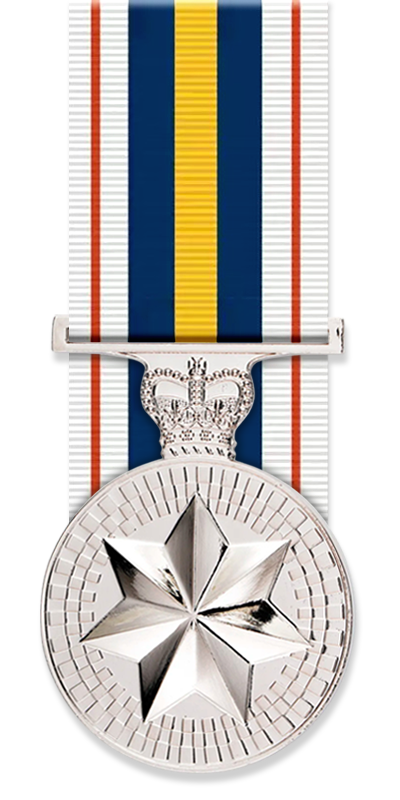
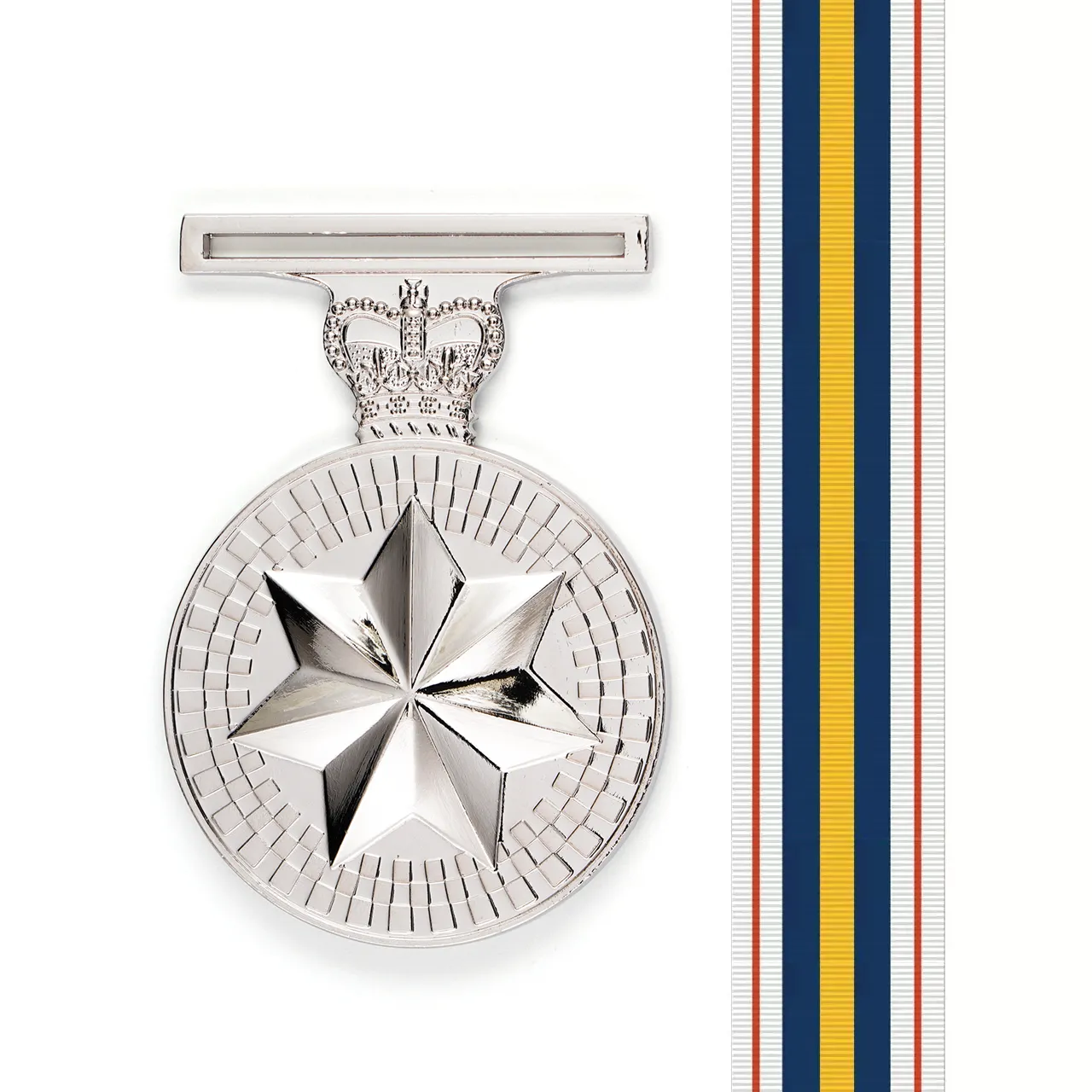
The medal is finished in cupro-nickel. The obverse features the Federation Star set inside an unbroken circular chequered band known as the Sillitoe Tartan, the chequered pattern recognised internationally as the symbol of police. The unbroken band carries a specific meaning: it signifies the unity and cooperation of the separate state, territory and federal police forces that together protect the whole country. The Saint Edward's Crown sits on the suspender bar, representing the Sovereign whom Australian police ultimately serve. The reverse carries two sprays of golden wattle, the national floral emblem, beneath a panel for the recipient's details, surrounded by the words FOR SERVICE AS AN AUSTRALIAN POLICE OFFICER.
The ribbon

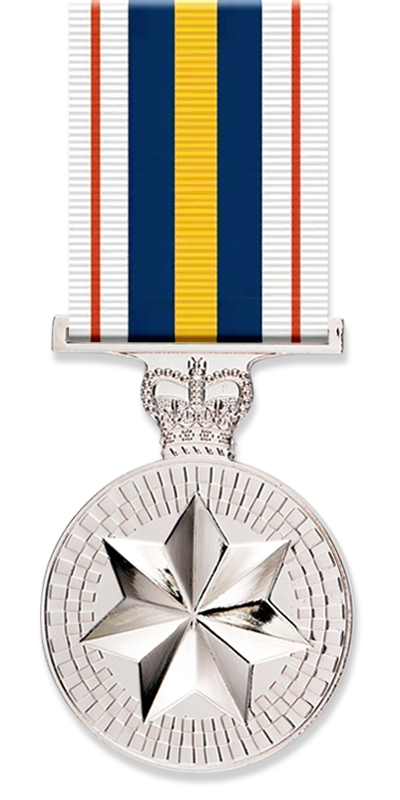
A central gold stripe, flanked by navy blue, then white carrying thin crimson lines.
The ribbon has a central gold stripe flanked by navy blue, then white, with a thin crimson stripe set within each white band. The symbolism is deliberate. Blue and gold are Australia's heraldic colours, defining this as an Australian award. Blue and white are the colours traditionally associated with police. The thin red stripes represent the ever-present hazards experienced in service as a police officer.
Eligibility
The medal is awarded by the Governor-General, on the recommendation of the Commissioner of the Australian police force of which the person is, or was last, a member. The qualifying standard is fifteen years of ethical and diligent service as a sworn police officer, with at least one day of that service on or after 14 February 1975.
- The fifteen years need not be continuous, and may be made up of several periods that add up to fifteen years;
- Only sworn members of an Australian police force qualify;
- The medal can be awarded for a shorter period where service was cut short by the member's death, or by an impairment related to the discharge of their duties.
Order of wear
The position of the medal in the Australian order of wear reflects its nature. It is worn immediately after the Civilian Service Medal 1939 to 1945 and before the long service awards. That placement is deliberate: it marks the medal as a recognition of ethical and diligent service across a police career, not as a long service medal.
Frequently asked questions
Is the National Police Service Medal a long service award?
No. Although fifteen years of service is required, it is not a long service medal. It recognises ethical and diligent service across a police career. Police continue to receive the National Medal separately for long service, and its position in the order of wear, before the long service awards, reflects this distinction.
Can an officer hold both the NPSM and the National Medal?
Yes. At the completion of fifteen years of ethical and diligent service a police officer may receive both the National Police Service Medal and the National Medal, because the two awards recognise different things.
Does the fifteen years need to be continuous?
No. The fifteen years of qualifying service need not be continuous and can be made up of several separate periods of service that together total fifteen years.
What does the Sillitoe Tartan represent?
The Sillitoe Tartan is the chequered band on the medal, an internationally recognised symbol of police. On the National Police Service Medal the band is unbroken, signifying the unity and cooperation of the state, territory and federal police forces.
Who designed the medal and ribbon?
The medal device was designed by Inspector Rick Steinborn of the New South Wales Police Force, and the ribbon was developed by Federal Agent James Cheshire of the Australian Federal Police.
Can the medal be taken back?
Yes. The award sets a high standard for retention. It may be cancelled on the advice of the member's Commissioner of Police if their service is later found to have been unethical or not diligent.