
History
The George Cross was announced on 23 September 1940 by King George VI, days after the climax of the Battle of Britain and during the third week of the Blitz, when there was a strong desire to reward the many acts of civilian courage that the war was demanding. The existing awards open to civilians were not judged suitable, so the King created the George Cross and the George Medal, giving his own name to the new distinction. In his broadcast he proposed a mark of honour for men and women in all walks of civilian life, the Cross to rank next to the Victoria Cross and the Medal for wider distribution.
The warrant makes the Cross primarily a civilian award, confining its use in the armed services to actions for which purely military honours are not normally granted: gallantry not in the presence of the enemy. It has been awarded 416 times since 1940, including three collective awards, to the Island of Malta, the Royal Ulster Constabulary and the National Health Service. Surviving holders of the earlier Empire Gallantry, Albert and Edward Medals were invited to exchange them for the Cross. As an Imperial award it retains its place in the Australian Order of Wearing, immediately after the Victoria Cross.
Design & ribbon
The medal
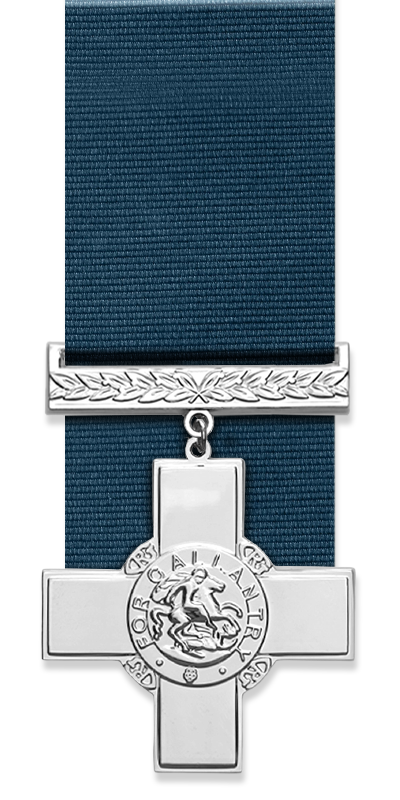
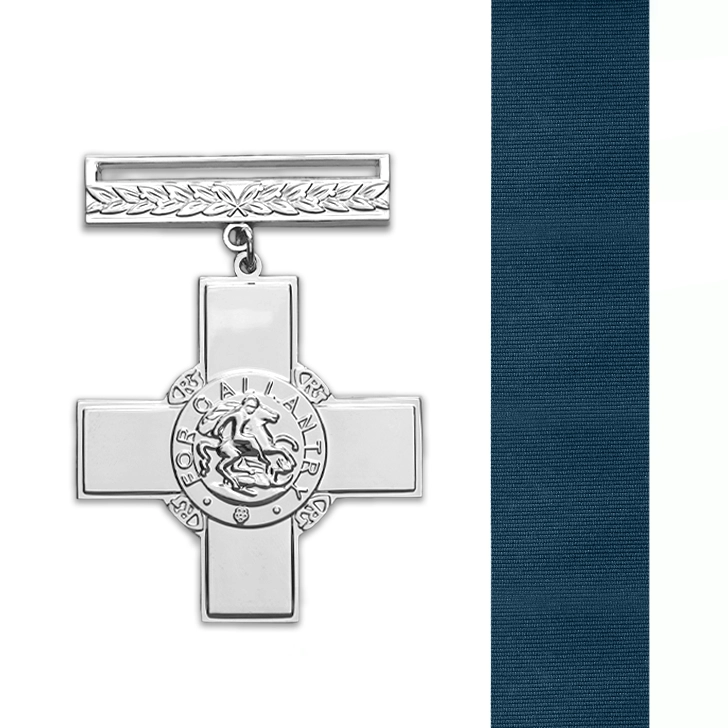
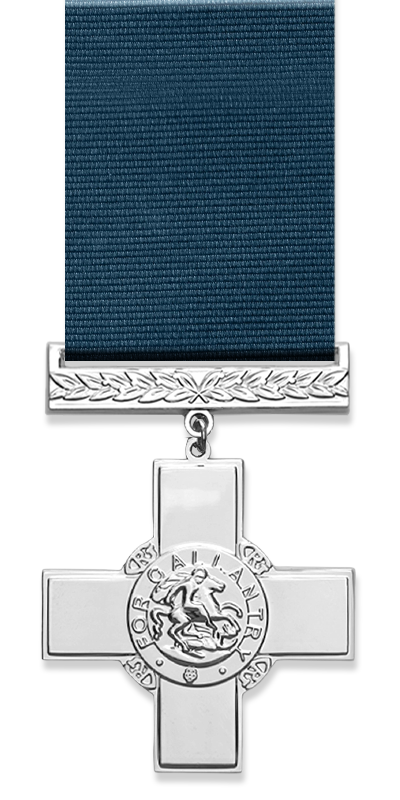
The Cross, designed by Percy Metcalfe, is a plain silver cross with four equal limbs, bearing in its centre a circular medallion showing Saint George and the Dragon surrounded by the inscription FOR GALLANTRY, with the royal cypher in the angle of each limb. The reverse is plain, engraved with the name of the recipient and the date of the award. The cross is attached by a ring to a bar ornamented with laurel leaves through which the ribbon passes.
The ribbon

Plain dark blue, with a miniature cross on the ribbon bar.
The ribbon is dark blue, one and a half inches wide, the width amended from the original one and a quarter inches in June 1941. In undress uniform, when the ribbon alone is worn, a miniature replica of the cross is affixed to its centre, a distinction peculiar to the George Cross and the Victoria Cross.
Clasps
Further acts meriting the Cross are recognised by a bar rather than a second award.
Eligibility
The Cross is granted in recognition of acts of the greatest heroism or of the most conspicuous courage in circumstances of extreme danger, not in the presence of the enemy.
- It may be awarded to members of the armed forces and to civilians, and posthumous awards have been allowed since its institution; it is intended primarily for civilians, with military awards confined to actions for which purely military honours are not normally granted;
- Recipients are entitled to the post-nominal letters GC; a bar may be awarded for a further act, though none has yet been made;
- As an Imperial award it is worn immediately after the Victoria Cross and before the insignia of all orders of chivalry.
Order of wear
Imperial awards were the honours of Australia before the Australian honours system was established in 1975, and they retain their place in the Order of Wearing. They are worn after the Australian honours of their kind and among the Imperial awards in the order set by the Australian Order of Wearing, which follows the British order of precedence.
Frequently asked questions
What is the George Cross awarded for?
Acts of the greatest heroism or the most conspicuous courage in circumstances of extreme danger, not in the presence of the enemy. It is the highest award for gallantry outside battle.
How does it relate to the Victoria Cross?
They are equal in stature: the Victoria Cross for valour before the enemy, the George Cross for gallantry everywhere else. Both are worn ahead of all orders of chivalry, and only these two carry a miniature emblem on the ribbon bar.
Who can receive it?
Civilians and military personnel, with the military awards confined to gallantry for which purely military honours are not granted. It may be awarded posthumously.
Has it been awarded collectively?
Yes, three times: to the Island of Malta in 1942, the Royal Ulster Constabulary in 1999, and the National Health Service in 2021.
What were the exchange awards?
Surviving holders of the Empire Gallantry Medal, the Albert Medal and the Edward Medal were invited to exchange them for the George Cross when those awards were superseded.
Where is it worn in the Australian order?
Immediately after the Victoria Cross and before the insignia of all orders of chivalry.