
History
Between 1951 and 1972 more than 300,000 young Australians were called into uniform under two national service schemes: the first, from 1951, which trained men for service at home, and the second, from 1964, which balloted twenty year olds by birthday into the Army, including for war service in Vietnam. In those twenty one years, 187 national servicemen died on active service and some 1,500 were wounded.
The Anniversary of National Service 1951-1972 Medal was introduced in 2001 to recognise those who completed their obligation under the schemes. Eligibility rests on a person's obligation to serve having been fulfilled under the National Service Act 1951 as it applied at the time, without discharge for disciplinary reasons; women were not conscripted under the Act. Former national servicemen and their next of kin can still apply to the Directorate of Honours and Awards today.
Design & ribbon
The medal
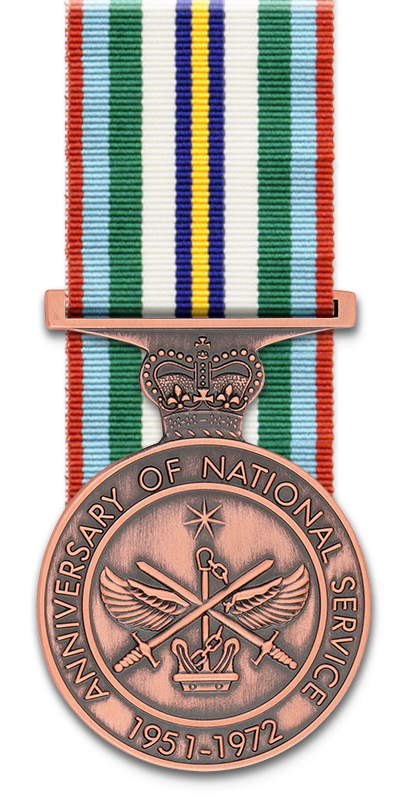
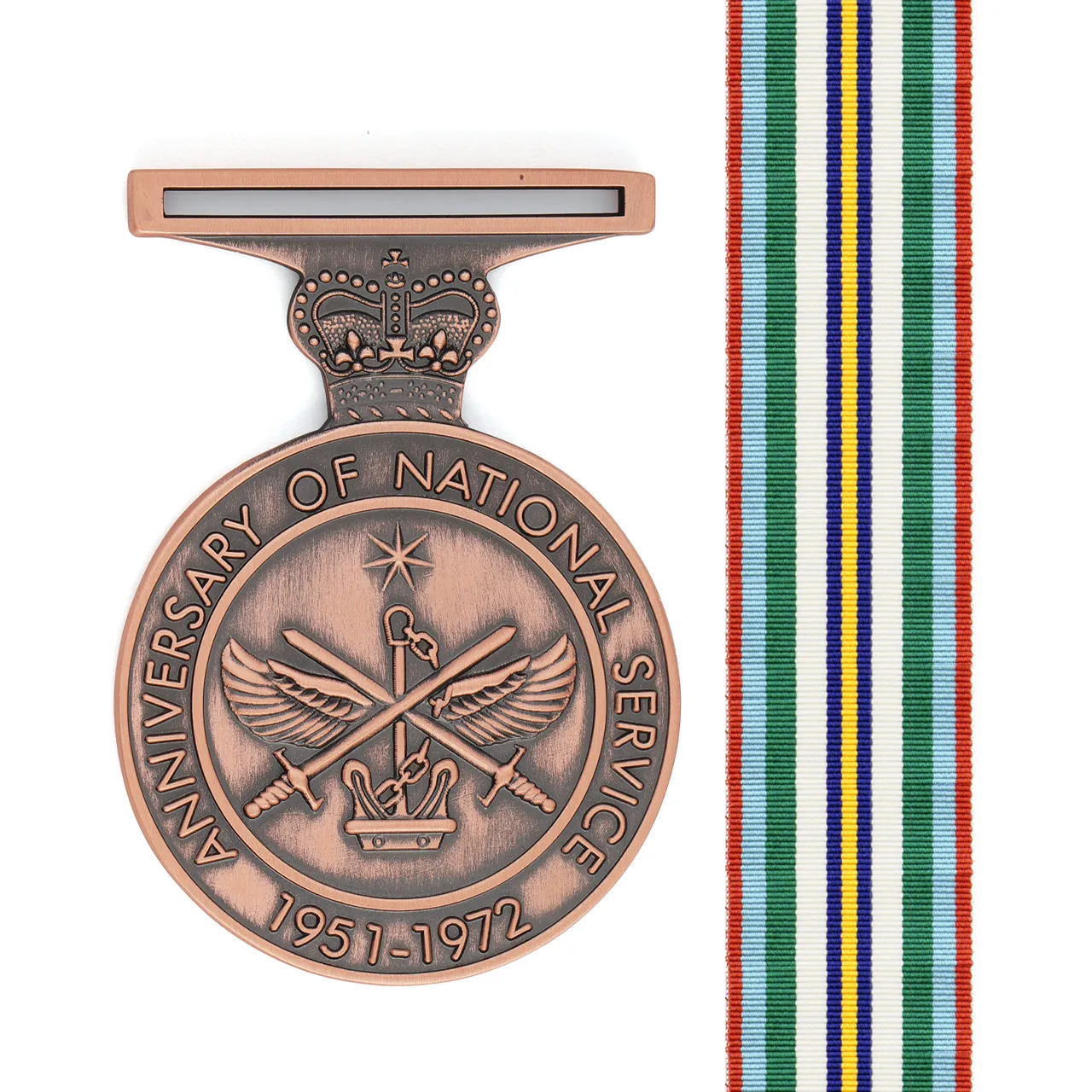
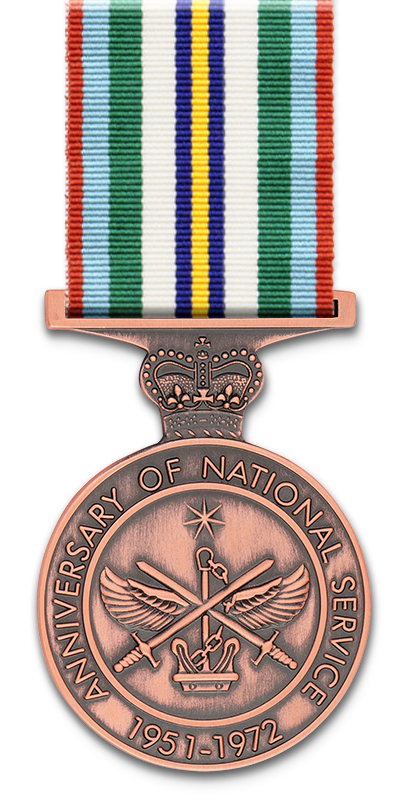
The medal is a circular bronze medal ensigned with the Crown of St Edward. The obverse bears a central device derived from the Australian Defence Force emblem, with the crossed swords of the Army taking precedence as the arm predominantly affected by national service, surmounted by the Federation Star. The words Anniversary of National Service run around the perimeter with the years 1951-1972 at the base. The reverse shows the Southern Cross overlaid on spreading rays, surrounded by a cog, a traditional symbol for the spirit of co-operation between the Defence Force and the community.
The ribbon
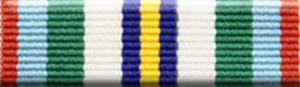
Gold and dark blue for the nation, white, green and light blue for the three Services, ochre for the soil of Australia.
The ribbon has a central gold stripe flanked by dark blue stripes, in turn flanked by stripes of white, green and light blue with ochre edges. The gold and dark blue were Australia's national colours of the time, the white, green and light blue represent the Navy, the Army and the Air Force, and the ochre edges represent the soil of Australia.
Eligibility
The medal is awarded by the Governor-General on the recommendation of the Chief of the Defence Force or a delegate, to those who completed their obligation under the two national service schemes that operated between 1951 and 1972.
- Eligibility depends upon a person's obligation to serve, and upon that obligation being fulfilled under the National Service Act 1951 as amended, as it applied to the individual at the time of service;
- The member must not have been discharged for disciplinary reasons; women were not conscripted under the Act;
- Former national servicemen and their next of kin can apply through the Directorate of Honours and Awards.
Order of wear
The medal is worn near the end of the Australian order, after the long service medals and before the Independence and Anniversary Medals. The precise neighbours in the order of wear should be confirmed against the current Australian Order of Wear.
Frequently asked questions
Who is eligible for the Anniversary of National Service Medal?
Those whose obligation to serve was fulfilled under the National Service Act 1951 as amended, as it applied at the time of their service, and who were not discharged for disciplinary reasons. More than 300,000 Australians served under the two schemes.
What were the two schemes?
The first ran from 1951 and trained young men for service at home. The second ran from 1964 to 1972 and balloted twenty year olds by birthday into the Army, including for war service in Vietnam.
Can families apply on behalf of a deceased national serviceman?
Yes. Former national servicemen and their next of kin can apply to the Directorate of Honours and Awards in the Department of Defence.
Were women eligible?
Women were not conscripted under the National Service Act, so the medal recognises the men called up under the schemes.
What do the ribbon colours mean?
The central gold and dark blue were Australia's national colours of the time, the white, green and light blue stripes represent the Navy, the Army and the Air Force, and the ochre edges represent the soil of Australia.
Does it carry a post-nominal?
No.